A cat is half-sleeping, half-listening to Federico Mompou’s “Pájaro triste”. This first tape in Chris Marker’s Bestiaire trilogy, a series of short films devoted exclusively to animals, features his beloved cat, Guillaume-en-Egypte.
In what is widely considered his greatest film, Len Lye reduces cinema to its most basic elements by scratching onto black and white film, using a variety of means ranging from dental tools to an ancient Native American arrowhead. The title references modern physics: ‘free radicals’ are particles of energy.
Eva Giolo silently and patiently portrays the same action over and over again. Her own body and those of her loved ones merge anonymously in a series of embraces, captured on blue-gray, faded 16mm film. Gazes are buried in necks and fingers intertwine or caress the contours of the other.
Using images shared on the Internet by Israelis during the Gulf War, the First Intifada, and trance music gatherings, Shuruq Harb paints the portrait of a Palestinian teenager in the 1990s. In the midst of Israeli pop culture and the political climate of the Oslo Accords, she comes to grips with her anxiety.
Filmed in Shatila, a refugee camp built in Lebanon when thousands of Palestinians fled their country in 1948. At an undetermined moment in the future, the refugees’ dream of returning to Palestine becomes a reality.
In his contribution to the omnibus film RO.GO.PA.G (1963), Pier Paolo Pasolini depicts Orson Welles making a film about the crucifixion of Jesus, while he, the cast, and the crew behave quite unholy. La Ricotta is a short, apocalyptic tirade against the conventions of filmmaking and the unchristian coldness of contemporary Christianity.
A woman, played by Maya Deren herself, returns home, falls asleep, and has vivid dreams that may or may not be happening in reality. Through repetitive images and a complete mismatch with the objective view of time and space, the woman’s dark inner desires play out on-screen.
Yes, Nobel Prize winner Samuel Beckett also made a film once, archetypically titled Film. A man tries to escape the gaze of an all-seeing eye. The disorienting camerawork comes from Oscar winner Boris Kaufman, whose brothers Dziga Vertov and Mikhail Kaufman created the legendary self-reflective masterpiece Man With a Movie Camera (1929).
The work of French activist, novelist, and essayist Jean Genet was considered controversial in the forties and fifties, because of its explicit homosexuality. Genet made only one film in his entire life, but Un Chant d’amour went on to inspire both David Bowie and Rainer Werner Fassbinder.
With a single camera movement, this film explores humankind’s relationship to the ground. The viewpoint continuously changes. Places, objects, people, and events come in and out of focus. These observations gradually speed up and reveal a double-sided ground, flipping like a tossed coin, which then slows again to oscillate around the Earth’s edge.
Zinal, a small town in the Swiss Alps, looks straight up toward the melting glaciers of the Couronne Impériale. The townspeople struggle with nihilistic indifference. When the threat is so immediate, and their powerlessness so great, can their response be anything other than cynicism? Then a paraglider falls mysteriously from the sky, and Zinal starts to change.
In this saturated film, Varda captures 1950s tourism on the Côte d'Azur: clear skies, burning sun, and cheeky parasols. A touristic tour on the French Riviera’s exoticism, full of captivating imagery, bathed in an atmosphere of nostalgia.
Filmmakers Paul Shemisi and Nizar Saleh embark on a journey from the Democratic Republic of Congo to Germany to screen their latest film. However, during a layover in Angola, their trip takes a harrowing turn when airport authorities question the authenticity of their documents.
Old Child depicts the fragmented story of Hazem, who had to flee Gaza. Throughout this stream-of-consciousness montage of dreams and reminiscences, he searches for order but also for the beauty he left behind.
Panning shots in a repeating full-circle movement show a room as a succession of still lives: a chair, some fruit on a table, a collection of solitary, waiting objects. There is the presence of a young woman: filmmaker Chantal Akerman herself, sitting on the bed eating an apple.
In what one could call Jonas Mekas’ first video blog, the Lithuanian avant-garde filmmaker reflects on his life and the art of cinema and representation.
By means of visual material gathered from online sources, filmmakers Olivia Rochette and Gerard-Jan Claes create a unique poetic realm in which thoughts, fears, desires, and worries are shared via webcam, and merge together.
In Suzan Pitt’s cult classic Asparagus, the indomitable growth of an asparagus plant is associated with female sexuality. As the urbane world turns absurdist, the green fruit transforms this reality.
Swollen Stigma is a visual, surrealistic narrative about a woman travelling both literally and psychically through several rooms. Memories, or fantasies, of another woman, fill her imagination. The film proposes lesbian imagery, and its shifting points of view jump between the protagonist, fantasy spaces, and her lover, making an internal world leak into what is external.
An artificial summer rules the greenhouse. Workers tend to carnations. In a multitude of splendid colours, they grow towards the sun until they’re ready to fulfill their cut-flower destiny. Carnations is an audiovisual meditation on movements within a carnation nursery close to filmmaker Martijn van de Wiele’s home.
This avant-garde work exposes how we hide behind a façade in times of crisis, as if nothing is wrong. Arthur Lipsett’s first collage film mixes dozens of black-and-white photographs with audio fragments. The film’s subtle criticism of the 1960s zeitgeist in the United States earned it an Oscar nomination.
In Magic, a portrait of Joris, images sourced from different periods in time are glued together. Worn-out VHS footage filmed by the artist’s father is placed beside 8mm images she filmed herself. Both have the same subject: one boy, both a son and a brother. Connecting images of then and now, a new narrative of remembering opens up.
Winter. A fifteen-year-old girl in a remote Georgian town tries to get closer to her older brother just as he decides to leave home in search of work abroad.
This is a cinematic letter to the title character, who left Tunisia and now lives in Belgium. Shot in the first year after the Tunisian revolution, this is a poetic journey through a troubled landscape. Between order and chaos, the film reveals a land of disillusionment but also of humour and hope.
The dream of an Iran post-Islamic Republic is not only part of the online discourse, but also of the protests on the streets. This is precisely what Iranian visual artist Saleh Kashefi depicts in their award-winning video And How Miserable is the Home of Evil: Iran’s Supreme Leader (finally) falls.
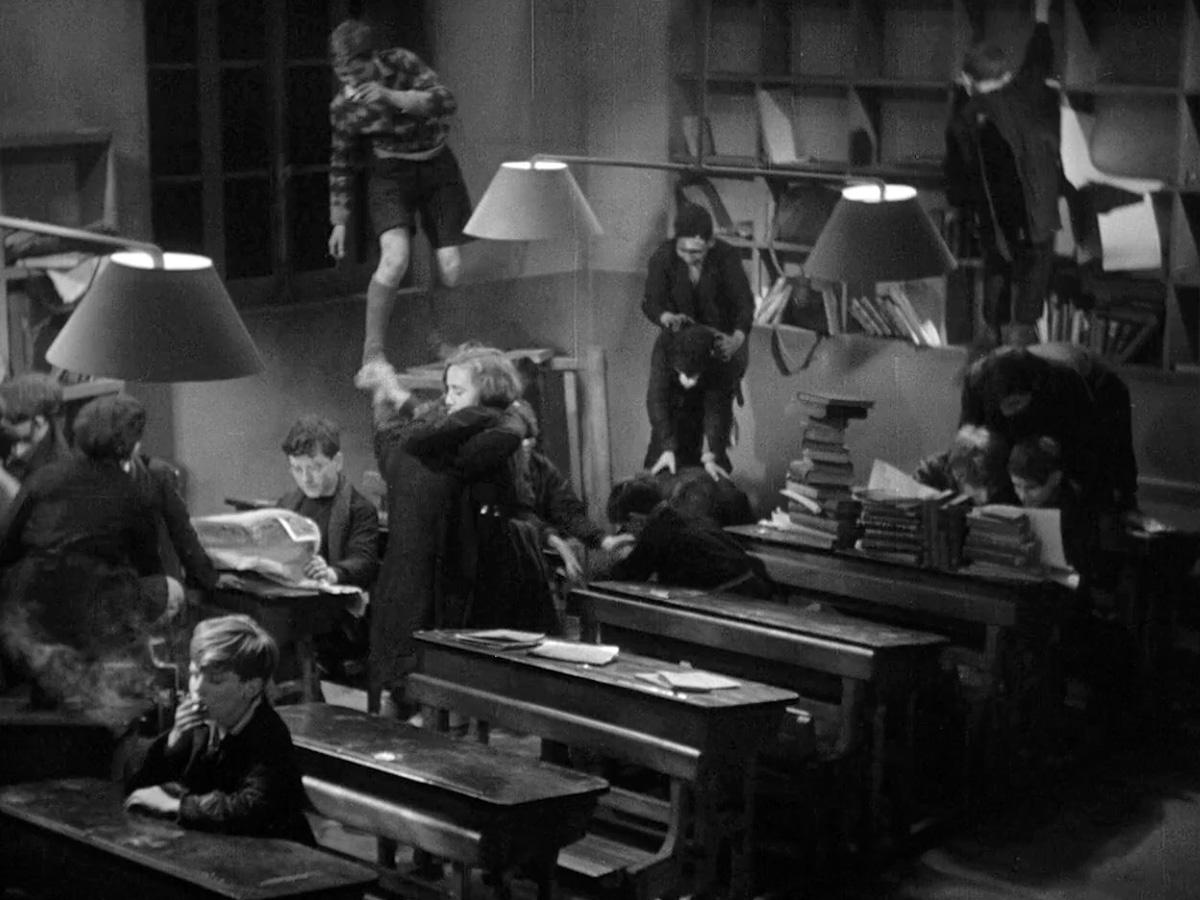
In Zero for Conduct, four rebellious pupils plan a revolt to take over the school. The film was first shown in Paris in 1933, but shocked so many viewers that it was subsequently banned from screens until the end of World War II.
Sofia is panicky again. The Universe decides to contact her—an other-worldly dialogue. Jacqueline Lentzou’s short film is a planet symphony for Mars, where people dream awake and fight for love.
Oman’s vast plains look so much like Mars that they are used as a training ground for astronauts. Two local girls gaze at the starry sky like curious scientists while the astronauts philosophise about living on the Red Planet.
In The Seasons, Artavazd Pelechian captures a reclusive farming community in its incessant struggle against the elements of nature. The film shows humanity trapped in a cruel but stunningly beautiful existence.
Dedicated to nutrition and the human attitude towards “production animals”, this YouTube-found footage collage provides disturbing insights into the behaviour of a Western affluent society towards animal products.
This satirical ethnographic film shows eating Belgians in diverse contexts.Dinner scenes at weddings, funerals, Christmas, and New Year’s Eve portray a country: loneliness and community alternate, just as wealth and poverty.
A young woman, played by Chantal Akerman herself, enters her flat in Brussels and begins a household routine that gradually degenerates. Parodying the everyday, she mops the floor, polishes her shoes, and sticks tape over the cracks in the door, thereby giving domestic life an explosive twist.
In 20th-century Colombia, resistance fighter Yarokamena, a member of the indigenous Uitoto tribe, called for rebellion against violent exploitation of the rubber mining industry in the Amazone and invoked the spiritual powers of war.
During his heyday, Buster Keaton was also known as The Great Stone Face. The American comedian is best known for his silent films, which focus on physical comedy and his deadpan facial expressions.
Eight thousand five hundred kilometres lie between the Amazon and the Ardennes. In his home country of Brazil, filmmaker Diego looks at the inaccessible forest from the outside. Its Belgian counterpiece, however, is easier to explore.
Punk author Kathy Acker’s work is the starting point for a conversation about gender identity and body transformation and is linked to the punk movement of the 1970s and 1980s.
An introspective essay about the search for a place between reality and imagination: a placeless place made up out of dreams and a longing for fluidity. Slowly, the grains of the compressed image become the sands of the atopic beach, revealing an imaginary place.
A woman trips and falls while rushing around the house. She gets up only to discover that her home has unusual features—it is built from paradoxes, filled with illusions, and covered with patterns.
Emma De Swaef, Marc James Roels, Belgium, 2011, 17’
A gentle, middle-aged man returns to the nudist colony he grew up in to visit his elderly mother. Her sudden death leaves Willy in a state of sadness. He soon finds himself lost in the midst of a savage wilderness, trying to find comfort.
Scorpio Rising is perhaps Kenneth Anger’s best-known work. Set to the beats of 1960s pop music, the film follows a group of bikers and explores the occult, homosexuality, and Nazism. It also idolises rebellious public figures such as James Dean and Marlon Brando.
In this cyberpunk animation, four creatures wobble like marionettes in a black void. An alien power tries to subdue them; police voices strike as if they were truncheons, but these vulnerable bodies start to fight back.
In this urgent diary film about longing for freedom and community, the filmmaker reflects on the individual yet collective experience of growing up queer in Tunisia today.
Confused about German bureaucracy and questioning her sexuality, Hoda, an Iranian asylum seeker in Berlin, finds herself hooked on Magdalena, who promised to ensure her asylum by marrying her. Due to changes in Magdalena’s private life, her decision to marry Hoda becomes more complex.
Dilan pays with her life for her forbidden love for a young man in a neighbouring village—a powerful poetic portrait of an honour killing in the rural Kurdish southeast of Turkey.
Spanish surrealist Luis Buñuel wrote his first feat together with Salvador Dalí, based on their dreams. Don’t get stuck on the plot. Buñuel deliberately omits chronology and opts for Freudian dream logic, in which scenes do not necessarily follow one another logically.
A portrait of contemporary suburban youth seeking to invent new contours of collective identity, against the backdrop of France in the throes of recession.
Symen and Sam pass their time in the monotony of a post-industrial suburb. They seem to linger in a kind of perpetual twilight countered by the invisible presence of ‘hardcore’. While gaming, they end up searching for the core of their desires.
Day and night, a giant sits on a hill, far away from his smaller fellow man. He fills his days organising things and making sure everything is in the right place at the right time.
Drawing on digital memories and using online tools such as Google Maps, Aulona Fetahaj reflects on how it feels to be the child of refugees in the digital age.
Mexico, October 2011. A mysterious dream gives birth to Cuco, a transgender latex pirate activist. This essayistic film follows their quest to create more recognition for the queer community.
The Brazilian trans woman Gisberta lived as an immigrant in Portugal. After she was brutally murdered, she became an icon for the transgender rights cause.
Pierre, 25 years old and on a scholarship for a prestigious Parisian university, is lodged by Francine, who is 75, disabled, and confined to her wheelchair. Both puzzled and disoriented, they witness the French presidential elections of 2017 play out.
After going missing, a woman is unable to remember her past until her former husband pays her a visit and she recalls a memory of where she lived with the man a long time ago.
Two siblings roam the mystical landscapes of Colombia, searching for their dead father's spirit. Their journey takes them from the city of Bogotá to the jungle, through realms of thought and deep into their haunted dreams.
A man finds himself haunted by a mysterious black tower in London that appears to follow him wherever he goes. The Black Tower isan example of a film that succesfully plays with emotions and the language of film.
Incident by a Bank is based on true facts and stages a surreal, failed bank robbery that the filmmaker himself witnessed in 2006, in central Stockholm. By constantly keeping the viewer at a sterile distance from the main action, Östlund slowly shifts the focus from the robbery to those witnessing the situation from a safe distance.
Set in a post-apocalyptic near-future, La Jetée tells the story of an unnamed man whose vivid childhood recollections make him the perfect guinea pig for an experiment in time travel. After a lengthy period of conditioning, he is sent back in time, where he falls in love with a woman whom he once saw on a pier.
Elephant is, without question, Alan Clarke’s bleakest film: a compilation of eighteen murders on the streets of Belfast, without explanatory narrative. After each killing, the camera dwells on the bodies, forcing the viewer to confront the brutality of their deaths.