A ship drifts in the middle of an endless sea. Aboard is a crew of five. They all cope with boredom — some by trying to overpower it; others by escaping into a parallel world guided by dreams.
A sleeping man dreams of a city at dusk. He is every angelic lover, caught off guard. The film goes in and out of his pulsating erotic dream: heated up, he dreams of landscapes, even of becoming the landscape.
In 1998, Semira Adamu, a 20-year-old Nigerian immigrant, died on Belgian soil of suffocation under a police pillow. Twenty years later, two women tell her story in a cry for justice. Through this film, they highlight the reality of detention centres: the harsh conditions of confinement, the suffering of detainees and the abuse by guards and police officers.
1947’s Fireworks is a milestone, as the first American film with a gay narrative. At age seventeen, Anger himself plays the lead character. The film illustrates the awakening of a suppressed desire, a gross fantasy.
The thaw of the so-called eternal snow of Páramo, a neotropical alpine ecosystem in the high Andes, exposes a layer of meaning about the origins and survival of the landscape.
Set in a post-apocalyptic near-future, La Jetée tells the story of an unnamed man whose vivid childhood recollections make him the perfect guinea pig for an experiment in time travel. After a lengthy period of conditioning, he is sent back in time, where he falls in love with a woman whom he once saw on a pier.
A man finds himself haunted by a mysterious black tower in London that appears to follow him wherever he goes. The Black Tower isan example of a film that succesfully plays with emotions and the language of film.
Spanish surrealist Luis Buñuel wrote his first feat together with Salvador Dalí, based on their dreams. Don’t get stuck on the plot. Buñuel deliberately omits chronology and opts for Freudian dream logic, in which scenes do not necessarily follow one another logically.
In this cyberpunk animation, four creatures wobble like marionettes in a black void. An alien power tries to subdue them; police voices strike as if they were truncheons, but these vulnerable bodies start to fight back.
Scorpio Rising is perhaps Kenneth Anger’s best-known work. Set to the beats of 1960s pop music, the film follows a group of bikers and explores the occult, homosexuality, and Nazism. It also idolises rebellious public figures such as James Dean and Marlon Brando.
In 20th-century Colombia, resistance fighter Yarokamena, a member of the indigenous Uitoto tribe, called for rebellion against violent exploitation of the rubber mining industry in the Amazone and invoked the spiritual powers of war.
A young woman, played by Chantal Akerman herself, enters her flat in Brussels and begins a household routine that gradually degenerates. Parodying the everyday, she mops the floor, polishes her shoes, and sticks tape over the cracks in the door, thereby giving domestic life an explosive twist.
The dream of an Iran post-Islamic Republic is not only part of the online discourse, but also of the protests on the streets. This is precisely what Iranian visual artist Saleh Kashefi depicts in their award-winning video And How Miserable is the Home of Evil: Iran’s Supreme Leader (finally) falls.
This avant-garde work exposes how we hide behind a façade in times of crisis, as if nothing is wrong. Arthur Lipsett’s first collage film mixes dozens of black-and-white photographs with audio fragments. The film’s subtle criticism of the 1960s zeitgeist in the United States earned it an Oscar nomination.
Swollen Stigma is a visual, surrealistic narrative about a woman travelling both literally and psychically through several rooms. Memories, or fantasies, of another woman, fill her imagination. The film proposes lesbian imagery, and its shifting points of view jump between the protagonist, fantasy spaces, and her lover, making an internal world leak into what is external.
Panning shots in a repeating full-circle movement show a room as a succession of still lives: a chair, some fruit on a table, a collection of solitary, waiting objects. There is the presence of a young woman: filmmaker Chantal Akerman herself, sitting on the bed eating an apple.
Old Child depicts the fragmented story of Hazem, who had to flee Gaza. Throughout this stream-of-consciousness montage of dreams and reminiscences, he searches for order but also for the beauty he left behind.
With a single camera movement, this film explores humankind’s relationship to the ground. The viewpoint continuously changes. Places, objects, people, and events come in and out of focus. These observations gradually speed up and reveal a double-sided ground, flipping like a tossed coin, which then slows again to oscillate around the Earth’s edge.
A woman, played by Maya Deren herself, returns home, falls asleep, and has vivid dreams that may or may not be happening in reality. Through repetitive images and a complete mismatch with the objective view of time and space, the woman’s dark inner desires play out on-screen.
Using images shared on the Internet by Israelis during the Gulf War, the First Intifada, and trance music gatherings, Shuruq Harb paints the portrait of a Palestinian teenager in the 1990s. In the midst of Israeli pop culture and the political climate of the Oslo Accords, she comes to grips with her anxiety.
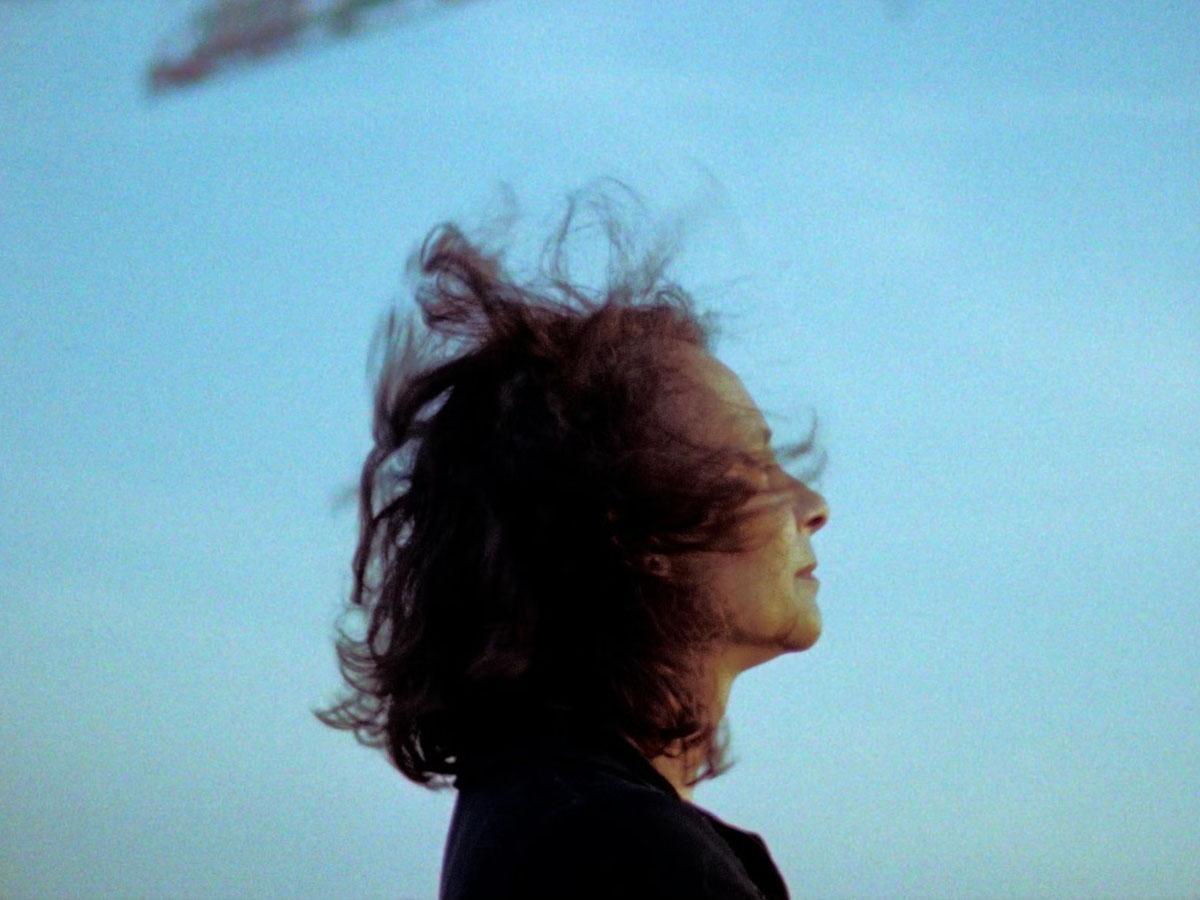
Eva Giolo silently and patiently portrays the same action over and over again. Her own body and those of her loved ones merge anonymously in a series of embraces, captured on blue-gray, faded 16mm film. Gazes are buried in necks and fingers intertwine or caress the contours of the other.
A poetic documentary in the form of a letter from a son to his mother, but read by her to him. What begins as an attempt to tell her story, slowly transforms into something else.
In what is widely considered his greatest film, Len Lye reduces cinema to its most basic elements by scratching onto black and white film, using a variety of means ranging from dental tools to an ancient Native American arrowhead. The title references modern physics: ‘free radicals’ are particles of energy.
Begone Dull Care brings a wild piece of music to life with abstract expressionist animation. Evelyn Lambart and Norman McLaren painted colours, shapes, and transformations directly onto their filmstrip, impossible to simulate with digital tools.
A woman lies awake at night. Nearby, a set of theatre backdrops unspools itself, unveiling two alternate landscapes. Upon the woman’s blue sheet, a flicker of light reflects and illuminates her realm of insomnia.
In Ever is Over All, Pipilotti Rist juxtaposes the field and its flowers with her magically powerful wand, and transposes acts of aggression and annihilation into benevolent and creative ones. An anarchic young woman gleefully breaks windows.
Letters from a Palestinian woman living in war-torn Lebanon to her daughter, whom she has not seen for years, and a series of photographs convey the effects of war and exile on their personal and cultural life, with a nuanced look at family relationships.
A man is sitting on a picnic blanket in a Chicago park on Lake Michigan. He is filmed from above. Every 10 seconds, the camera zooms out by a factor of 10. Finally, we see the entire universe, with constellations floating around like clouds of cream in ink-black coffee.
During the Cold War, the Thai village of Nabua was accused of harbouring communists. Its inhabitants were subject to violent reprisals. Phantoms of Nabua evokes these atrocities, but does so under a luminous guise.
All My Life is a 3-minute pan movement that opens on an old picket fence framed by the blue sky above and a stretch of summer-brown grass below. On the soundtrack, you can hear the crackle and hiss of an old record. Soon, Ella Fitzgerald starts singing “All My Life” in a 1936 session with the pianist Teddy Wilson.
Today, the flicker film Arnulf Rainer is still a landmark in the history of cinema. In this radical work, Peter Kubelka reduced cinema to its simplest form of expression: each frame is composed of light or darkness, silence or sound.
Zuza Banasińska reinvents the famous Slavic witch Baba Yaga through a clever montage of films from the Polish Educational Film Studio archive, containing sexist content. Questioning their own non-binary identity, they unleash the queer dimension of found footage tasked with conveying a normative conception of identity.
Germaine Dulac’s The Seashell and the Clergyman was arguably the first surrealist film ever made. The film tells the story of a clergyman who falls madly in love with a beautiful woman, but must defeat an equally eager rival.
In 2014, artist and forensic audio analyst Lawrence Abu Hamdan examined audio files of the shots that killed Nadeem Nawara and Mohamed Abu Daher in the West Bank of Palestine. Rubber Coated Steel does not preside over the voices of the victims but seeks to amplify their silence.
Two young men in a pickup truck, from different parts of the world, discover each other through the use of a camera. As the camera lenses change, a landscape of rice fields and a cinema crew get into the frame. The camera then reshoots the road and the men, as if we were witnessing a film rehearsal.
Wavelength consists of almost no action. The film’s spine is its famous zoom from a fixed camera position. The spectator is led to concentrate on this central element, the photograph, until the image is washed out and the film comes to an end.
An authoritative voice-over pre-empts the events in the image, seeming to order not only the people, cars, and moving objects on the screen but also the actual camera movements on the street in view. John Smith draws attention to how controlling and directional the practice of voice-over actually is.
In Outer Space, a woman no longer fights an unknown entity, but that portion of the filmstrip that is normally unseen when film is projected—the “outer space” of the film’s image, consisting of the optical soundtrack and its perforations.
Zbigniew Rybczynski worked eight hours a day for ten months on the Oscar-winning Tango. He brings together a jumble of cut-out photos featuring countless figures of all kinds and ages in a flawlessly synchronised animation. The work was formally highly innovative at the time.
Dimensions of Dialogue demonstrates that communication can and will break down. During this 12-minute magnum opus, Jan Švankmajer demonstrates his virtuosity and limitless invention by shifting his artistic style and animation techniques three times.
In Hapax Legomena I: Nostalgia, Hollis Frampton presents 12 pictures and reminisces about them. After about a minute, the photos catch fire and burn to ashes. Memory and anticipation merge.
In the dream-like narrative of At Land, a woman, played by filmmaker Maya Deren herself, is washed up on a beach and goes on a strange journey, encountering other versions of herself. Deren described the film as about the struggle to maintain one’s personal identity.
Spacy elaborates the concept of ‘infinite regress’ through a zoom-in to a grandstand on which animated photos show a zoom of the same stand, ad infinitum, with reverses and variations. All its components—location, illusion, and time—are strictly combined in an endless cycle, like a Möbius strip or an Escher film, in a Japanese tempo, from slow to fast.
Mothlight was created by painstakingly collaging bits and pieces of organic matter—moth wings, most notably, as well as flowers, seeds, leaves, and blades of grass—and sandwiching them between two layers of clear 16-mm Mylar editing tape.
In a shopping mall, two women sing about their favourite items but are quickly pursued by a masked cannibal who is intent on forcing his way to their love. Possibly in Michigan is an operatic fairy tale of cannibalism and dread in America.
Made in 1993, when the Bosnian War was at its apex, this film compresses untold hours of action into two minutes. A static photograph is revisited once and again. Hail, Sarajevo is a morsel of history in and of itself.
Everything in Anticipation of the Night is shown in a multitude of aspects, at varying speeds, with crucial changes in lighting and graininess. This film bids farewell to the protagonist’s last dying thought and to all the primitive “point of view” tricks of narrative cinema.
This short animated film seems playful only at first glance—in fact, it tells the story of a life on the margins of society in a no less disturbing way. While the filmmaker is reading quotes from conversations with an invalid man from eastern Germany, a mechanical ballet of light switches and plastic dolls is set in motion.
In this expression of gendered pain, joy, and hardship, Chick Strand collaborates with five women who share their experiences through direct, frank stories. Throughout these testimonies, Soft Fiction considers the identification and representation of womanhood, and the sense of possession and dispossession through consensual and abusive sexuality.
With a 16mm Bolex camera, Rose Lowder developed her own unique way of filming. Her famous “Bouquets” consist of a series of one-minute compositions whose 1440 frames are interlaced so that each bouquet of flowers also becomes a bouquet of images.
Brakhage’s avant-garde classic is an intimate impression of the birth of his first child. The film features the first contractions, the actual delivery, and the cutting of the umbilical cord.
Of the more than eighty moving-image works that Barbara Hammer created, her 1974 film Dyketactics remains her most iconic. A four-minute paean to lesbian sexuality, the film publicly announced Hammer’s blossoming sexual identity.
A silent meditation on death depicting bodies lying in a morgue, this is one of the starkest works of body horror in which Brakhage makes the monster our very own perception.
The Hymns of Muscovy is a trip to the eponymous planet, which is an upside-down space twin of the city of Moscow. Gliding along its surface, we look down at the sky and see historic architectural styles fly by—the exuberant Socialist Classicism, aka the Stalinist Empire, the laconic and brutalist Soviet Modernism, and the hodgepodge of their contemporary knock-offs and revivals.
Through dancing, The Motherfucker’s Birthday shows the evil of the dictator and the horror people endure under powerful political leaders. The film presents dancing, a universal and uniquely human activity often representing joy, with eerie footage of Saddam and his sons’ torture tools while they dance.
Like an animal in one of Eadweard Muybridge’s scientific photo experiments, five undramatic moments in a man’s life are observed by a woman. A study in visual obsession and a twist on the notion of the “gaze”.
A broken phone and the digital memory of a broken queer relationship. Through the careful manipulation of discarnate metal components and the filmmaker’s attentive look at an intimate archive, a fading first love surfaces. Loveboard is a playful reflection on what remains.
A silent film of collaged and painted sequences of lovemaking between artist Carolee Schneemann and her then partner, composer James Tenney, observed by their cat, Kitch.
This experimental animated film delves into feelings of loss and helplessness, remnants of a traumatic experience. The emotional wounds are visually translated into a pulsating presence that embodies a dark and disturbing image of femininity.