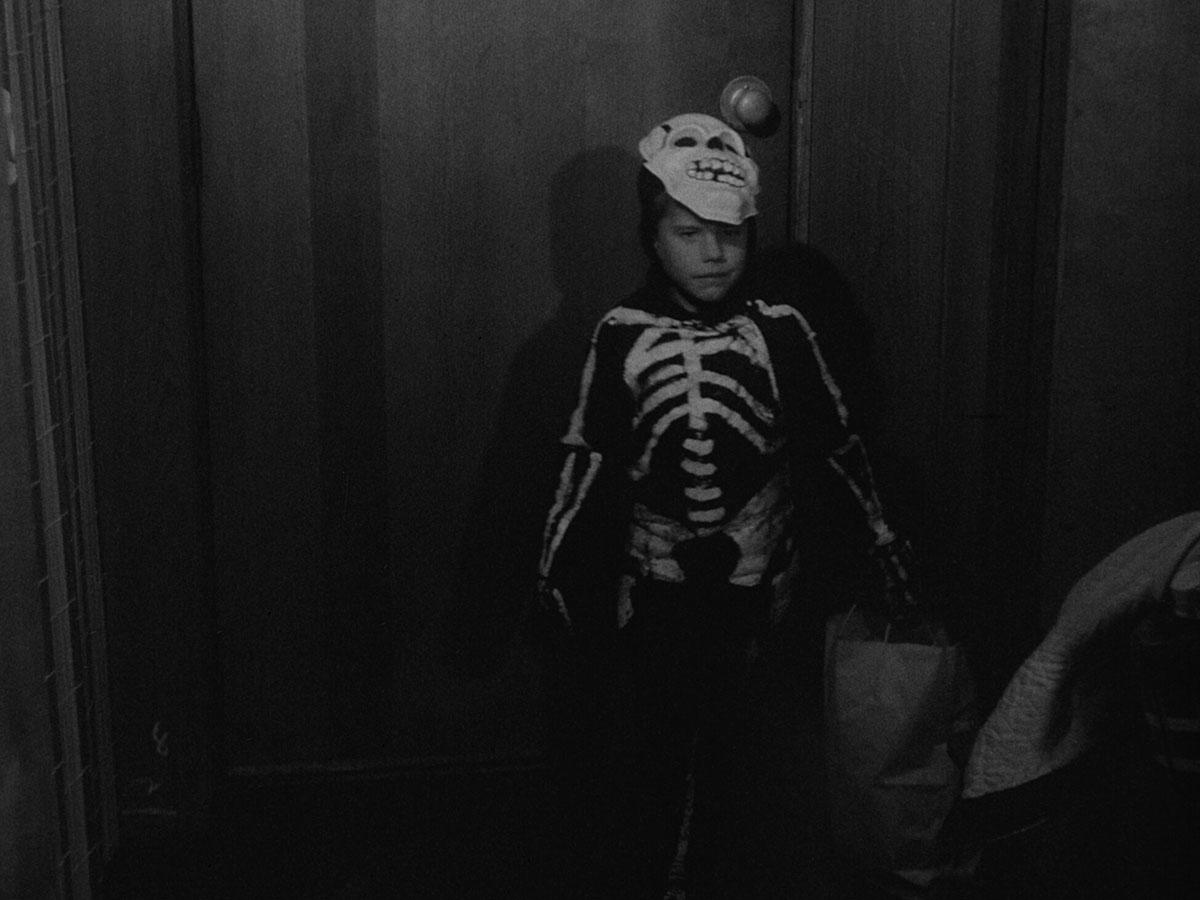
A young lad dresses up for an annual round of trick-or-treating with his school friends in this 1960 public service announcement. However, their night’s haul won’t benefit themselves.
In Sawyer Avenue, Sunday Afternoon, Bill Morrison presents a chronology of an ICE raid and the civil resistance that follows it. A found-footage collage of mobile phone and bodycam footage.
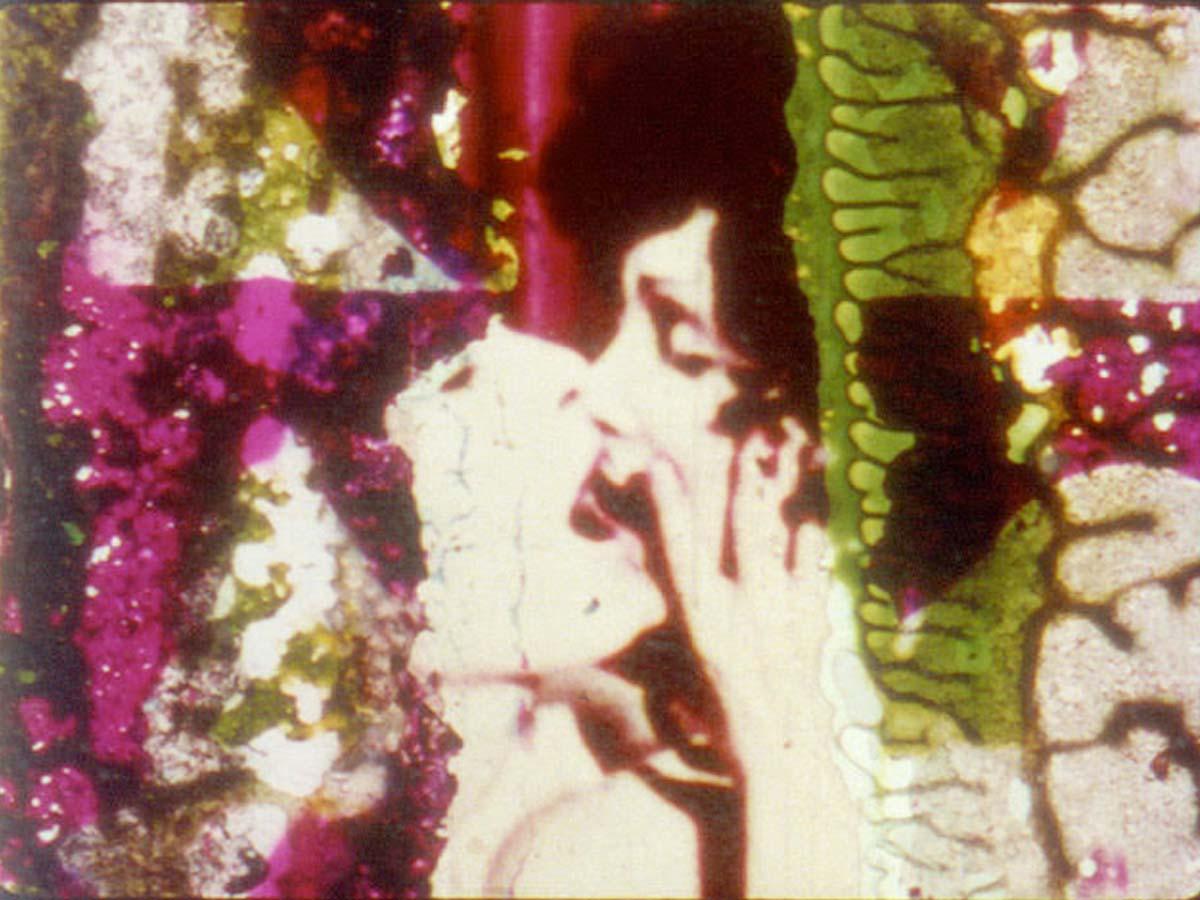
According to Peggy Ahwesh, there is beauty and ecstasy in decay. With her 16mm blow-up of a pornographic Super 8 film, the American artist seeks sensuality.
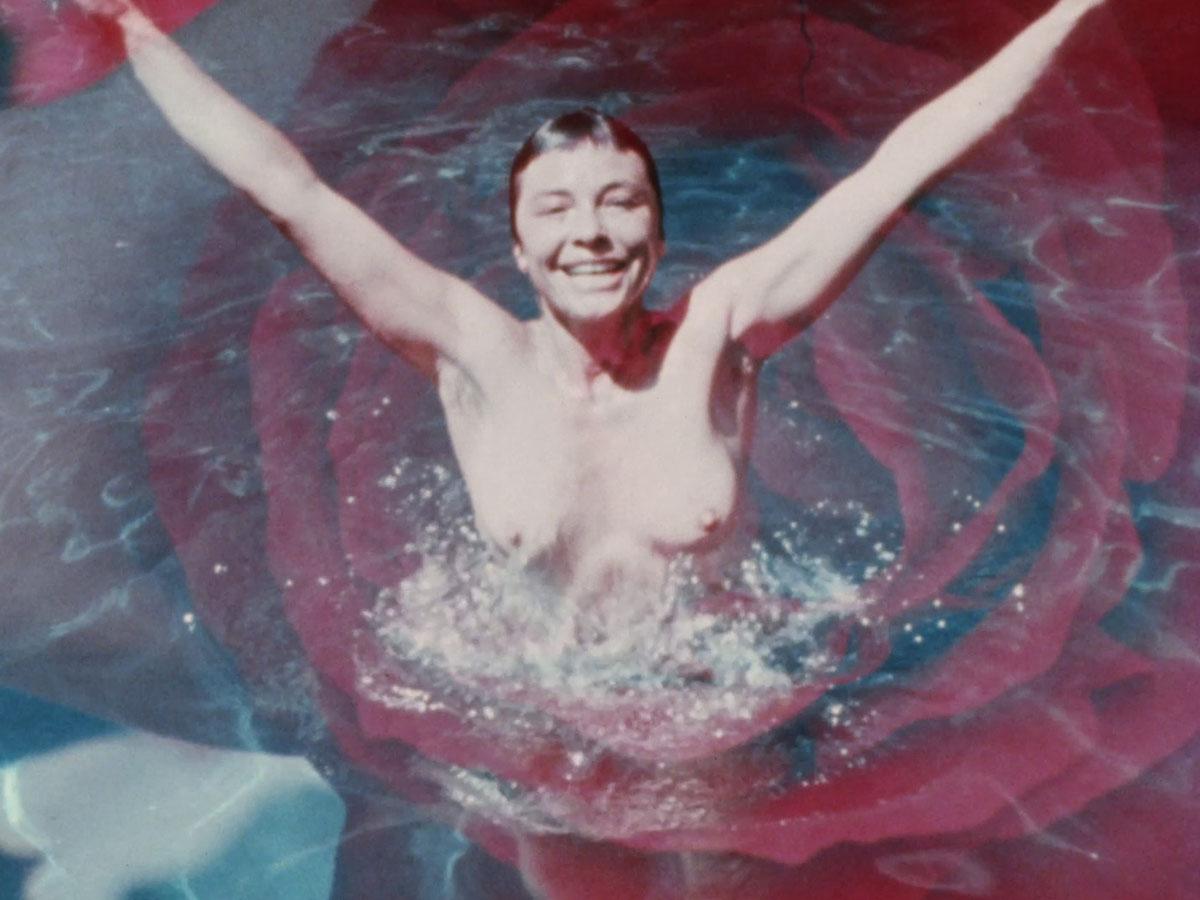
A series of cameo portraits of Barbara Hammer’s friends and lovers intercut with a playful celebration of fruits and vegetables in nature. The culminating footage evokes a tantric painting of sustained sexuality.
Using the sixth century B.C. lyricist’s poetry, a group of women unwrap the papyrus gauze of the lesbian goddess and bring her to life. Made by Barbara and six students at the Women’s Building in Los Angeles.
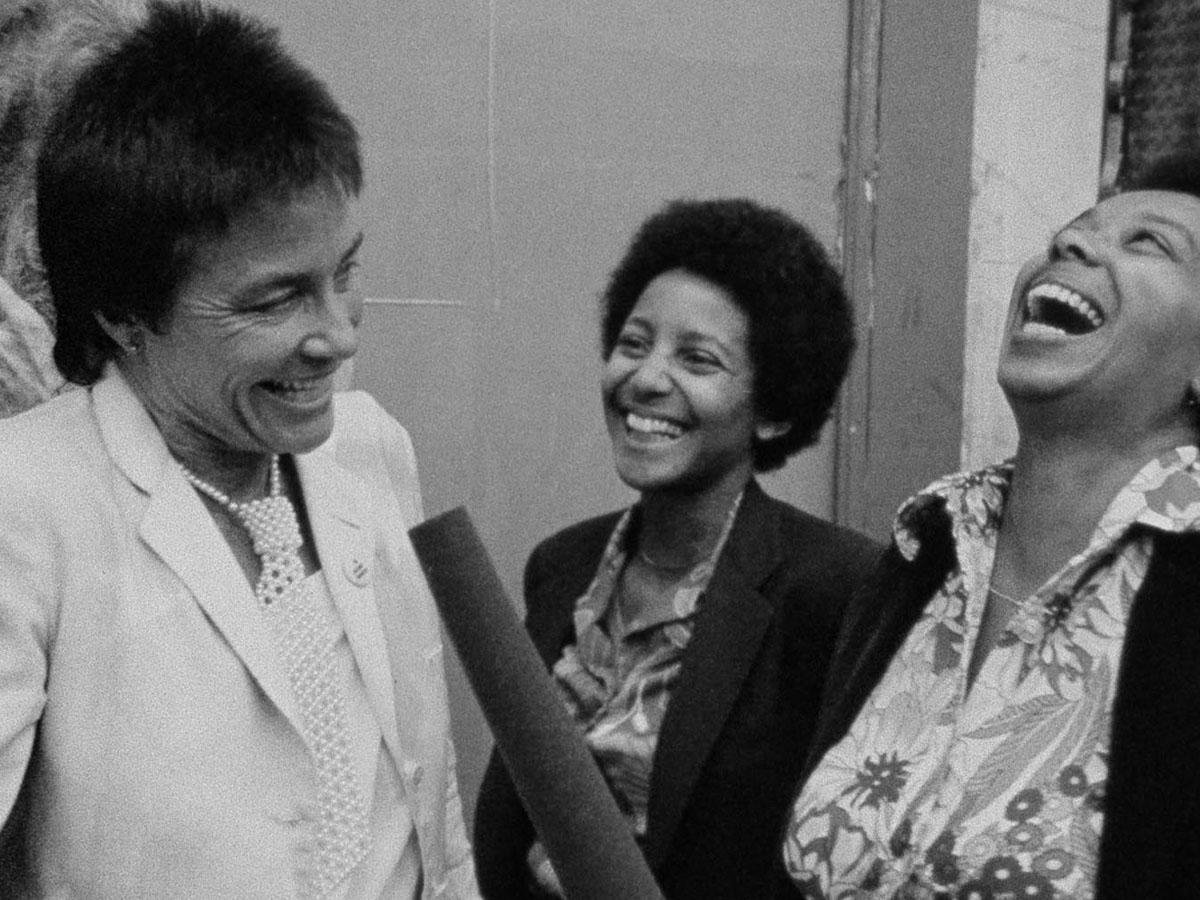
Barbara Hammer takes out her camera to film audiences at screenings of her films. She wanted to show the diversity in a women’s audience: the sophistication, the thoughtfulness, the fun-loving spirit, the flirtations, the detailed, the subtle.
Shellie Fleming deconstructs Sylvia Plath’s Tulips and creates new word combinations that transform the poem. The poetry can be heard, seen, and felt in Devotio Moderna, which becomes a highly tangible experience.
A journey to the underworld begins within our own entrails. This film explores the intimate rhythm of digestion only to next investigate the becoming of geological eras, inspired by Gamaliel Churata’s El Pez de Oro, in which he states, “we all carry the dead alive; that the dead live.”
This video diary depicts a young woman’s flat, the fears and fantasies about her body plainly revealed as she wakes up with a bloated face, full of self-loathing after a night of compulsive over-eating.
The endearing observation Spaghetti Aza paints not only the portrait of a sleepy boy but also, indirectly, of two doting parents. A one-minute home movie by Ken Jacobs, a pioneer of the American avant-garde film of the 1960s and ’70s.
A silent film of collaged and painted sequences of lovemaking between artist Carolee Schneemann and her then partner, composer James Tenney, observed by their cat, Kitch.
Martí arrives in Bilbao for an artistic residency. In his new room, his clothes occupy only a small portion of the enormous wardrobe. But when he meets someone, the wardrobe slowly begins to fill up. Where has the emptiness gone, the free space, the little corner that was his?
Like an animal in one of Eadweard Muybridge’s scientific photo experiments, five undramatic moments in a man’s life are observed by a woman. A study in visual obsession and a twist on the notion of the “gaze”.
Through dancing, The Motherfucker’s Birthday shows the evil of the dictator and the horror people endure under powerful political leaders. The film presents dancing, a universal and uniquely human activity often representing joy, with eerie footage of Saddam and his sons’ torture tools while they dance.
A silent meditation on death depicting bodies lying in a morgue, this is one of the starkest works of body horror in which Brakhage makes the monster our very own perception.
Of the more than eighty moving-image works that Barbara Hammer created, her 1974 film Dyketactics remains her most iconic. A four-minute paean to lesbian sexuality, the film publicly announced Hammer’s blossoming sexual identity.
Clips sampled from films, newscasts, sporting events, music videos, and citizen videos traverse the twentieth century, focusing on the lives of Black people set against the backdrop of systemic racism and White supremacism. Taken as a whole, Jafa’s montage comprises a poignant, visceral meditation on African American identity and history.
Brakhage’s avant-garde classic is an intimate impression of the birth of his first child. The film features the first contractions, the actual delivery, and the cutting of the umbilical cord.
A little girl is taken on a mind-bending tour of her distant future. An element of childhood whimsy is integral to balancing out the film’s dark absurdism, paving the way for its core theme: life is precious, and the sadness permeating our day-to-day is a reminder to cherish it.
In this expression of gendered pain, joy, and hardship, Chick Strand collaborates with five women who share their experiences through direct, frank stories. Throughout these testimonies, Soft Fiction considers the identification and representation of womanhood, and the sense of possession and dispossession through consensual and abusive sexuality.
llusions is a gripping critique of cinema’s power to shape perception, exploring the myth of racial identity. Julie Dash’s drama shows the instrumentalisation of Hollywood during wartime.
Everything in Anticipation of the Night is shown in a multitude of aspects, at varying speeds, with crucial changes in lighting and graininess. This film bids farewell to the protagonist’s last dying thought and to all the primitive “point of view” tricks of narrative cinema.
In a shopping mall, two women sing about their favourite items but are quickly pursued by a masked cannibal who is intent on forcing his way to their love. Possibly in Michigan is an operatic fairy tale of cannibalism and dread in America.
Mothlight was created by painstakingly collaging bits and pieces of organic matter—moth wings, most notably, as well as flowers, seeds, leaves, and blades of grass—and sandwiching them between two layers of clear 16-mm Mylar editing tape.
This postmodern retelling of Karen Carpenter’s affliction by anorexia enraged her family and initially got the film banned. Blending archival material, artificial talking heads, and Barbie-doll reenactments, Todd Haynes criticises the objectification of female celebrities.
A polemical, avowedly personal video documentary on the American Black gay experience. Marlon Riggs celebrates Black men loving Black men as a revolutionary act.
What is Senegal exactly? Reassemblage: From the Firelight to the Screen is a film about its people and, at the same time, a reflection on the conventions of ethnographic cinema. It shows the mechanisms of manipulation in the seventh art form.
In the dream-like narrative of At Land, a woman, played by filmmaker Maya Deren herself, is washed up on a beach and goes on a strange journey, encountering other versions of herself. Deren described the film as about the struggle to maintain one’s personal identity.
In Hapax Legomena I: Nostalgia, Hollis Frampton presents 12 pictures and reminisces about them. After about a minute, the photos catch fire and burn to ashes. Memory and anticipation merge.
Wavelength consists of almost no action. The film’s spine is its famous zoom from a fixed camera position. The spectator is led to concentrate on this central element, the photograph, until the image is washed out and the film comes to an end.
All My Life is a 3-minute pan movement that opens on an old picket fence framed by the blue sky above and a stretch of summer-brown grass below. On the soundtrack, you can hear the crackle and hiss of an old record. Soon, Ella Fitzgerald starts singing “All My Life” in a 1936 session with the pianist Teddy Wilson.
Filmed over a single unbroken take, this work brings together slice-of-life vignettes. On a busy street corner, three young men have a conversation over food. Suddenly, a motorcycle crash occurs nearby. As the crowd clears, a young boy performs street tricks and a beer girl plies her trade.
A pristine white bathroom soon becomes a site of crimson-stained shaving carnage in Martin Scorsese’s daring student film, a potent and disturbing allegory for the horrors of the Vietnam War. What starts out as a pleasant morning soon goes horribly wrong, turning into a bloody spectacle of self-mutilation.
A man is sitting on a picnic blanket in a Chicago park on Lake Michigan. He is filmed from above. Every 10 seconds, the camera zooms out by a factor of 10. Finally, we see the entire universe, with constellations floating around like clouds of cream in ink-black coffee.
In Ever is Over All, Pipilotti Rist juxtaposes the field and its flowers with her magically powerful wand, and transposes acts of aggression and annihilation into benevolent and creative ones. An anarchic young woman gleefully breaks windows.
In what is widely considered his greatest film, Len Lye reduces cinema to its most basic elements by scratching onto black and white film, using a variety of means ranging from dental tools to an ancient Native American arrowhead. The title references modern physics: ‘free radicals’ are particles of energy.
A woman, played by Maya Deren herself, returns home, falls asleep, and has vivid dreams that may or may not be happening in reality. Through repetitive images and a complete mismatch with the objective view of time and space, the woman’s dark inner desires play out on-screen.
Yes, Nobel Prize winner Samuel Beckett also made a film once, archetypically titled Film. A man tries to escape the gaze of an all-seeing eye. The disorienting camerawork comes from Oscar winner Boris Kaufman, whose brothers Dziga Vertov and Mikhail Kaufman created the legendary self-reflective masterpiece Man With a Movie Camera (1929).
In what one could call Jonas Mekas’ first video blog, the Lithuanian avant-garde filmmaker reflects on his life and the art of cinema and representation.
In Suzan Pitt’s cult classic Asparagus, the indomitable growth of an asparagus plant is associated with female sexuality. As the urbane world turns absurdist, the green fruit transforms this reality.
During his heyday, Buster Keaton was also known as The Great Stone Face. The American comedian is best known for his silent films, which focus on physical comedy and his deadpan facial expressions.
Scorpio Rising is perhaps Kenneth Anger’s best-known work. Set to the beats of 1960s pop music, the film follows a group of bikers and explores the occult, homosexuality, and Nazism. It also idolises rebellious public figures such as James Dean and Marlon Brando.
1947’s Fireworks is a milestone, as the first American film with a gay narrative. At age seventeen, Anger himself plays the lead character. The film illustrates the awakening of a suppressed desire, a gross fantasy.