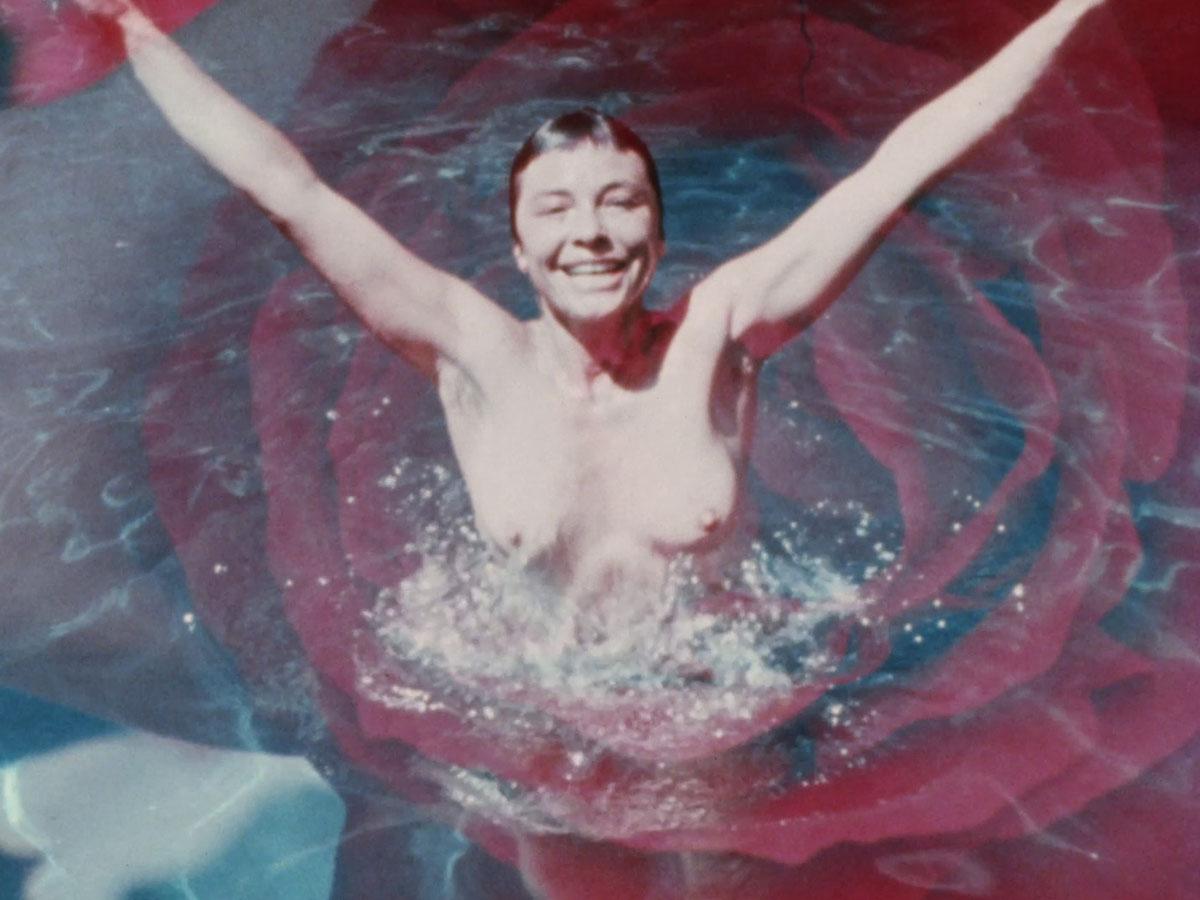
Using the sixth century B.C. lyricist’s poetry, a group of women unwrap the papyrus gauze of the lesbian goddess and bring her to life. Made by Barbara and six students at the Women’s Building in Los Angeles.
Shellie Fleming deconstructs Sylvia Plath’s Tulips and creates new word combinations that transform the poem. The poetry can be heard, seen, and felt in Devotio Moderna, which becomes a highly tangible experience.
Artist Eva Giolo films her friends in their own homes and asks them to perform a few simple actions: gestures that reflect the fragile balance of everyday life, and, at times, become more aggressive. A cinematic poem in response to the global pandemic of 2020.
By interweaving esoteric texts and images, Working Knowledge of Ritual underscores the interconnectedness of spirituality and nature. The film muses on our energies alongside the natural world, inspired by the writings of Leonard Jones.
The routines of two women fuse together over time. One is busy with her bread, the other with her memories. Their similar gestures, repeated again and again, slowly unfold the special bond that unites them.
In this fictional epistolary film, writer Marguerite Duras, a member of the French Resistance during the Second World War and partner to a Holocaust survivor, uses her titular alter ego to voice a deeply personal grief.
This experimental animated film delves into feelings of loss and helplessness, remnants of a traumatic experience. The emotional wounds are visually translated into a pulsating presence that embodies a dark and disturbing image of femininity.
In 1954, on a Calais beach, Agnès Varda took a photograph of a man, a boy and a dead goat. Almost thirty years later, she returns to that image, the moment she made it, the way she remembers it (sometimes incorrectly, as she finds out), and the interconnections between past, present and future.
Maryam Tafakory creates an intimate inner world that moves between the concrete and the abstract. Layers of found and original footage are superimposed to fill in some of the cracks, the deletions, the limits of representation. Mast-del is a love song that would never pass through censorship.
Everything in Anticipation of the Night is shown in a multitude of aspects, at varying speeds, with crucial changes in lighting and graininess. This film bids farewell to the protagonist’s last dying thought and to all the primitive “point of view” tricks of narrative cinema.
A poetic amalgam of Yuri Norstein’s memories, hopes, and fears for the future. Tale of Tales depicts his post-war childhood, remnants of the personal tragedies of war, and the little wolf character in the lullaby his mother used to sing.
Marguerite Duras takes us on a nighttime car ride through an unpopulated Paris in mid-August, in a single, uninterrupted shot from inside the car. From the end of night till dawn, a depopulated Paris soothes itself with Duras’ affecting voice-over, accompanied by cello accords.
All My Life is a 3-minute pan movement that opens on an old picket fence framed by the blue sky above and a stretch of summer-brown grass below. On the soundtrack, you can hear the crackle and hiss of an old record. Soon, Ella Fitzgerald starts singing “All My Life” in a 1936 session with the pianist Teddy Wilson.
After the revolution in 1979, Iran prohibited the depiction on the silver screen of men and women touching. Since then, directors have relied on every cinematic trick in the book to mirror ecstatic tension. Nazarbazi collages these intense cinematic moments into a poem about love and desire.
A woman lies awake at night. Nearby, a set of theatre backdrops unspools itself, unveiling two alternate landscapes. Upon the woman’s blue sheet, a flicker of light reflects and illuminates her realm of insomnia.
Eva Giolo silently and patiently portrays the same action over and over again. Her own body and those of her loved ones merge anonymously in a series of embraces, captured on blue-gray, faded 16mm film. Gazes are buried in necks and fingers intertwine or caress the contours of the other.
By means of visual material gathered from online sources, filmmakers Olivia Rochette and Gerard-Jan Claes create a unique poetic realm in which thoughts, fears, desires, and worries are shared via webcam, and merge together.
Swollen Stigma is a visual, surrealistic narrative about a woman travelling both literally and psychically through several rooms. Memories, or fantasies, of another woman, fill her imagination. The film proposes lesbian imagery, and its shifting points of view jump between the protagonist, fantasy spaces, and her lover, making an internal world leak into what is external.
In Magic, a portrait of Joris, images sourced from different periods in time are glued together. Worn-out VHS footage filmed by the artist’s father is placed beside 8mm images she filmed herself. Both have the same subject: one boy, both a son and a brother. Connecting images of then and now, a new narrative of remembering opens up.
Punk author Kathy Acker’s work is the starting point for a conversation about gender identity and body transformation and is linked to the punk movement of the 1970s and 1980s.
An introspective essay about the search for a place between reality and imagination: a placeless place made up out of dreams and a longing for fluidity. Slowly, the grains of the compressed image become the sands of the atopic beach, revealing an imaginary place.
Day and night, a giant sits on a hill, far away from his smaller fellow man. He fills his days organising things and making sure everything is in the right place at the right time.
Set in a post-apocalyptic near-future, La Jetée tells the story of an unnamed man whose vivid childhood recollections make him the perfect guinea pig for an experiment in time travel. After a lengthy period of conditioning, he is sent back in time, where he falls in love with a woman whom he once saw on a pier.
In 1962, beloved and controversial poetess Forugh Farrokhzad went to Azerbaijan and made her only short film: a portrait of a leper colony. The House is Black is an empathetic portrait that illuminates a world burdened by tragedy, yet sustained by community.
A sleeping man dreams of a city at dusk. He is every angelic lover, caught off guard. The film goes in and out of his pulsating erotic dream: heated up, he dreams of landscapes, even of becoming the landscape.
A ship drifts in the middle of an endless sea. Aboard is a crew of five. They all cope with boredom — some by trying to overpower it; others by escaping into a parallel world guided by dreams.