1947’s Fireworks is a milestone, as the first American film with a gay narrative. At age seventeen, Anger himself plays the lead character. The film illustrates the awakening of a suppressed desire, a gross fantasy.
A man finds himself haunted by a mysterious black tower in London that appears to follow him wherever he goes. The Black Tower isan example of a film that succesfully plays with emotions and the language of film.
Scorpio Rising is perhaps Kenneth Anger’s best-known work. Set to the beats of 1960s pop music, the film follows a group of bikers and explores the occult, homosexuality, and Nazism. It also idolises rebellious public figures such as James Dean and Marlon Brando.
This avant-garde work exposes how we hide behind a façade in times of crisis, as if nothing is wrong. Arthur Lipsett’s first collage film mixes dozens of black-and-white photographs with audio fragments. The film’s subtle criticism of the 1960s zeitgeist in the United States earned it an Oscar nomination.
Swollen Stigma is a visual, surrealistic narrative about a woman travelling both literally and psychically through several rooms. Memories, or fantasies, of another woman, fill her imagination. The film proposes lesbian imagery, and its shifting points of view jump between the protagonist, fantasy spaces, and her lover, making an internal world leak into what is external.
Panning shots in a repeating full-circle movement show a room as a succession of still lives: a chair, some fruit on a table, a collection of solitary, waiting objects. There is the presence of a young woman: filmmaker Chantal Akerman herself, sitting on the bed eating an apple.
With a single camera movement, this film explores humankind’s relationship to the ground. The viewpoint continuously changes. Places, objects, people, and events come in and out of focus. These observations gradually speed up and reveal a double-sided ground, flipping like a tossed coin, which then slows again to oscillate around the Earth’s edge.
A woman, played by Maya Deren herself, returns home, falls asleep, and has vivid dreams that may or may not be happening in reality. Through repetitive images and a complete mismatch with the objective view of time and space, the woman’s dark inner desires play out on-screen.
Using images shared on the Internet by Israelis during the Gulf War, the First Intifada, and trance music gatherings, Shuruq Harb paints the portrait of a Palestinian teenager in the 1990s. In the midst of Israeli pop culture and the political climate of the Oslo Accords, she comes to grips with her anxiety.
In what is widely considered his greatest film, Len Lye reduces cinema to its most basic elements by scratching onto black and white film, using a variety of means ranging from dental tools to an ancient Native American arrowhead. The title references modern physics: ‘free radicals’ are particles of energy.
Begone Dull Care brings a wild piece of music to life with abstract expressionist animation. Evelyn Lambart and Norman McLaren painted colours, shapes, and transformations directly onto their filmstrip, impossible to simulate with digital tools.
All My Life is a 3-minute pan movement that opens on an old picket fence framed by the blue sky above and a stretch of summer-brown grass below. On the soundtrack, you can hear the crackle and hiss of an old record. Soon, Ella Fitzgerald starts singing “All My Life” in a 1936 session with the pianist Teddy Wilson.
Today, the flicker film Arnulf Rainer is still a landmark in the history of cinema. In this radical work, Peter Kubelka reduced cinema to its simplest form of expression: each frame is composed of light or darkness, silence or sound.
Germaine Dulac’s The Seashell and the Clergyman was arguably the first surrealist film ever made. The film tells the story of a clergyman who falls madly in love with a beautiful woman, but must defeat an equally eager rival.
Wavelength consists of almost no action. The film’s spine is its famous zoom from a fixed camera position. The spectator is led to concentrate on this central element, the photograph, until the image is washed out and the film comes to an end.
In Outer Space, a woman no longer fights an unknown entity, but that portion of the filmstrip that is normally unseen when film is projected—the “outer space” of the film’s image, consisting of the optical soundtrack and its perforations.
In Hapax Legomena I: Nostalgia, Hollis Frampton presents 12 pictures and reminisces about them. After about a minute, the photos catch fire and burn to ashes. Memory and anticipation merge.
In the dream-like narrative of At Land, a woman, played by filmmaker Maya Deren herself, is washed up on a beach and goes on a strange journey, encountering other versions of herself. Deren described the film as about the struggle to maintain one’s personal identity.
Spacy elaborates the concept of ‘infinite regress’ through a zoom-in to a grandstand on which animated photos show a zoom of the same stand, ad infinitum, with reverses and variations. All its components—location, illusion, and time—are strictly combined in an endless cycle, like a Möbius strip or an Escher film, in a Japanese tempo, from slow to fast.
Mothlight was created by painstakingly collaging bits and pieces of organic matter—moth wings, most notably, as well as flowers, seeds, leaves, and blades of grass—and sandwiching them between two layers of clear 16-mm Mylar editing tape.
Everything in Anticipation of the Night is shown in a multitude of aspects, at varying speeds, with crucial changes in lighting and graininess. This film bids farewell to the protagonist’s last dying thought and to all the primitive “point of view” tricks of narrative cinema.
In this expression of gendered pain, joy, and hardship, Chick Strand collaborates with five women who share their experiences through direct, frank stories. Throughout these testimonies, Soft Fiction considers the identification and representation of womanhood, and the sense of possession and dispossession through consensual and abusive sexuality.
With a 16mm Bolex camera, Rose Lowder developed her own unique way of filming. Her famous “Bouquets” consist of a series of one-minute compositions whose 1440 frames are interlaced so that each bouquet of flowers also becomes a bouquet of images.
Brakhage’s avant-garde classic is an intimate impression of the birth of his first child. The film features the first contractions, the actual delivery, and the cutting of the umbilical cord.
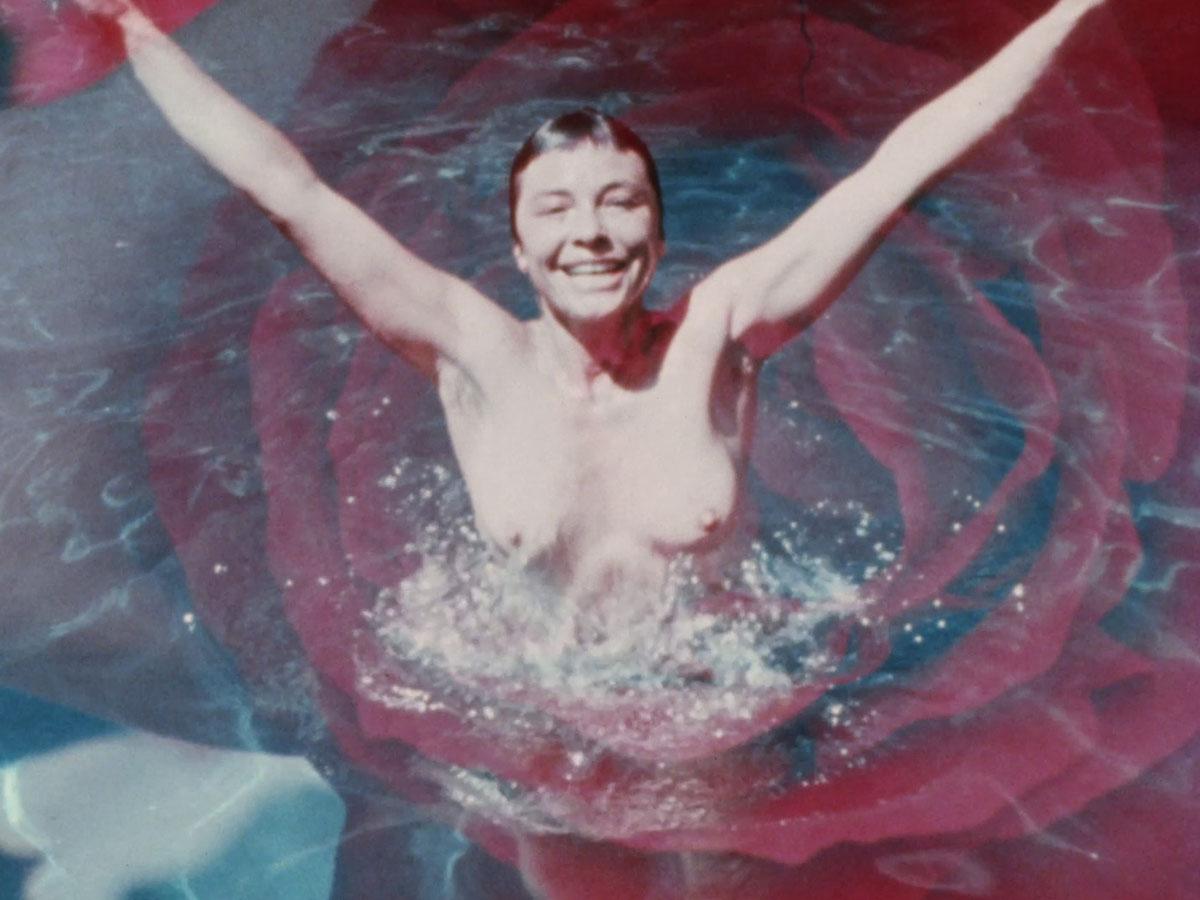
Of the more than eighty moving-image works that Barbara Hammer created, her 1974 film Dyketactics remains her most iconic. A four-minute paean to lesbian sexuality, the film publicly announced Hammer’s blossoming sexual identity.
A silent meditation on death depicting bodies lying in a morgue, this is one of the starkest works of body horror in which Brakhage makes the monster our very own perception.
A silent film of collaged and painted sequences of lovemaking between artist Carolee Schneemann and her then partner, composer James Tenney, observed by their cat, Kitch.
A journey to the underworld begins within our own entrails. This film explores the intimate rhythm of digestion only to next investigate the becoming of geological eras, inspired by Gamaliel Churata’s El Pez de Oro, in which he states, “we all carry the dead alive; that the dead live.”
Using the sixth century B.C. lyricist’s poetry, a group of women unwrap the papyrus gauze of the lesbian goddess and bring her to life. Made by Barbara and six students at the Women’s Building in Los Angeles.