yanco Home
Menu
  • Home
  • watch
  • magazine
  • calendar
  • index
  • Subscribe
Search Log in
  • nl
  • en
You are here
  • Home
  • Magazine
  • In Search of Authenticity
Brown Bag (Ari Marcopoulos, 2020)

In Search of Authenticity

Image-making in Skate Culture

essay by
Tianyu Jiang
14.11.2026

In 1998, Nike launched an ad series, “What If We Treated All Athletes the Way We Treat Skateboarders?”, featuring parodies that portrayed runners, golfers, and tennis players being regulated and harassed for simply playing their sports.1 The quirky subversion of the public scrutiny skaters face reveals the brand’s ambition to enter the lucrative market of underground youth by showing it gets the community. Now considered iconic for its creativity, the campaign was received poorly by the skaters themselves at the time. Their skepticism toward outsiders’ image-making attests to the subculture’s anti-establishment values, which have long found expression in DIY practices of self-documentation.
The late 1990s and early 2000s saw skate videos develop a distinct “street” aesthetic, made possible by Sony’s VX1000, enhanced with a fisheye lens. Paying homage to this era, skater-filmmaker Colin Read grabbed the same camcorder in the 2010s to make a series of videos. In Tengu: God of Mischief (2013), Read stitches together a stream of sequences filmed over two and a half years by envisioning skaters as tengu—untamed Japanese creatures that fly high and dive deep—and follows them on rooftops, through subways, across platforms. Though composed of hundreds of individual shots, Tengu embodies a single, “authentic” skater profile: daring, rebellious, and worshipped in the collective imagination. “It’s our human duty to enjoy life” and “we’ve got to be greedy about living”: quotes from Akira Kurosawa’s Ikiru (1952) play over the crisp sound of boards hitting the pavement. The mythic figure of the urban skater emerges from the gritty nightscape. He audaciously indulges in the freedom and self-gratification that come with surfing on the city’s edges.

Read more

Tengu: God of Mischief

Colin Read, USA, Japan, France, 2013, 40’

For Tengu: God of Mischief, Colin Read spent over two years filming skateboarders, from the rooftops and subways of New York to the streets of Tokyo and Bordeaux. His moving camera creates a sense of continuity, reminiscent of a city symphony

Read more

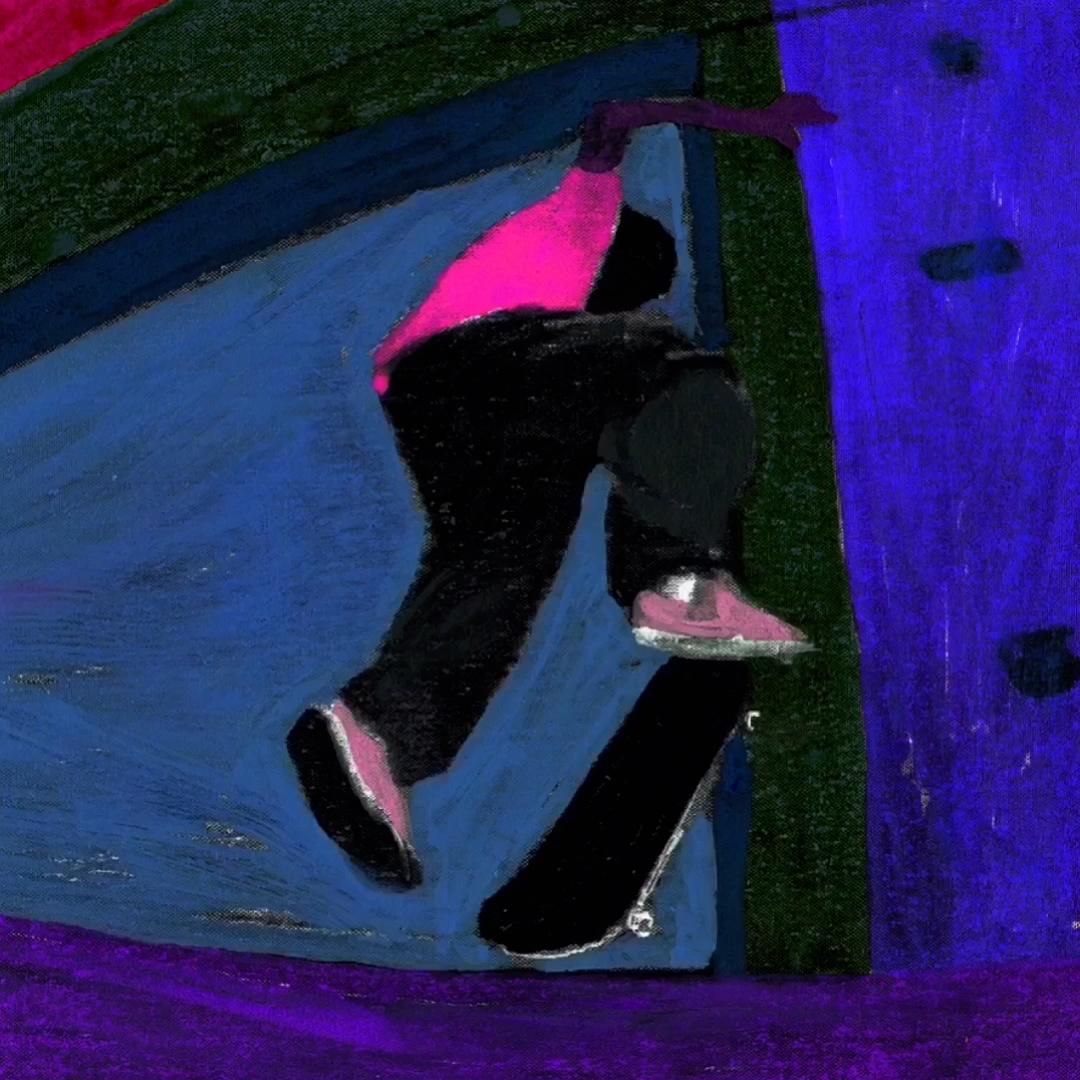
Becky Beal and Lisa Weidman, pioneers of skateboarding research, suggest that visual representations of skating at the turn of the 21st century overwhelmingly catered to a masculine ideal centred on toughness and risk-taking.2 Tengu uses this imagery, looping us into his subcultural spectacle of trick execution. Read’s deliberate retro aesthetic and the editing choices of the satisfying, smooth landings, feed into the nostalgic reproduction of an idealised—and perhaps, mythologised—’90s skate scene. In his animated short Together (2024), Leon Washere brings a soft touch to the legacy of insider skate videos. The cityscape of concrete and steel melts into vibrant colour blocks, while the camera choreography follows the VX1000 template, zooming in on skaters’ trick achievements in their boyish, oversized silhouettes. In an interview, the artist explains that his creative process starts with a specific trick or skater in mind and then moves on to illustration and colouring.3 Though working in different visual mediums, Tengu and Together both belong to a contemporary continuation of the early-2000s insider DIY skate-video movement, aspiring to recreate the brisk “flow” chased by a generation of skaters who grew up in the analogue era.

Read more

Together

Leon Washere, USA, 2024, 6’

Together is a silent compilation of short, animated clips by Leon Washere. His process consists of rotoscoping live-action skate footage: each frame is printed, hand-painted, and rescanned.

Read more
Skateboard Sense (Sid Davis, 1979)

Millennial artists’ nostalgia has contributed to the canonisation of the ’90s skate video aesthetic, and Brown Bag (2020) is an extraordinarily authentic example, based on a Super 8 film artist Ari Marcopoulos uncovered in a long-forgotten brown bag in his studio. Teen groups in baggy clothes roam the streets and corners of mid-90s New York. Skaters’ seconds of suspension in the air stretch into two decades of dust and sediment. Miles Davis’s electric, jazzy track “Tatu (Part 1)” jams alongside the drifting figures, improvising around the thick, steady beats, a sonic reminder that every skate trick returns to the ground. Marcopoulos’s discovery archives a time when the noise and frenzy of the new century’s neoliberal market economy had not yet entirely inundated the city.

Read more

Brown Bag

Ari Marcopoulos, USA, 2020, 7’

In Brown Bag, Ari Marcopoulos and a gang of East Coast skaters take to the streets of Manhattan. The Dutch-American photographer shot his 8mm footage back in 1993, but only rediscovered the grainy time capsule during the COVID pandemic, wrapped in a brown paper bag.

Read more

Despite its celebration of individual progression, skateboarding culture remains deeply communal and convivial. Its emphasis on a non-competitive ethos means that one skates with, but not against, each other. Jonah Hill’s fiction feature Mid90s (2018) and Bing Liu’s documentary Minding the Gap (2018) are among the many titles in which skateboarding mediates stories of friendship and belonging. In All We Ever Wanted Was Everything (2014), Enzo Smits takes us to the periphery of the skate scene, introducing us to the “outsiders.” Signature adrenaline-fueled shots defining skate video production dissolve into the ambient natural soundscape and a coming-of-age melancholy. We are caught in the hypnotic in-between of becoming, where skateboarding is both a gateway to an identity yet-to-be and a reminder of the boredom here-and-now. Static frames of teen boys gazing out in a black Thrasher sweatshirt, browsing the in-game merch shop, trying on sneakers in real life, and walking together with their boards in hand all point to the B-side of skater authenticity: the desire to belong and to be seen.

Read more

All We Ever Wanted Was Everything

Enzo Smits, Belgium, 2014, 19’

A portrait of young skateboarders growing up in a Flemish suburban town. We meet different characters as they go about their daily routines: riding their skateboards, hanging out, daydreaming.

Read more

The archetype of the alienated, subcultural youth in skateboarding representations, however, fractures when we look at some of the activity’s early footage. Canadian director Claude Jutra’s The Devil’s Toy (1969) is among the very first films about skateboarding. The narrator sarcastically calls the new craze in Montreal “an epidemic from which no one was secure.” Dedicated to “all victims of intolerance,” The Devil’s Toy cuts into the board’s material anatomy and kinetic principles, concluding that its variations of maneuvering are infinite. Boys and girls on boards—the “pilots of the missile”—are exhilarated by the free-wheeling downhill glide. Eventually, the public authorities take alarm at the kids’ “mindless” takeover of the roadways and direct them to enclosed ice-rinks—a measure that aspires to prevent youth on wheels from sabotaging the coveted orderliness and serenity of middle-class urban neighbourhoods but does not prevent the skaters from having fun.

Read more

The Devil’s Toy

Claude Jutra, Canada, 1966, 15’

In The Devil’s Toy, youngsters reclaim the streets. Skateboarding, a then-new pastime viewed with suspicion by the police and adults, gave young people a thrilling sense of speed and freedom.

Read more

Despite its celebration of individual progression, skateboarding culture remains deeply communal and convivial. Its emphasis on a non-competitive ethos means that one skates with, but not against, each other.

Tianyu Jiang
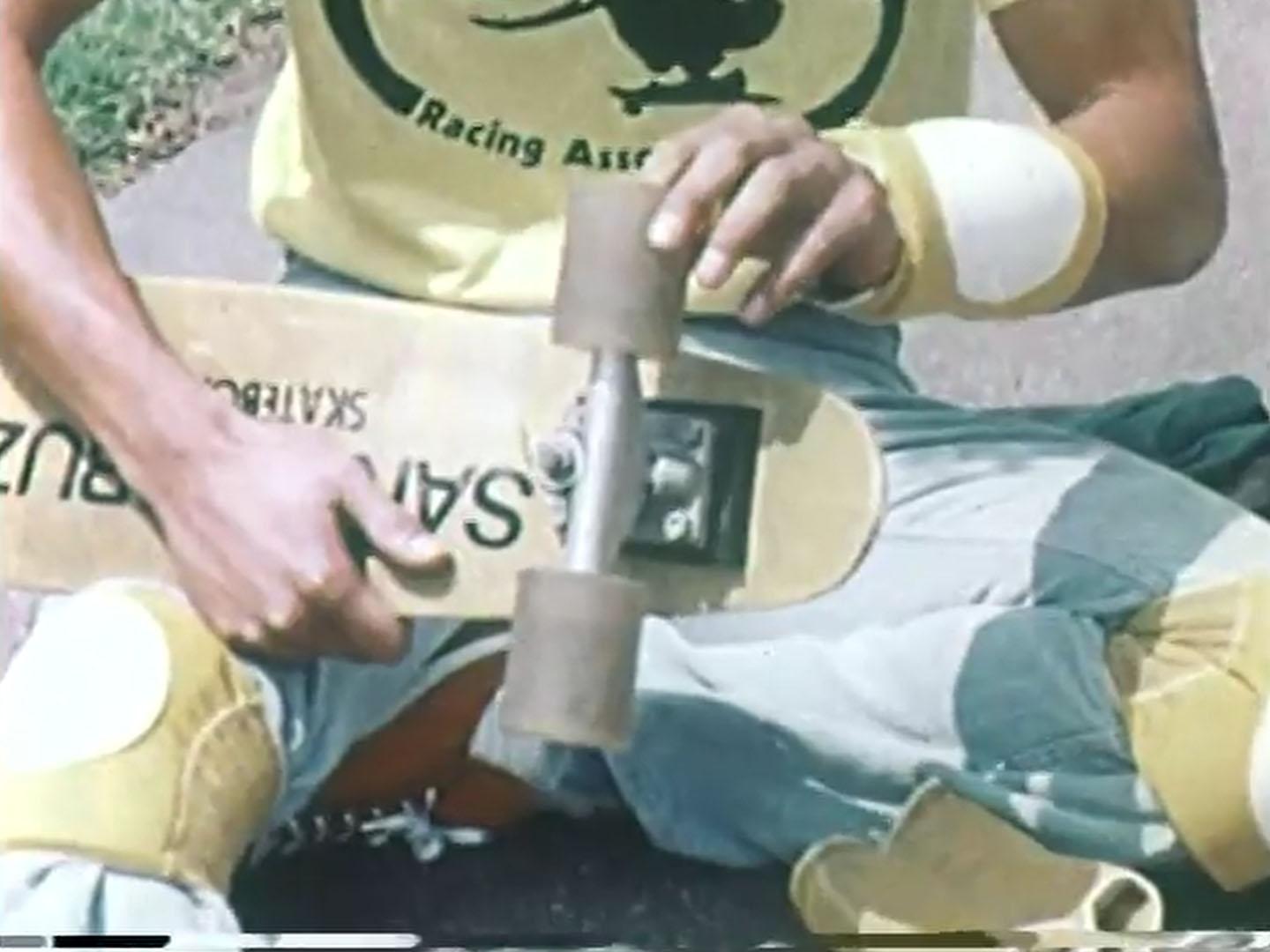
Skateboarders’ unease with a predetermined and regulated lifestyle extends to a deliberate disregard for protective measures. In the late 1970s, skateboarding turned into a multi-billion-dollar global industry. At the same time, in the US, media reports of a growing number of skate-related accidents and injuries, along with liability concerns from the mostly privately funded skateparks, created a market demand for protective gear. Sid Davis’s Skateboard Sense (1979) offers a glimpse of the effort at the time to raise safety awareness among skater youth. Presenter Tom Padaca, a known professional surfer and skateboarder, recommends wearing complete safety gear and skating in designated, confined areas, rendering an activity driven by unruliness and spontaneity into an institutionalised sport, a development that steered rebellious helmetless youngsters in the direction of counterculture companions. The irony of Skateboard Sense peaks, in hindsight, when Padaca lectures, “you can’t have any fun skateboarding across the streets, there’s just too much on the way.”

Read more

Skateboard Sense

Sidney Davis, USA, 1975, 9’

In this safety video, Sidney Davis warns of the ‘dangers’ of skateboarding in a light-hearted manner. The film offers a basic guide for the novice skater: regularly check the bolts on your wheels and find a spot with few people around.

Read more

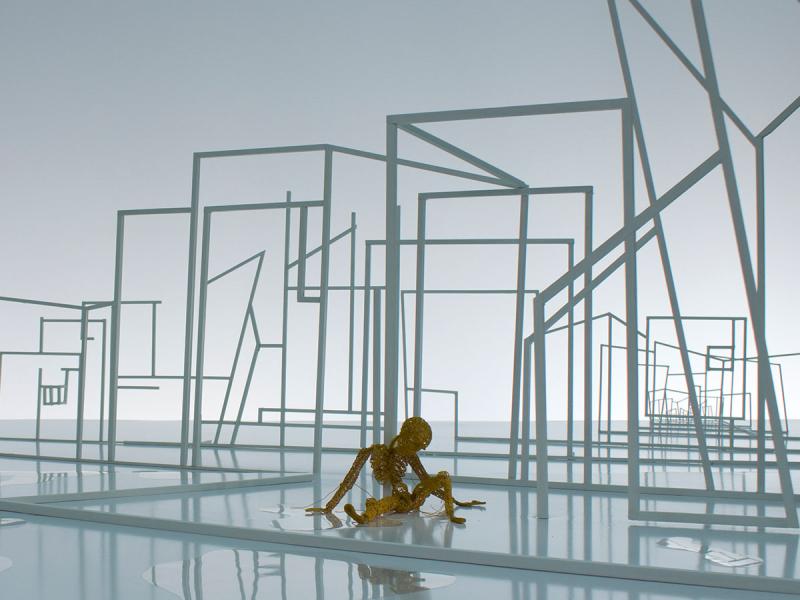
Because “too much on the way” is often precisely what helps skaters gain their momentum. Rotterdam-based designer and researcher Pedro Gil Farias’s machinima In Search of Productive Friction (2025) reimagines this entanglement between the rowdy urban environment and the skater’s body, using a modded Pyramid Ledges map in Skater XL. Speaking from the perspective of the personified architectural complex, Farias defends the intrusive skater, who disrupts mundane routines and sparks new spaces and new actions. Instead of maintaining what critic René Boer calls the “smooth city”, skateboarding’s playful intervention momentarily disrupts the space’s absorption into the gentrified urban grid.

Read more

In Search of Productive Friction

Harshit Vishwakarma, Hugo Pilate, Pedro Gil Farias, Portugal, 2024, 5’

This machinima explores the perspective of a self-conscious replica of a plaza inside the video game Skater XL. The plaza reflects on its original, its own condition, and its relationship to a peculiar visitor: a white silhouette of a skater.

Read more

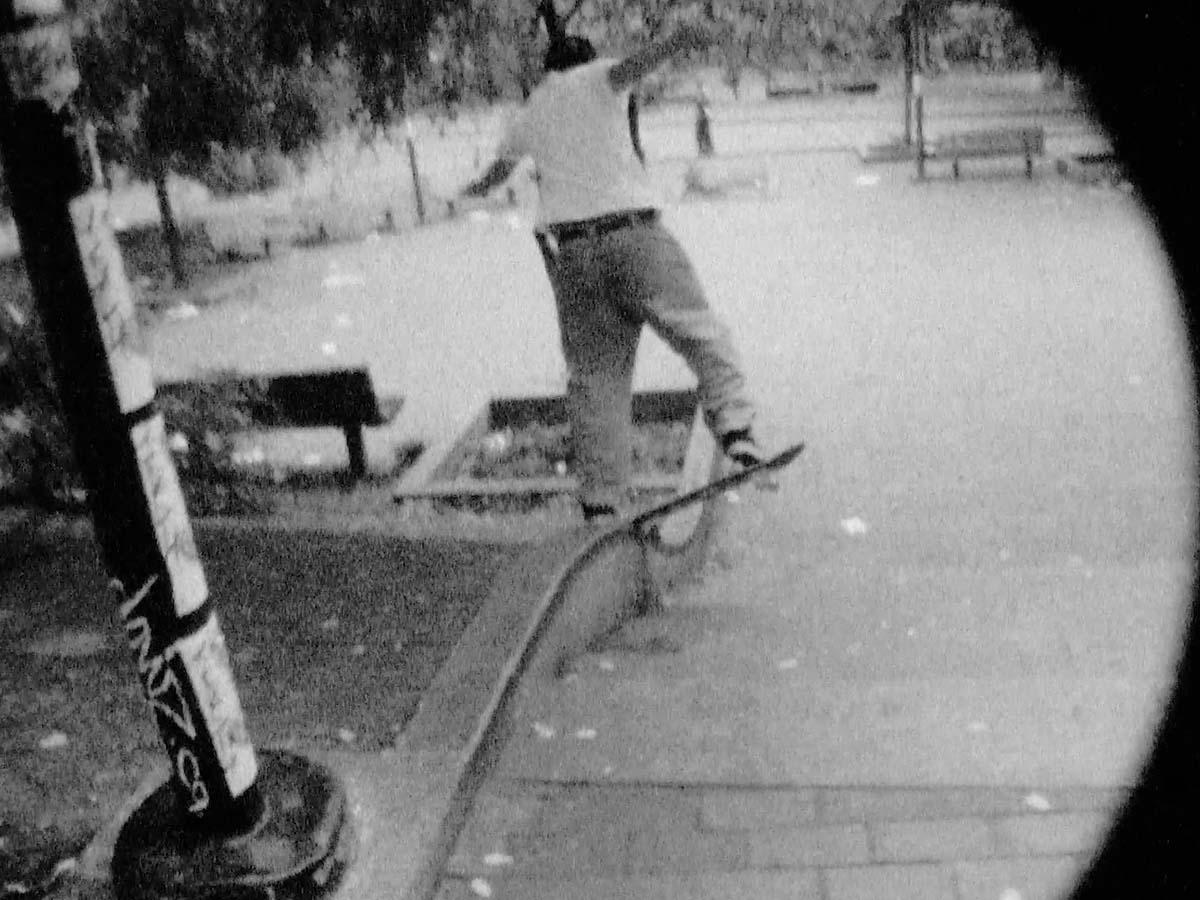
To be locked in, to make sense of surroundings, to see the surface anew and to make it skatable: this embodied attentiveness to space seems to be an intrinsic quality skaters pursue. In its minimal production, Belgian designer Abel Kleinblatt’s Sidewalks (2022) is a footnote to that alternative spatial thinking, which pushes the boundaries of skateboarding culture. Sidewalks gives credit to skaters’ reinterpretation of public spaces, referencing Mark Gonzales’s performance “skate ballet” (1988) in Germany and pairing it with Kleinblatt’s own attempt to ride a board inside Antwerp’s contemporary art museum. Interestingly, Gonzales himself has reflected on how the search for something new can lead you back to familiar habits. This raises a question that Sidewalks leaves largely unexplored: if skateboarding is about breaking conventions, how should we address the comfort zone within skate culture itself?

Read more

Sidewalks

Abel Kleinblatt, Belgium, 2022, 13’

In this desktop essay, Belgian skater-photographer Abel Kleinblatt examines how sidewalks are designed to guide pedestrian movement and how skateboarders recontextualise that urban architecture, giving curbs and pavements an alternative purpose.

Read more
Together (Leon Washere, 2024)

Skateboarding, after all, is a narrative device. The authenticity historically and still associated with it rests on one narrow interpretation of masculinity, persisting among small-town boys, urban teens, and entrepreneurial male veterans. In a space where an “authentic insider” is imagined and re-enacted predominantly as male, nonconformity lies in disidentifying with the scene’s masculine-coded norms. The unapologetic, rat-holding female skaters in Danny Plotnick’s Skate Witches (1986), for instance, voice a punk manifesto against gatekeeping within the male-dominated scene.4 Considering the emergence of women and queer representation in the renaissance of skateboarding-themed popular visual productions, as seen in Crystal Moselle’s feature film Skate Kitchen (2018) and the HBO spin-off series Betty (2020-2021), alongside the dissemination of archival print and audiovisual materials unearthed by feminist DIY initiatives such as the Womxn Skate History project, there is good reason to hope for the long-overdue dismantling and queering of skateboarding’s performative masculinity.

Read more about

#552 Brown Bag
#553 In Search of Productive Friction
#82 All We Ever Wanted Was Everything
#556 Tengu: God of Mischief
#554 Sidewalks
#558 Together
#557 The Devil’s Toy
#555 Skateboard Sense
  • 1

    Nike, “What If?” advertising campaign series, created by Goodby Silverstein & Partners (San Francisco, 1997/1998).

  • 2

    Becky Beal and Lisa Weidman, “Authenticity in the skateboarding world,” in To the Extreme: Alternative Sports Inside and Out (2003): 337-352.

  • 3

    Ayla Angelos, “Painting each frame by hand, Leon Washere talks us through his rotoscoping animation process,” It’s Nice That, July 17, 2020.

  • 4

    For the film’s backstory and its impact, see Natalie Porter, “The Skate Witches,” Womxn Sakte History, April 10, 2022.

This text was published to accompany the release of Trick Shots, yanco’s skate-film collection presented in collaboration with Brussels skate-hub and community Skatelab. This essay is also available in print as part of our limited-edition skate zine Trick Shots, in collaboration with the Brussels skate-zine collective Sluggish.

Skatelab
Sluggish

read more

Kaalkapje (Marthe Peters, 2024)
artikel
Read more

Tedere pijn

Marthe Peters’ Kaalkapje (2024)

Michiel Philippaerts
29.03.2024

Al wat de pas afgestudeerde filmstudent Marthe Peters nodig heeft om te reflecteren op de spanningen en tegenstrijdigheden tussen het verleden en het heden, zijn verloren video-opnames uit haar jeugd. Aangevuld met nieuwe, poëtische beelden (handen die tekenen, een kat aaien, of met kaarsenvet spelen) en een doordachte voice-over, verkent Peters de littekens van een vergeten tijd uit haar leven.

Read more
© TOWARDS THE SUN, FAR FROM THE CENTER (Luciana Merino & Pascal Viveros, 2024)
Towards the Sun, Far from the Center (Luciana Merino & Pascal Viveros, 2024)
essay
Read more

If You Look At It Long Enough...

On Towards the Sun, Far From the Center

Călin Boto
23.04.2025

Much has changed in the last decades, but the concepts of clarity and detail still dominantly inform our appreciation of experiences and knowledge, including art. So an unclear film such as Chilean filmmakers Luciana Merino and Pascal Viveros’ Towards the Sun, Far from the Center, engages with contemporaneity in ways unsuspected at first glance. And when I say that it’s an unclear film, I mean this in the most obvious way: its image, consisting of slow pans of Santiago taken from a bird’s eye view (at a pace different from that of a drone—maybe from a crane?) is zoomed-in so much that it seems bidimensional; not abstract, but plastic, toyish, slightly unreal.

Read more
Speech for a Melting Statue (Collectif Faire-part, 2023)
article
Read more

Beyond Leopold II’s Empty Pedestal

Collectif Faire-part’s Speech for a Melting Statue (2023)

Nadia Nsayi Madjedjo
14.09.2026

Speech for a Melting Statue by Collectif Faire-part examines a social issue that has long been a concern in Belgium—in part due to activist campaigns—but only truly made its way onto the political agenda around the time of the Black Lives Matter movement: how should we best deal with colonial monuments in public spaces?

Read more
Carnations (Martijn Van de Wiele, 2021)
essay
Read more

The Returning Flower

Martijn Van de Wiele’s Carnations

Boet Meijers
16.11.2024

There is a certain solemnity in this portrayal of nature: as a camera operator, Van de Wiele gets down on his knees in some of the images, filming the plants from below and letting their crowns stand out against a bright blue sky to which they stretch their fingers, as if—if left unpruned—they would continue to grow into eternity, closer and closer to their nourishing sun. A favour is done to the carnations here; framed individually, they are momentarily freed from mass production, a space in which a flower becomes the flower.

Read more
© Meltse Van Coillie
Portretfoto © Meltse Van Coillie
interview
Read more

“Film moet een kunst blijven, geen consumptiemiddel”

Meltse Van Coillie over elephantfish

Michiel Philippaerts
12.05.2019

Meltse Van Coillie over het moedige maakproces van haar docufictie elephantfish, bekroond met een VAF Wildcard.

Read more
© Perpetual Night (Pedro Peralta, 2020)
artikel
Read more

Choreografie met lens en licht

Pedro Peralta’s Perpetual Night

Inge Coolsaet
04.02.2021

De technische uitdaging die de jonge Portugese filmmaker aangaat in zijn kortfilm Perpetual Night getuigt van onverbiddelijke bekwaamheid.

Read more
Paradise (Laura Vandewynckel, 2014)
essay
Read more

Impassable Gates

Laura Vandewynckel’s Paradise (2014)

Najrin Islam
13.06.2026

In five minutes, Paradise scans what determines movement for racially distinct peoples. Borders seek to contain, and any transgressions are preemptively curbed through restrictive legislation or bureaucratic rigmarole. As architect and researcher Shahram Khosravi and Mahmoud Keshavarz point out in their article, “The Magic of Borders”, border fortifications—materialised through visa protocols, military operations, or propaganda media—facilitate mobility for the white traveller as much as they restrict it for racialised refugees.

Read more
© MISTY PICTURE (Christoph Girardet & Matthias Müller, 2021)
Misty Picture (Christoph Girardet & Matthias Müller, 2021)
essay
Read more

Cinematic Ghosts

On Christoph Girardet and Matthias Müller’s Misty Picture

Oana Ghera
09.12.2024

Through association, repetition, and accumulation, Christoph Girardet and Matthias Müller showcase the inventory of Hollywood formal clichés that contributed to the creation of the Twin Towers’ symbolic capital, reflecting at the same time on the power of those images to haunt our collective imagination to this day.

Read more

Subscribe to our monthly newsletter for updates on new releases, publications, and events!

Subscribe

yanco is a magazine and streaming library for short-form moving image

kortfilm.be vzw
Boondaalse Steenweg 249
1050 Elsene
BE 0478 441 315
info@yanco.be

with the support of the Flanders Audiovisual Fund (VAF) of the Flemish Government

VAF
  • about
  • colophon
  • privacy policy
Facebook Instagram LinkedIn YouTube Letterboxd
design by de Ronners
website by eps en kaas