
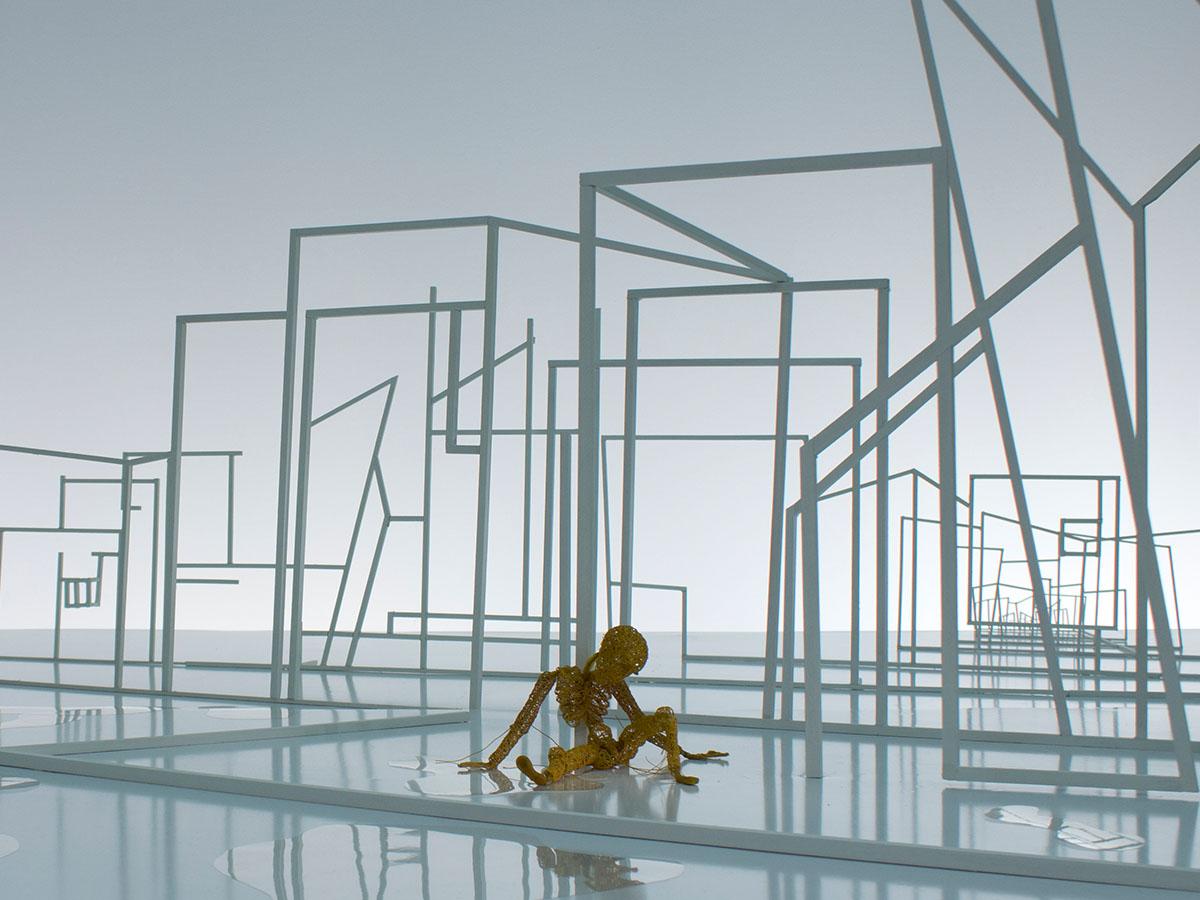
Within the first few seconds of the animated short Paradise, we see a white man walking through a sterile landscape reminiscent of an airport, pulling out a key to unlock a door through which he walks towards his private jet—except this door is invisible to us. In fact, there are no doors in this space, just a labyrinthine grid of white columns through which to pass. The invisibility of this threshold (and his unique access to it) speaks to the man’s privilege as a traveller from the Global North. The jet passes over a sea and reaches a patently more colourful land, where men contest each other to serve him and women dance for him to exotic music as he feasts on local food. The people in this “paradise” realise the white man’s fantasy of their land—with cultural entertainment and eager hospitality against sunset backdrops.
Impassable Gates
Laura Vandewynckel’s Paradise (2014)
The acknowledgement of the “refugee crisis” as such has also made us immune to images of shipwrecks and deaths in the water and on the shores, which get categorised as a natural offshoot of illegal movement across borders.
This “crisis” also paints migration—a natural community impulse for survival, especially along shorelines—as a crime. It masks the violence perpetuated by border control infrastructures, whose coordinates of mobility and immobility are rooted in colonial logics of organising. In this film, these infrastructures bleed into each other—we notice that the sea carries debris from the white columns in the airport, and puddles of seawater are visible across the airport floor—both attesting to the porosity of maritime frontiers.
Laura Vandewynckel’s Paradise distills white desire for possession and entitlement into a clear picture of the wrongs they produce—contained in the neat dimensions of puppetry. The white body (coming from a world largely built on colonial loot) only wants the pleasures of the Global South without having to touch the bodies that inhabit it. But the migrant body from this part of the world resists it by getting on the boat to seize the life that is denied to them. Their movement towards a better life, towards their version of a “paradise”, is a protracted quest that is succinctly captured by our belated realisation that the coloured man crouched in the airport at the end of the film was present at the start as well—visible only as a reflection in a puddle of the water that had abandoned him in his Eden.


