yanco Home
Menu
  • Home
  • watch
  • magazine
  • calendar
  • index
  • Subscribe
Search Log in
  • nl
  • en
You are here
  • Home
  • Magazine
  • Unbridged Distances
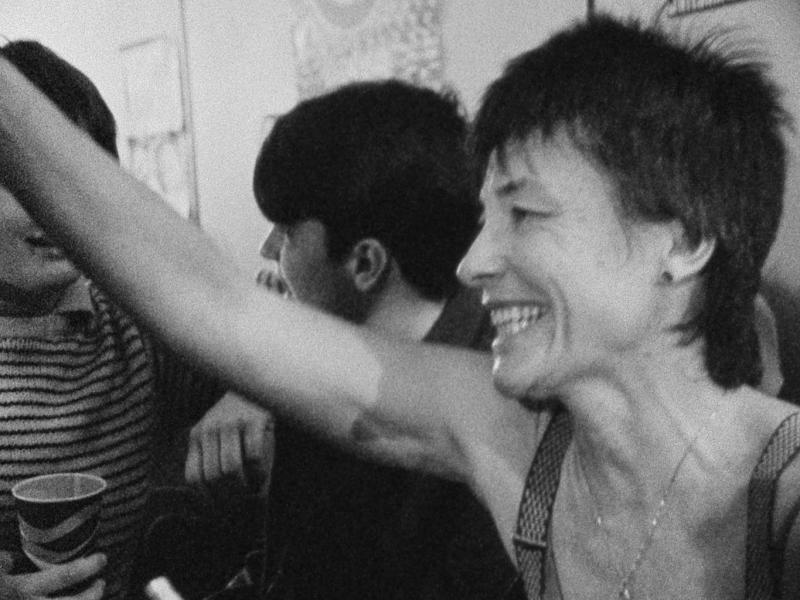
Conversation Nord-Sud : Daney/Sanbar (Simone Bitton & Catherine Poitevin, 1991)

Unbridged Distances

“une place vide dans un paysage”

essay by
Öykü Sofuoğlu
20/20 Vision
19.10.2026

By their very nature, archival images do not lend themselves to easy interpretation; they are at once too conspicuous and too ambiguous to be read straightforwardly. Temporal distance is the most obvious obstacle to interpreting archival images, whose ambiguities demand both intellectual and perceptual labour to unravel. Although they have been absorbed into the digital sphere, where they circulate mostly as facsimiles and are counterfeited by artificial intelligence, they continue to persist and resist. They unsettle viewers in a productive way, forcing them to actively question their ways of seeing and of relating to others.

Curated by Inge Coolsaet for argos, the programme “une place vide dans un paysage” presents archival imagery as a gateway between collective memory and personal experiences. In both films, conversation acts as a mnemonic catalyst. Despite their mutual resonance, both works are laden with absences, gaps and unresolved tensions, particularly in the context of countries whose national histories are scarred by colonial oppression, forced displacement and exile.

Initially conceived as a three-channel video installation, Amina Menia’s National Liberation Football (2022) examines the politico-symbolic role football played in the Algerian struggle for independence from France. While the politicisation of football as a form of soft power in our neoliberal, capitalist world might be a phenomenon to frown upon, the buoyant warmth conveyed by the filmmaker’s voice—as she tells her daughter about the happiness she felt when Algeria won a qualifying match against Egypt in 2009—attests to a deeper, visceral attachment that extends beyond contemporary geopolitics. As one of many manifestations of the postcolonial condition, this patriotic surge of emotion, which she shared with hundreds of thousands of Algerians, leads Menia to explore its historical roots.

The triptych creates a visual balance between the film’s interview and archival components, often displaying footage across two of its three screens simultaneously. Its emotional weight is concentrated on the right side of the screen, where Menia’s conversation with Rachid Mekhloufi unfolds. An important figure in the history of A.S. Saint-Étienne until the late 1960s, Mekhloufi is best known for being one of the ten footballers who clandestinely left their French clubs to form the National Liberation Front’s football team in an effort to support the Algerian cause. This conversation alternates with Slimane Zeghidour’s commentary, more detached and analytical, and providing broader context on how football and its signifiers helped consolidate Algerian national identity despite the ethnic, religious, and cultural divisions that characterise its society.

In her exchanges with Mekhloufi, Menia’s questions guide the conversation, tracing—in broad brushstrokes and more or less chronologically—the years from Mekhloufi and his teammates’ audacious venture into the FLN team to his post-independence career as a coach. At first glance, the archival material in the central section might seem merely illustrative. Its heterogeneity, however, resists the tendency of official narratives to impose a false sense of historical uniformity. Photographs, posters, film reels, newspaper excerpts, and TV footage aptly demonstrate the inadequacy of official history as a discursive tool, since the post-colonial subject, whose existence is rooted in the in-betweenness of languages, cultures, and countries, requires a multitude of polyphonic and transgenerational histories to express itself.
How can Palestinians afford to disregard any visual medium when, even to this day, they are compelled to document their existence, prove their presence, and counter their own erasure? When Daney expresses his doubts about cinema no longer keeping its moral promise vis-à-vis history, his words are nonetheless charged with an anxious regret for the future. Fearing cinema’s displacement from historical memory is not comparable to being dispossessed of one’s homeland and forced into exile. Yet, this does not mean these two realities cannot coexist and unfold simultaneously.

Öykü Sofuoğlu

One of the most striking aspects of National Liberation Football is that it treats the cinematic image, if not with indifference, as no more privileged than any other medium it incorporates. The formal approach adopted in the central section noticeably hinges on multimedia compilation and, as such, hints at a homogenisation of different forms of images within the film. In a way, Menia’s treatment of the cinematic image counters the predominantly Western assessment of cinema as the primary witness of the 20th century. The film implicitly illustrates how selective and biased cinema can be.

The second film in the programme, Conversation Nord-Sud : Daney/Sanbar (1993), more explicitly explores whether images are capable of preserving memory and bearing witness to personal and collective histories. Unlike Menia’s film, where images and words unfold on equal footing, following a mutual rhythm and trajectory, filmmakers Simone Bitton and Catherine Poitevin configure a setting in which conversations emanate from images.

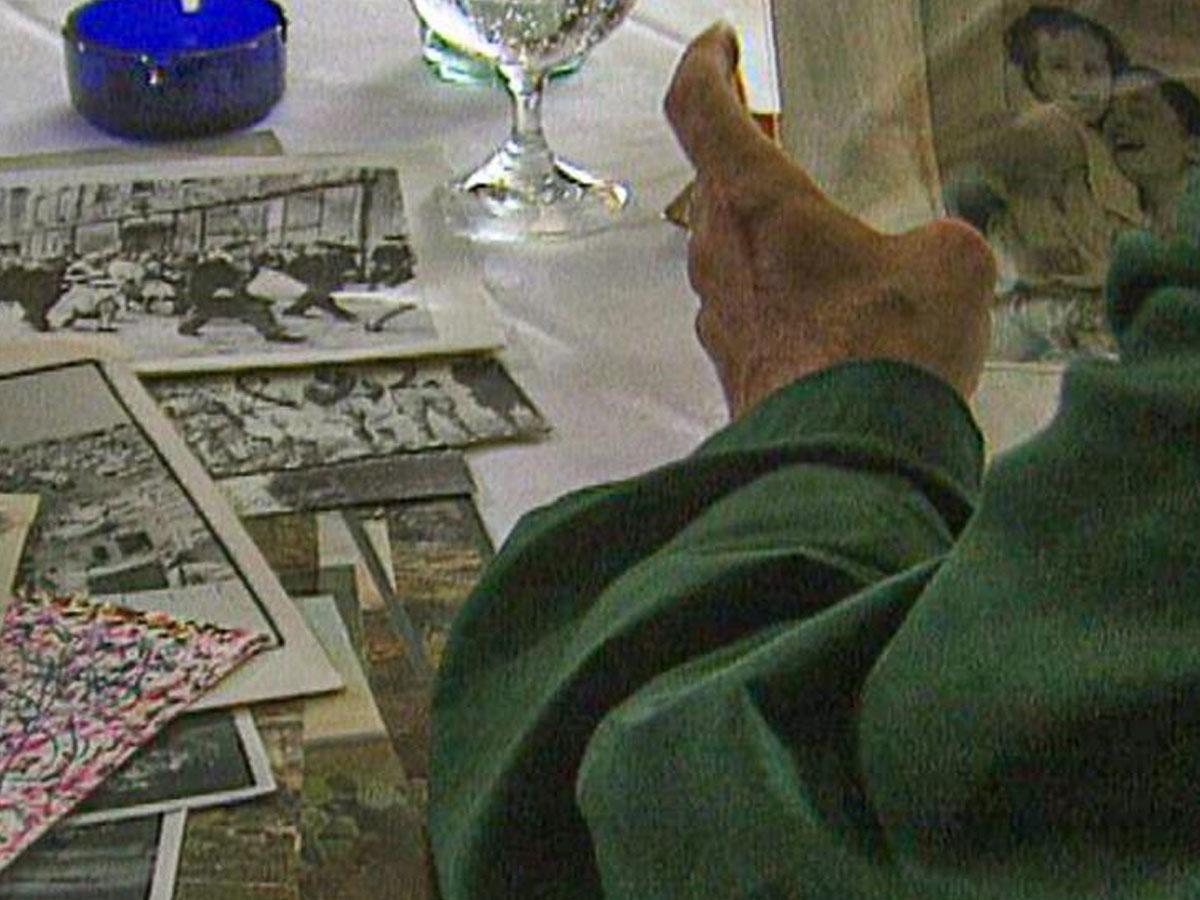
The premise is simple: Palestinian historian, writer, and poet Elias Sanbar and French film critic and theorist Serge Daney spend an afternoon together at a Parisian bistro near Bastille, conversing through images that have shaped them into who they are. From the outset, the binary dynamics suggested by the film’s title prove to be less balanced in light of Sanbar’s reflections on the Nakba. By making his people’s dispossession the starting point, Sanbar suggests that their respective historical experiences may resist easy communication between them. Daney is intelligent and considerate enough not to attempt to even out the differences between his own experiences and those of his interlocutor, letting brief but solemn silences speak for themselves. If, according to Sanbar, death is embodied through the empty spaces in a landscape, silences that rhythm their discussion emerge as its aural counterpart.

Despite the gravity of the matters they discuss—the Nakba, but also the German occupation of France and May ’68—their exchanges convey a sense of playfulness, reminiscent of a dance or a chess game. Each move seems to bring the photographs they show into a proto-cinematic montage. Daney is arguably a cinematic thinker who not only thinks about cinema but thinks through it. He mentions a childhood-rooted sense of discomfort with photography. His ability to disregard photographs—as they are not rare artefacts to which he must cling in order to reconstruct his personal history—further underscores the distance between the two interlocutors. So does his belief in cinema’s predominance as a historical witness in the European context.

How can Palestinians afford to disregard any visual medium when, even to this day, they are compelled to document their existence, prove their presence, and counter their own erasure? When Daney expresses his doubts about cinema no longer keeping its moral promise vis-à-vis history, his words are nonetheless charged with an anxious regret for the future. Fearing cinema’s displacement from historical memory is not comparable to being dispossessed of one’s homeland and forced into exile. Yet, this does not mean these two realities cannot coexist and unfold simultaneously. The year is 1991. The Gulf War has just ended, yet, in retrospect, we know that other forms of displacement were still to come: images would be exiled to digital screens, while Palestinians would increasingly be reduced to images of perpetual victimhood, even as they faced the reality of genocide.

Read more about

#542 Conversation nord-sud, Daney / Sanbar
#543 Foot de Libération Nationale

    “une place vide dans un paysage” is part of 20/20 Vision, a monthly micro-cinema night in argos’s Black Box, a shifting line-up of video works, from shorts to features, from their archive and beyond. With only 20 chairs for 20 spectators, the audience gathers for a screening programme shaped around a topic or a filmmaker. yanco and argos collaboratively publish a monthly essay on each programme.

    In “une place vide dans un paysage”, complex geopolitical conflicts transit through history by way of personal recollections and archival images, which seem to shore each other up against the recurrence of political oppressions, the weight of history, and the erasure of collective narratives. Both films become and remain relevant, especially against the backdrop of the recent harassment of the Iranian football team by the US government, host of the 2026 World Cup, and the sustained violence against the Palestinian people.

    Bio Öykü Sofuoğlu

    Öykü Sofuoğlu is a Turkish film critic and journalist based in Paris. Her film-related writings have been published in various outlets, including International Documentary Magazine, Screen Slate, and Letterboxd Journal. She is also one of the co-editors of Outskirts Film Magazine. 

    read more

    Paradise (Laura Vandewynckel, 2014)
    Paradise (Laura Vandewynckel, 2014)
    essay
    Read more

    Impassable Gates

    Laura Vandewynckel’s Paradise (2014)

    Najrin Islam
    13.06.2026

    In five minutes, Paradise scans what determines movement for racially distinct peoples. Borders seek to contain, and any transgressions are preemptively curbed through restrictive legislation or bureaucratic rigmarole. As architect and researcher Shahram Khosravi and Mahmoud Keshavarz point out in their article, “The Magic of Borders”, border fortifications—materialised through visa protocols, military operations, or propaganda media—facilitate mobility for the white traveller as much as they restrict it for racialised refugees.

    Read more
    Red Giant (Anne Verbeure, 2021)
    Red Giant (Anne Verbeure, 2021)
    essay
    Read more

    The Lonely Observer

    Anne Verbeure’s Red Giant (2021)

    Dora Leu
    20.08.2023

    To be a giant comes with the burdensome nature of giant-ness. Most things look infinitely smaller than you. You move awkwardly, lankily, to not inadvertently step on anything you might not see. Thus, this Red Giant proceeds with unsure gestures, sluggishly, as if both depressed and aware of the potential inconveniences his size may cause. Yet, contrary to his stature, a sense of fragility surrounds the giant. Perhaps his nakedness makes him look like a tall, helpless baby. The film’s visual style further underscores this, with the pinkish hues of paint that collect around his small eyes and nose, denoting a form of innocence.

    Read more
    Audience (Barbara Hammer, 1982)
    Audience (Barbara Hammer, 1982)
    essay
    Read more

    Dead, I Won’t Be Forgotten

    Barbara Hammer’s Legacy

    Carmel Curtis
    05.10.2026

    The five works in Film Fest Gent’s Barbara Hammer: A Short Film Retrospective, presented in collaboration with yanco and Art Cinema OFFoff, span thirty-five years and together they demonstrate a pattern in Barbara’s work: no disguise. What she felt in her own body and what she showed on screen were often the same sensation, not translated but transmitted. In that transparency, her personal vulnerability can expand outward into something universal that extends beyond the individual body and beyond the screen.

    Read more
    © I’m Hungry, I’m Cold (Chantal Akerman, 1980)
    I’m Hungry, I’m Cold (Chantal Akerman, 1980)
    article
    Read more

    Life Begins Right Here, Right Now

    Chantal Akerman’s I’m Hungry, I’m Cold (1984)

    Michaël Van Remoortere
    17.03.2025

    Henri Bergson believed that the phenomenon called humour arises when the material world falls short of our spiritual aspirations. Had he lived long enough to savour Chantal Akerman’s work, he could have found proof for his thesis. Not only was Akerman a gifted metteuse en scene of Chaplinesque slapstick, but how she depicted romantic love was also a source of uncontrollable chuckling, thanks to this gap between wishful dreaming and all-too-human reality.

    Read more
    Trains de plaisir (Henri Storck, 1930)
    Trains de plaisir (Henri Storck, 1930)
    essay
    Read more

    Harmony by the Sea

    Henri Storck’s Trains de plaisir (1930)

    Bjorn Gabriels
    30.10.2022

    Earlier in 1930, Storck was entitled ‘official filmmaker of the city of Ostend’. Allowing him to—next to his sales and administrative work in his late father’s shoe shop—take to town and record gentlemen in bespoke suits, seated in beach chairs with legs extended off the ground in an attempt to keep their precious shoes from touching the water, as seen in Trains de plaisir. The twentysomething had been tasked with capturing day-to-day life in Ostend, to be screened in theater. He himself, however, negotiated room for personal work and experiment.

    Read more
    © As If Mother Cried That Night (Hoda Taheri, 2023)
    As If Mother Cried That Night (Hoda Taheri, 2023)
    interview
    Read more

    Love Under Surveillance

    A Conversation with filmmaker Hoda Taheri

    Jori(k) A. Galama
    12.02.2025

    Over the past few years, Hoda Taheri (Tehran, 1992) has toured many a film festival with her short films Mother Prays All Day Long (2022), As If Mother Cried That Night (2023), and Mother is a Natural Sinner (2024), the first of which you can watch via yanco’s streaming library. In this “mother trilogy”, Taheri zooms in on relevant issues such as the right to abortion and the treatment of refugees in Europe. She takes on the lead role herself, cunningly and humorously dramatising her own biography.

    Read more
    D’un château l’autre (Emmanuel Marre, 2018)
    D’un château l’autre (Emmanuel Marre, 2018)
    essay
    Read more

    Van links naar rechts

    Emmanuel Marre’s D’un château l’autre

    Öykü Sofuoğlu
    03.04.2023

    The year is 2017. As the French presidential elections approach, the spirit of the times marches at full speed into unrest. Pierre Nisse portrays a young adult whose inner conflicts resonate with those of the outside world. Exasperated trying to fit in with the upper-class frivolities of his university, Pierre looks for answers in the dominant political discourses. D’un château l’autre follows his steps and sneaks into the political rallies of Emmanuel Macron and Marine Le Pen to show us the self-evident artificiality of these gatherings à la Trump.

    Read more
    Waithood (Louisiana Mees-Fongang, 2019)
    Waithood (Louisiana Mees-Fongang, 2019)
    essay
    Read more

    In limbo

    Louisiana Mees-Fongang’s Waithood

    Benjamin Antonissen
    02.02.2022

    Athens often is perceived as the ideal holiday destination. It is the birthplace of democracy, overflowing with culture, and has exceptional cuisine and countless picturesque squares to spend time carelessly. This, however, isn’t the image the five twentysomethings in Waithood have of the Greek capital. For them, Athens feels like a prison where they are forced to kill time together. Christos, the only one in the group with a stable job, cleans up luxurious Airbnbs. When the tourists leave, he and his friends take over the apartments. And then the waiting takes over. Christos and his friends are insecure about their future. Waithood refers to the stagnation recent graduates can find themselves in, especially in economically challenged regions.

    Read more

    Subscribe to our monthly newsletter for updates on new releases, publications, and events!

    Subscribe

    yanco is a magazine and streaming library for short-form moving image

    kortfilm.be vzw
    Boondaalse Steenweg 249
    1050 Elsene
    BE 0478 441 315
    info@yanco.be

    with the support of the Flanders Audiovisual Fund (VAF) of the Flemish Government

    VAF
    • about
    • colophon
    • privacy policy
    Facebook Instagram LinkedIn YouTube Letterboxd
    design by de Ronners
    website by eps en kaas