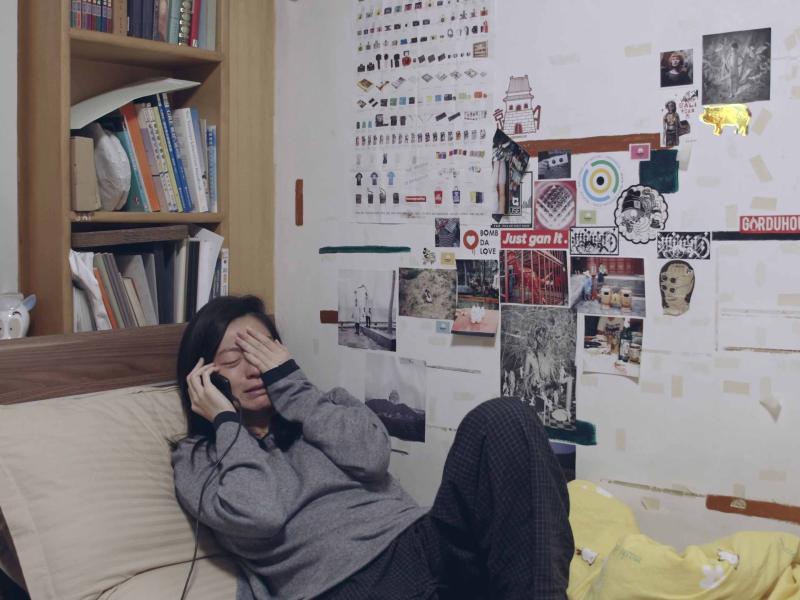
Over the past few years, Hoda Taheri (Tehran, 1992) has toured many a film festival with her short films Mother Prays All Day Long (2022), As If Mother Cried That Night (2023), and Mother is a Natural Sinner (2024), the first of which you can watch via yanco’s streaming library. In this “mother trilogy”, Taheri zooms in on relevant issues such as the right to abortion and the treatment of refugees in Europe. She takes on the lead role herself, cunningly and humorously dramatising her own biography.
The influence of citizenship on relationships is a common thread throughout your work. In As If Mother Cried That Night, for example, we see the struggle of an Iranian couple trying to gain asylum by becoming pregnant from a German man. What brought you to that subject matter?
Around the age of 18, I left Iran for Malaysia, to eventually end up in Berlin. The bureaucracy in Germany surprised me—at first, positively. In Iran, corruption is widespread: if you don’t know or bribe the right people, you won’t get much done. Because of the complex procedures and paperwork in Germany, the rule of law is more substantial. But gradually, my admiration crumbled. I began to see how the government extensively penetrates the private lives of individuals—specifically those without German passports. Who you go to bed with can make a difference in whether you are allowed to stay in Germany or not.
The government has a rule, for example, that if you want to marry to get citizenship, you have to sleep under the same roof at least five nights a week. During interviews with the Federal Bureau of Migration and Flüchtlinge, very intimate questions are asked, such as: “When did your girlfriend last menstruate?” These rules reflect a heteronormative framework in which non-traditional relationships are often ignored or made difficult. It always involves two people, and when two women have a child, the non-biological mother must initiate adoption proceedings. But when a man and a woman are married, any child the woman has—even if conceived by another man—is automatically her husband’s child. Moreover, the non-European partner is made dependent on the European one. This leads to situations where a European partner abuses a non-European partner by threatening to block the path to citizenship.
How do you view the changing climate around migration in Europe?
In many parts of Europe, there is a rising trend of right-wing, anti-immigrant views, with some people calling for stricter policies. These ideas overlook the fact that many countries have aging populations, and immigrants play an important role in their economies. At the same time, I try not to polarise in my work. I mostly morph the cliché image of the migrant in the European imagination, such as the mistaken notion that progressive values only exist in Europe.
In Mother is a Natural Sinner, the dialogue between the Iranian couple, led by the female character, addresses issues of gender and sexuality in a way that feels progressive, even by European standards. She challenges traditional views and pushes for a more open, inclusive perspective. Her views are bold and confrontational, questioning societal norms in radical and necessary ways, not just within the context of Iranian culture but also in broader global discussions.