yanco Home
Menu
  • Home
  • watch
  • magazine
  • calendar
  • index
  • Subscribe
Search Log in
  • nl
  • en
You are here
  • Home
  • Magazine
  • Van links naar rechts
D’un château l’autre (Emmanuel Marre, 2018)

Van links naar rechts

Emmanuel Marre’s D’un château l’autre

essay by
Öykü Sofuoğlu
03.04.2023

In D’un château l’autre, Emmanuel Marre’s Pardino d’Oro winner at the Locarno International Film Festival, there’s an imperceptibly poignant moment where the depiction of a domestic space encapsulates the political, social, and existential dichotomies that run throughout the film. We see Pierre and Francine. The former is an outcast student from SciencesPo, the prestigious French institution for political studies. The latter is Pierre’s aging and wheelchair-bound landlady, whom he assists regularly. At the beginning of the scene, Pierre puts Francine to bed. She asks him to play a Brahms record to help her go to sleep. Cut to Pierre standing at the window, looking outside. The reflection of Francine lying in bed occupies the left side of the frame.

Marre cleverly uses the window to frame his characters in a natural split-screen, creating a filmic space that harbors several binary oppositions. One can even speculate about the political subtext of their positions. But one thing is clear: although Marre’s framing separates Pierre and Francine and serves as a metonymic device to underline their different social realities, they share the same space, not only physically but also emotionally, through their intimate connection that blossoms gradually throughout the film.

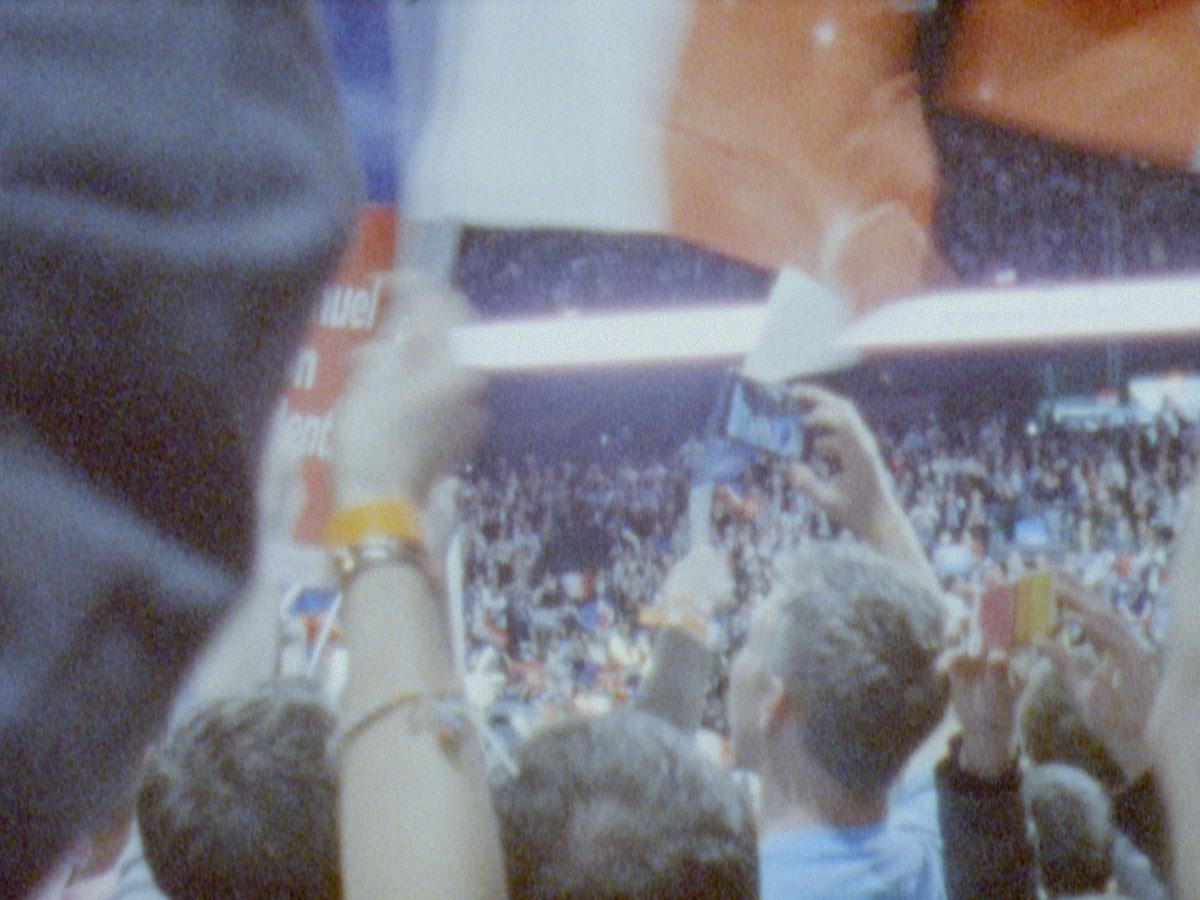
The year is 2017. As the French presidential elections approach, the spirit of the times marches at full speed into unrest. Pierre Nisse portrays a young adult whose inner conflicts resonate with those of the outside world. Exasperated trying to fit in with the upper-class frivolities of his university, Pierre looks for answers in the dominant political discourses. D’un château l’autre follows his steps and sneaks into the political rallies of Emmanuel Macron and Marine Le Pen to show us the self-evident artificiality of these gatherings à la Trump. In Macron’s rally at Bercy, the speakers blast DJ Snake & Lil Jon’s hit Turn Down for What, while the zombie-like audience dances along, wearing its most expressionless faces, adorned with shirts, caps, or banners inscribed with the presidential candidate’s name, the newest LREM (La République en Marche) merch. As the Debordian spectacle builds up to its sensational peak, turn down for what, indeed? The political scene is now a dance floor where David Guetta and La Marseillaise fuel the public’s nationalistic sentiments to the same extent: Aux armes citoyens, we are titanium.

Amidst those deadpan faces that feign cheerfulness, Pierre sticks out like a sore thumb. The very incarnation of an observational eye, he fixes his gaze in a way whose meaning only becomes apparent when he tells Francine about his insecurities. Marre incorporates Pierre’s confusion and restlessness into the filmic image. Alternating between the clean precision of the digital image and the nostalgic blurs and imperfections of Super 8, he externalizes Pierre’s fragile state of mind and volatile political opinions. By contrast, given her age, physical condition, and views on life, Francine resembles an anchor that keeps him from drifting away to the farthest shores of the ideological spectrum. Yet, she’s not a figure of stagnation. During her discussions with Pierre, when the latter shares his hostility towards his social environment, Francine tries to encourage him to take action for positive change, to move forward, and, most importantly, to live for himself. Sadly, things are easier said than done.

Later on, during a heartfelt scene on the rooftop of Centre Pompidou, Francine opens up to Pierre about her relationship with her children and how her happiness depends on their visits. Although it’s unclear whether Francine’s lines were scripted or not, her trembling voice and falling tears suggest otherwise. Knowing that one of her children is behind the camera, filming this intimate confession, adds much to the emotional weight of this moment. Marre frames Pierre and Francine in profile throughout the entire scene, capturing them as they contemplate the darkening Paris sky. However, at one point, he briefly cuts to a close-up of their hands clasped together before returning to their faces once again. Like the one described at the beginning, this is also a fleeting, easy-to-miss moment in the liminal space between the profilmic and diegetic realities, where even the simplest of gestures—a touch, a gaze, or a smile—is imbued with profound meaning and emotion, thus making it impossible to detach them from either realm.

From Left to Right, from adulthood to old age, indifference to friendship, and personal to political, D’un château l’autre is a film that wanders a lot—not in the least aimlessly, but rather in line with the confusion and yearning felt by the characters. There’s no beginning or end to its wanderings, only serendipitous pauses at these fleeting moments. And when these do happen, they are such a joy for us to watch.

watch now

Read more

D’un château l’autre

Emmanuel Marre, Belgium, 2018, 40’

Pierre, 25 years old and on a scholarship for a prestigious Parisian university, is lodged by Francine, who is 75, disabled, and confined to her wheelchair. Both puzzled and disoriented, they witness the French presidential elections of 2017 play out.

Read more

    Bio Öykü Sofuoğlu

    Öykü Sofuoğlu is a Turkish film critic and journalist based in Paris. Her film-related writings have been published in various outlets, including International Documentary Magazine, Screen Slate, and Letterboxd Journal. She is also one of the co-editors of Outskirts Film Magazine. 

    read more

    Waithood (Louisiana Mees-Fongang, 2019)
    Waithood (Louisiana Mees-Fongang, 2019)
    essay
    Read more

    In limbo

    Louisiana Mees-Fongang’s Waithood

    Benjamin Antonissen
    02.02.2022

    Athens often is perceived as the ideal holiday destination. It is the birthplace of democracy, overflowing with culture, and has exceptional cuisine and countless picturesque squares to spend time carelessly. This, however, isn’t the image the five twentysomethings in Waithood have of the Greek capital. For them, Athens feels like a prison where they are forced to kill time together. Christos, the only one in the group with a stable job, cleans up luxurious Airbnbs. When the tourists leave, he and his friends take over the apartments. And then the waiting takes over. Christos and his friends are insecure about their future. Waithood refers to the stagnation recent graduates can find themselves in, especially in economically challenged regions.

    Read more
    © Dimensions of Dialogue (Jan Švankmajer, 1983)
    artikel
    Read more

    Dialoog doorgelicht

    Jan Švankmajers Dimensions of Dialogue

    Michiel Philippaerts
    28.12.2017

    In deze kortfilmklassieker bestudeert Jan Švankmajer de verschillende aspecten van ‘dialoog’ op een ludieke en verrassend pessimistische manier.

    Read more
    Red Giant (Anne Verbeure, 2021)
    Red Giant (Anne Verbeure, 2021)
    essay
    Read more

    The Lonely Observer

    Anne Verbeure’s Red Giant (2021)

    Dora Leu
    20.08.2023

    To be a giant comes with the burdensome nature of giant-ness. Most things look infinitely smaller than you. You move awkwardly, lankily, to not inadvertently step on anything you might not see. Thus, this Red Giant proceeds with unsure gestures, sluggishly, as if both depressed and aware of the potential inconveniences his size may cause. Yet, contrary to his stature, a sense of fragility surrounds the giant. Perhaps his nakedness makes him look like a tall, helpless baby. The film’s visual style further underscores this, with the pinkish hues of paint that collect around his small eyes and nose, denoting a form of innocence.

    Read more
    © Meshes of the Afternoon (Maya Deren & Alexander Hammid, 1946)
    artikel
    Read more

    Door de mazen van het net

    Maya Deren en Alexander Hammids Meshes of the Afternoon

    Michiel Philippaerts
    04.12.2023

    Meshes of the Afternoon werd tachtig jaar geleden opgenomen, maar de geesten die destijds deze cirkelvormige filmdroom teisterden zijn noch verouderd, noch verjaard. Maya Deren speelt slim met ontdubbeling, een vage droom-in-droom structuur en bizarre inserts van dagdagelijkse objecten.

    Read more
    Portret van Marcel Broodthaers (1972, Düsseldorf) © Joaquim Romero Frías
    artikel
    Read more

    Ceci ne serait pas du cinéma: de films van Marcel Broodthaers

    Jan Sulmont
    24.05.2023

    Een inkijk in het filmische werk van de Belgische poëet en kunstenaar Marcel Broodthaers (1924-1976), dit jaar postuum een eregast van het Internationale Kurzfilmtage Oberhausen.

    Read more
    The Jungle Knows You Better Than You Do (Juanita Onzaga, 2017)
    The Jungle Knows You Better Than You Do (Juanita Onzaga, 2017)
    essay
    Read more

    Enduring Spirits

    Juanita Onzaga’s The Jungle Knows You Better Than You Do

    Alonso Aguilar
    01.05.2023

    With inequality as rampant as it can get and failed political structures eroding more and more as time shows their inherent futility, the milieu of the Latin American urban center has truly evolved into a no man’s land, a non-place of sheltered privilege juxtaposed to chaotic urgency, a “phantom city” as the initial narrator of Juanita Onzaga’s The Jungle Knows You Better Than You Do calls what she used to think as her hometown of Bogotá. The past tense of the latter statement has to do with her moving on from the Colombian capital, a setting that for her can only evoke violence and forgotten bodies, a sense of phantasmagoria close-knit with her family history.

    Read more
    Your Father Was Born 100 Years Old, and So Was the Nakba (Razan AlSalah, 2017)
    Your Father Was Born 100 Years Old, and So Was the Nakba (Razan AlSalah, 2017)
    essay
    Read more

    Images in Fracture

    On “Reclaiming Archives”

    Arta Barzanji
    11.05.2026

    The opening gesture in 20 Handshakes for Peace (2014) by Mahdi Fleifel sets the terms for “Reclaiming Archives”, a programme in which images—official, historical, and digital—no longer function as stable records of the past. Instead, they appear as sites of staging, distortion, and loss. The films approach archives through their gaps and distortions. Found footage is shown as incomplete and shaped by the systems that produced it.

    Read more
    © OURS (MORGANE FRUND, 2022)
    interview
    Read more

    Voorbij de blootstelling

    Een gesprek met Morgane Frund over Ours en pogingen om de ‘male gaze’ te temmen

    Bo Alfaro Decreton
    25.05.2023

    Tijdens het maken van haar afstudeerfilm zag Morgane Frund zich gedwongen koers te wijzigen. “Je kunt beelden nooit genoeg in vraag stellen.”

    Read more

    Subscribe to our monthly newsletter for updates on new releases, publications, and events!

    Subscribe

    yanco is a magazine and streaming library for short-form moving image

    kortfilm.be vzw
    Boondaalse Steenweg 249
    1050 Elsene
    BE 0478 441 315
    info@yanco.be

    with the support of the Flanders Audiovisual Fund (VAF) of the Flemish Government

    VAF
    • about
    • colophon
    • privacy policy
    Facebook Instagram LinkedIn YouTube Letterboxd
    design by de Ronners
    website by eps en kaas