yanco Home
Menu
  • Home
  • watch
  • magazine
  • calendar
  • index
  • Subscribe
Search Log in
  • nl
  • en
You are here
  • Home
  • Magazine
  • Harmony by the Sea
Trains de plaisir (Henri Storck, 1930)

Harmony by the Sea

Henri Storck’s Trains de plaisir (1930)

essay by
Bjorn Gabriels
Translated by
Laïka Planchenault
30.10.2022

“Que d’eau! Que d’eau!” Water and nothing but water, that is what Jean Vigo witnessed watching some of Henri Storck’s Ostend films at the second Congrès International du Cinéma Indépendant, from the 27th of November until the 1st of December at Palais des Beaux-arts in Brussels. Although the exclamation may connote irritation on Vigo’s part, this was not the case. After all, Vigo himself traveled to the Belgian capital to present À propos de Nice (1930), a social-satirical portrait of the Mediterranean port town in the South of France. The film obviously did not lack water. Storck, however, in his first films—amongst which Images d’Ostende (1929-1930) and Trains de plaisir (1930)—paid special attention to the crashing waves and the interplay of sea and shore. The two filmmakers bonded in between the Brussels’ screenings, as Storck would later travel to Nice to assist Vigo on the set of Zéro de conduite (1933).

Earlier in 1930, Storck was entitled ‘official filmmaker of the city of Ostend’. Allowing him to—next to his sales and administrative work in his late father’s shoe shop—take to town and record gentlemen in bespoke suits, seated in beach chairs with legs extended off the ground in an attempt to keep their precious shoes from touching the water, as seen in Trains de plaisir. The twentysomething had been tasked with capturing day-to-day life in Ostend, to be screened in theater. He himself, however, negotiated room for personal work and experiment.

Some years prior, another trip to Brussels heavily impacted Storck’s filmic ambitions. On the 11th of February in 1927, he attended a screening of Moana (1923-1926), Robert Flaherty’s film depicting the fictionalized lives of inhabitants of the Polynesian island Savai’i relying on fishing for subsistence. Although the ocean waves crashing into the rocky shore have the water rising to heights unthinkable in the Belgian seascape, Flaherty’s exoticizing images must have reminded Storck of his hometown. On his train ride back to Ostend, he swore to start a film club. He also vowed to wield the camera himself: “I had no doubt that we too could make such truthful, such real, such beautiful, such humane films.” 1

The truthful nature of Moana and other of Flaherty’s works like Nanook of the North (1922), where he staged or even invented local rites, had been rebutted many times. However, the films’ impact remains the same. As a documentary filmmaker, Storck strived to be a witness of his own time; in his earlier films, this manifested itself in poetic observations of the city where he grew up, where he lived across a movie theater, and where he was introduced into artistic circles thanks to his family. His development as a filmmaker was influenced by the likes of painters James Ensor, Félix Labisse, Léon Spilliaert, and other Ostend locals.

Should we interpret the bent-over beach visitors’ behinds or the naked squatting child, as they present themselves in Trains de plaisir, as a reference to Ensors’ scatological paintings? Storck can hardly be described as provocative. Much like the long, striped unisex bathing suits he captures on film, his style, too, is modest. Vigo in À propos de Nice, with its freely whooshing camera, associative and invigorating editing, and the subjects on display, proves himself much more playful. Vigo’s approach to coastal life is explicitly surrealist: take the jump cut from dressed to naked woman, or the sudden burnt face of a man, or the attention to the chaotic nature of carnival and dance. This blatant ridiculing of the bourgeois lifestyle shows the Ensorian spirit much more present in Vigo’s work than that of the young filmmaker who joined Ensor for porto in the afternoon.

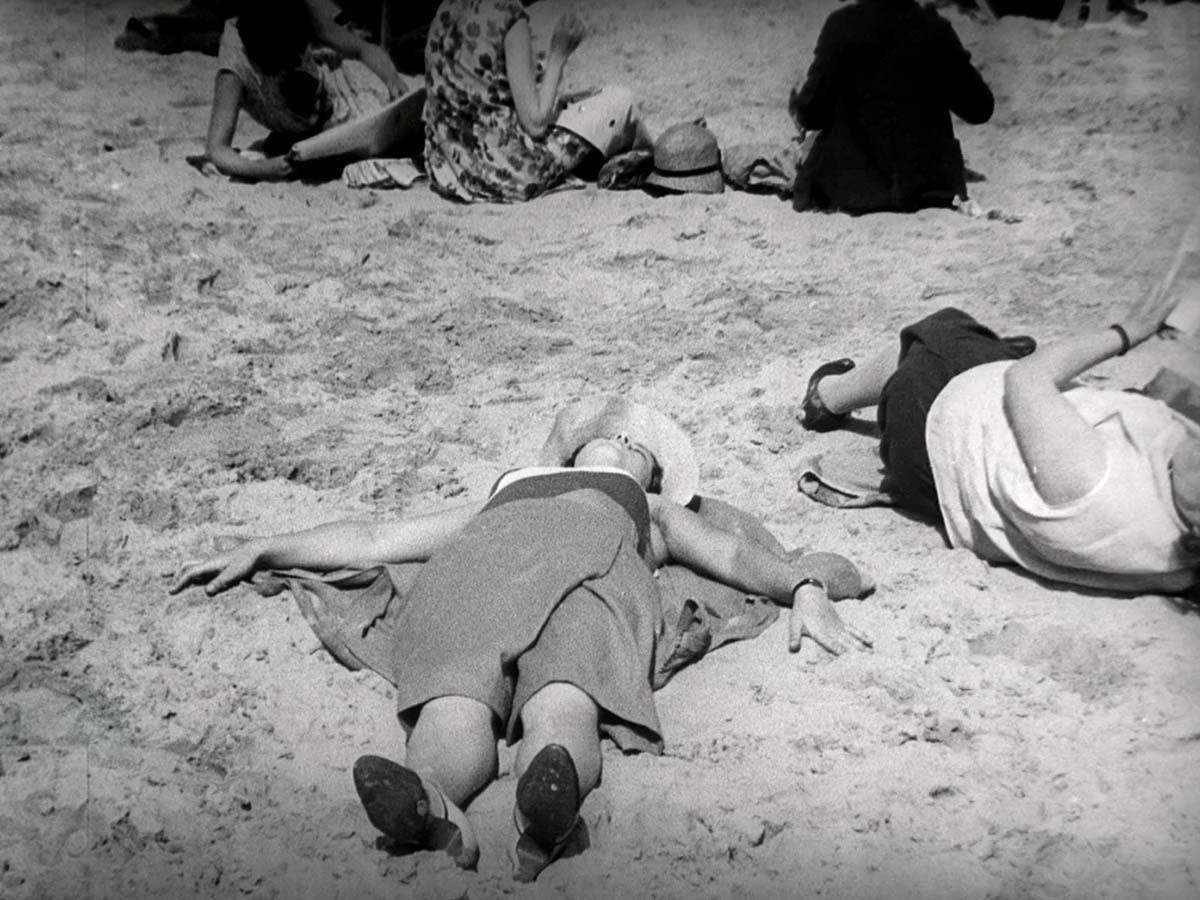
Nonetheless, the correlation between the bourgeoisie, leisure time, and the beach is clear in Storck’s work too. Hats and dressing shoes dart around children who are scared of the water, anxiously latch on to their mother’s hand, or, contrastingly, lose themselves completely in their beach and sea-inspired games. It is a light irony but a predominant harmony that exemplifies Storck’s portrayal of the carefree life at the beach. No trace of trains to be found—unlike in À propos de Nice—however, the title does suggest travel via railway to the Belgian coast. Dabbling their feet in the water, playing rough, and tumbling on the soft sand, the people depicted in his film enjoy themselves as much as Storck does while recording and rhyming his images. With the exception of one bare behind, Trains de plaisir shows a lyrical prudeness, both in the camera's handling and the overall attitude; the film feels more stable and harmonious than Vigo’s. We are left to imagine the train ride home ourselves, perhaps with grains of sand still rubbing between our toes.

watch now

Read more

Trains de plaisir

Henri Storck, Belgium, 1930, 8’

The beach and its sunbathers. A series of sketches, small moments that culminate in a wry, loving portrait of a Sunday at the beach.

Read more

    read more

    Derek Jarman
    artikel
    Read more

    Derek Jarman, meer dan ooit

    Stoffel Debuysere
    29.03.2025

    Hoe resoneert de nalatenschap van Derek Jarman? Afgaand op het groot aantal retrospectieves, publicaties en hommages die aan zijn werk en leven worden gewijd: vandaag meer dan ooit. Drie decennia nadat hij het leven liet aan AIDS-gerelateerde complicaties is Jarman alomtegenwoordig in deze tijd die aanvoelt als in voortdurende crisismodus.

    Read more
    Paradise (Laura Vandewynckel, 2014)
    Paradise (Laura Vandewynckel, 2014)
    essay
    Read more

    Impassable Gates

    Laura Vandewynckel’s Paradise (2014)

    Najrin Islam
    13.06.2026

    In five minutes, Paradise scans what determines movement for racially distinct peoples. Borders seek to contain, and any transgressions are preemptively curbed through restrictive legislation or bureaucratic rigmarole. As architect and researcher Shahram Khosravi and Mahmoud Keshavarz point out in their article, “The Magic of Borders”, border fortifications—materialised through visa protocols, military operations, or propaganda media—facilitate mobility for the white traveller as much as they restrict it for racialised refugees.

    Read more
    © As If Mother Cried That Night (Hoda Taheri, 2023)
    As If Mother Cried That Night (Hoda Taheri, 2023)
    interview
    Read more

    Love Under Surveillance

    A Conversation with filmmaker Hoda Taheri

    Jori(k) A. Galama
    12.02.2025

    Over the past few years, Hoda Taheri (Tehran, 1992) has toured many a film festival with her short films Mother Prays All Day Long (2022), As If Mother Cried That Night (2023), and Mother is a Natural Sinner (2024), the first of which you can watch via yanco’s streaming library. In this “mother trilogy”, Taheri zooms in on relevant issues such as the right to abortion and the treatment of refugees in Europe. She takes on the lead role herself, cunningly and humorously dramatising her own biography.

    Read more
    Henry is a Girl Who Likes to Sleep (Marthe Peters, 2026)
    Henry is a Girl Who Likes to Sleep (Marthe Peters, 2026)
    article
    Read more

    In the Bosom of Images

    Marthe Peters’ Henry is a Girl Who Likes to Sleep (2026)

    Öykü Sofuoğlu
    31.03.2026

    Henry is a Girl Who Likes to Sleep finds the filmmaker once again looking back at herself, this time by orienting her gaze toward her beloved cat, the titular Henry—a chubby white feline with tricoloured splotches on her fur. Throughout the film, Marthe Peters delivers a playful voice-over addressed to Henry, drawing comparisons between their bodies, their unique habits and traits, while also questioning the love and affection she may be burdening her cat with.

    Read more
    © La Chambre (Chantal Akerman, 1972)
    La Chambre (Chantal Akerman, 1972)
    article
    Read more

    A Room of Her Own

    Chantal Akerman’s La Chambre

    Öykü Sofuoğlu
    17.11.2024

    Lounging on a small bed, Chantal Akerman’s posture seems casual and relaxed at first glance, but the repetitive tilts of her head—to the left and then back to center—contrasting with the smooth glide of the camera suggest otherwise. Restlessness is in the air, yet before we can discern it, the image is already on the move, retracing its steps for a second time.

    Read more
    © 18 000 WORLDS (SAODAT ISMAILOVA, 2023)
    verslag
    Read more

    Achttienduizend werelden

    Saodat Ismailova’s eerste grote solotentoonstelling in het Eye

    Ils Huygens
    09.05.2023

    In het Eye Filmmuseum in Amsterdam loopt een prachtige solotentoonstelling van filmmaakster Saodat Ismailova. Haar werk beweegt zich tussen film en audiovisuele installatie.

    Read more
    © In Flanders Fields (Sachin, 2024)
    In Flanders Fields (Sachin, 2024)
    article
    Read more

    A Voice For The Ghosts

    Sachin’s In Flanders Fields

    Eneos Çarka
    13.08.2025

    In Flanders Fields is a ghost story. Directed by Rajasthan-based filmmaker Sachin, the short film is a poetic meditation on war, colonial erasure, and ancestral presence in foreign land. The director introduces us to a rarely acknowledged fact in dominant historical narratives: during the First World War, as many as 1.4 million Indians were conscripted by the British and sent to the frontlines in Flanders. This revelation sets the stage for a cinematic elegy to those forgotten men.

    Read more
    © J’ai faim, j’ai froid (Chantal Akerman, 1980)
    artikel
    Read more

    Het leven start hier en nu

    Chantal Akermans J’ai faim, j’ai froid (1984)

    Michaël Van Remoortere
    17.03.2025

    Henri Bergson geloofde dat het fenomeen genaamd humor ontstond wanneer de materiële wereld tekortdeed aan onze spirituele aspiraties. Had hij lang genoeg geleefd om het werk van Chantal Akerman te zien, dan kon hij in haar films een bewijs van zijn stelling vinden. Niet alleen was Akerman een begenadigd metteuse en scène van Chaplineske slapstick-taferelen, ook hoe zij de romantische liefde toont is, door de kloof tussen wensdroom en al te menselijke realiteit, vaak een bron van onbedaarlijk gniffelen.

    Read more

    Subscribe to our monthly newsletter for updates on new releases, publications, and events!

    Subscribe

    yanco is a magazine and streaming library for short-form moving image

    kortfilm.be vzw
    Boondaalse Steenweg 249
    1050 Elsene
    BE 0478 441 315
    info@yanco.be

    with the support of the Flanders Audiovisual Fund (VAF) of the Flemish Government

    VAF
    • about
    • colophon
    • privacy policy
    Facebook Instagram LinkedIn YouTube Letterboxd
    design by de Ronners
    website by eps en kaas