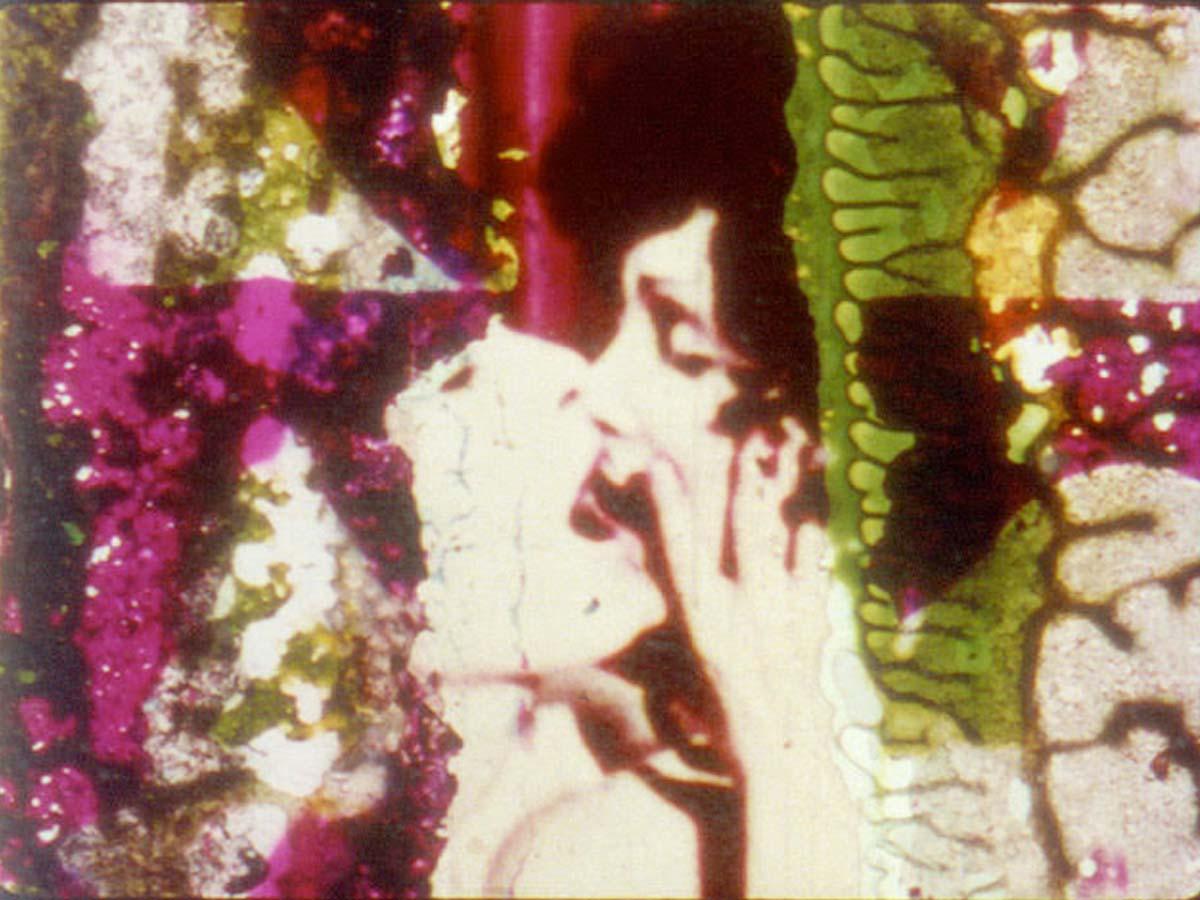
According to Peggy Ahwesh, there is beauty and ecstasy in decay. With her 16mm blow-up of a pornographic Super 8 film, the American artist seeks sensuality.
A series of cameo portraits of Barbara Hammer’s friends and lovers intercut with a playful celebration of fruits and vegetables in nature. The culminating footage evokes a tantric painting of sustained sexuality.
Shellie Fleming deconstructs Sylvia Plath’s Tulips and creates new word combinations that transform the poem. The poetry can be heard, seen, and felt in Devotio Moderna, which becomes a highly tangible experience.
A silent film of collaged and painted sequences of lovemaking between artist Carolee Schneemann and her then partner, composer James Tenney, observed by their cat, Kitch.
Hand-painted watercolours explore bodies, desire, and the tension between both in this experimental animated film. Due to an explosion of colour and movement that escapes classical animation, an unusual sensorial force is achieved. Alternating colours, lines, and density, the drawings question pornography and normative sexuality.
It is sometimes said that if a man places a pearl under the skin of his penis, he will bring the woman the greatest pleasure. He grants her the greatest of all pleasures, while she will give him anything he desires. After a playful love dance, she melts into him, at the cost of losing themselves in each other to arrive at their deepest desires.
Of the more than eighty moving-image works that Barbara Hammer created, her 1974 film Dyketactics remains her most iconic. A four-minute paean to lesbian sexuality, the film publicly announced Hammer’s blossoming sexual identity.
In this expression of gendered pain, joy, and hardship, Chick Strand collaborates with five women who share their experiences through direct, frank stories. Throughout these testimonies, Soft Fiction considers the identification and representation of womanhood, and the sense of possession and dispossession through consensual and abusive sexuality.
In a shopping mall, two women sing about their favourite items but are quickly pursued by a masked cannibal who is intent on forcing his way to their love. Possibly in Michigan is an operatic fairy tale of cannibalism and dread in America.
The work of French activist, novelist, and essayist Jean Genet was considered controversial in the forties and fifties, because of its explicit homosexuality. Genet made only one film in his entire life, but Un Chant d’amour went on to inspire both David Bowie and Rainer Werner Fassbinder.
In Suzan Pitt’s cult classic Asparagus, the indomitable growth of an asparagus plant is associated with female sexuality. As the urbane world turns absurdist, the green fruit transforms this reality.
Swollen Stigma is a visual, surrealistic narrative about a woman travelling both literally and psychically through several rooms. Memories, or fantasies, of another woman, fill her imagination. The film proposes lesbian imagery, and its shifting points of view jump between the protagonist, fantasy spaces, and her lover, making an internal world leak into what is external.
Confused about German bureaucracy and questioning her sexuality, Hoda, an Iranian asylum seeker in Berlin, finds herself hooked on Magdalena, who promised to ensure her asylum by marrying her. Due to changes in Magdalena’s private life, her decision to marry Hoda becomes more complex.
This is the story of Copa-Loca. Paulina is the girl at the heart of this abandoned Greek summer resort. Everyone cares for her and she cares about everyone – in every possible way.
1947’s Fireworks is a milestone, as the first American film with a gay narrative. At age seventeen, Anger himself plays the lead character. The film illustrates the awakening of a suppressed desire, a gross fantasy.
A sleeping man dreams of a city at dusk. He is every angelic lover, caught off guard. The film goes in and out of his pulsating erotic dream: heated up, he dreams of landscapes, even of becoming the landscape.