yanco Home
Menu
  • Home
  • watch
  • magazine
  • calendar
  • index
  • Subscribe
Search Log in
  • nl
  • en
You are here
  • Home
  • Magazine
  • Why So Serious?!
© BAN♡ITS (Omar Chowdhury, 2024)
BAN♡ITS (Omar Chowdhury, 2024)

Why So Serious?!

On Omar Chowdhury’s BAN♡ITS

article by
Ren Scateni
12.02.2025

As much as we should collectively try to resist polarisations and binarisms, let’s face it: the world is not quite helping us out. This is a time of widespread right-wing resurgence, lack of funds for cultural institutions, and overpowering aggression towards all marginalised communities. So, it may be a bit cringe to support a billionaire vigilante with daddy issues, who punishes petty criminals as a way to offset his guilt over wealth and privilege.

“There’s a reason why everybody hates Batman in those movies,” comments one of the titular protagonists in Omar Chowdhury’s BAN♡ITS. Set in a liminal space between Bangladesh and India, the film follows a group of self-proclaimed “destitutes”, and “agents of chaos” who rob the rich to give to the poor and are obsessed with Heath Ledger, because “he died for his art.” Inhabiting a lawless limbo where radical credos—“we reject the norms”—coexist with state-sanctioned anarchic stances—“order needs chaos”—these outlaws are as porous and opaque as Chowdhury’s film itself.

Based across Brussels and Dhaka, Chowdhury thrives on betweenness in his practice as he explores peripheral spaces and ambiguous categorisations, like in the performance and installation series Faydabad To-Let (2020) and Faydabad For-Sale (2022) that comments on neglected modernist buildings in the Dhaka periphery, or the video work Augustijn (2018) that touches upon religion while demystifying film as an artistic construct. With his art, Chowdhury intentionally blurs narrative boundaries, leaving the viewer oblivious to the interplay between reality and fiction.

BAN♡ITS uses this same para-fictional approach by highlighting opposed histories of peasants’ political resistance through a pop-inflected lens, which is further complicated with questions around authorship, ethnography—albeit mediated by the artist’s diasporic identity—and its own acute complicity in the structures it proposes to unmask, especially around the art world and its fraught dynamics. What to make of such an introspective work then?

“Do you know why you’re making the film?” asks one of the bandits abruptly. “Uh, not really. I’m just interested, I guess,” is the artist’s reply. “What a privilege,” responds the bandit, candidly. Indeed, sharing in cultural capital is a thing for the few, not for the many. However, in BAN♡ITS, which recalls thermal imaging through its fluorescent negative-positive inversion, the artist is as anonymous as his subjects, although not as invisible. On display is the bandits’ intoxication with their long-gone days of glory, whose fading vestiges are captured by the artist’s camera as they reenact a past heist of apparent minimal significance but of extreme mythopoetic grandeur.

This narrative is a little too similar to the one of cultural institutions desperately trying to navigate the fractured, current state of affairs. After shifting alliances and renouncing past vows in the face of Imperialist pressure, their progressive and pluralist ideals of inclusivity are defunct, and their flimsy ethical backbones exposed. If Chowdhury’s bandits are stuck in a self-indulgent delusion—their vigour exhausted, their ideologies just another script to rehearse—then we need a new generation of outlaws. One that can propel revolutions, transcending chaos and order alike.

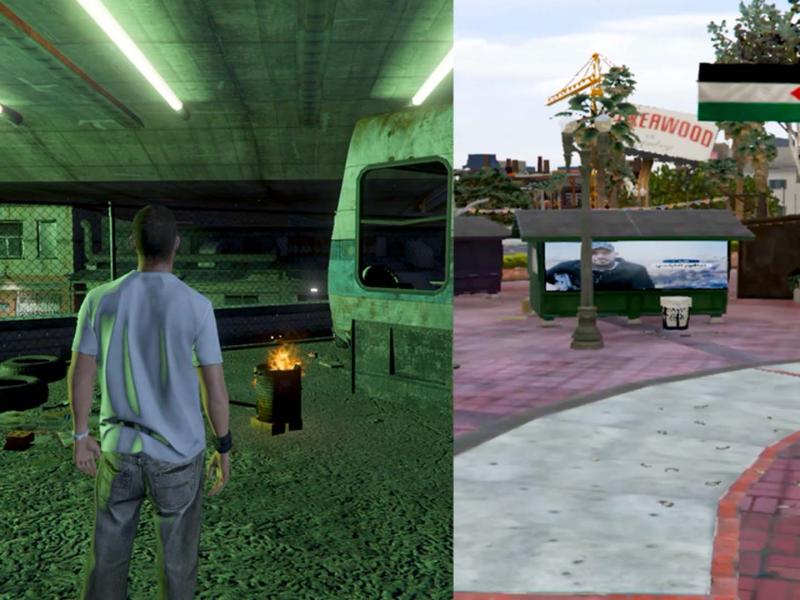
    BAN♡ITS was part of IFFR’s Tiger Short Competition last week and has previously won a New Cinema Award at Berwick Film & Media Arts Festival.

    Bio Ren Scateni

    Ren Scateni is a film curator and writer whose practice embraces experimental works and artists’ moving image that explore the interstices of political, disruptive, and liminal identities. His writing has appeared in various art and film magazines, including ArtReview, Hyperallergic, and Sight and Sound. Ren is currently Curatorial Lead at Glasgow Short Film Festival and has been/is working across curation, consulting, editing, mentoring, and PR for festivals, cultural organisations, and companies, including Berwick Film & Media Arts Festival, Queer East, Festival du Nouveau Cinéma, BFI Doc Society, and Square Eyes. Ren is a Trustee of Alchemy Film & Arts.

    read more

    © Dimensions of Dialogue (Jan Švankmajer, 1983)
    artikel
    Read more

    Dialoog doorgelicht

    Jan Švankmajers Dimensions of Dialogue

    Michiel Philippaerts
    28.12.2017

    In deze kortfilmklassieker bestudeert Jan Švankmajer de verschillende aspecten van ‘dialoog’ op een ludieke en verrassend pessimistische manier.

    Read more
    Like An Event In A Dream Dreamt By Another - Rehearsal (Firas Shehade, 2023)
    Like An Event In A Dream Dreamt By Another - Rehearsal (Firas Shehade, 2023)
    interview
    Read more

    Machinima: the Metamorphosis of Mapping

    A Conversation with Dmitry Frolov and Vladimir Nadein

    Xinyi Wang
    31.10.2026

    Born on the threshold between game and cinema, “machinima”—films made within the world of video games—is a rapidly expanding genre. Dmitry Frolov and Vladimir Nadein have been co-curating machinima for over four years. This time invited by yanco, they bring a new selection of machinima to Antwerp, as part of the Breedbeeld Kortfilmfestival. “Ludic Cartographies” is a beautiful example of machinima’s aesthetic methods and political potential. Spanning essay film, artist moving image, and research videos, it has a formal fluidity and inherently carries a “documentary quality that gazes at the past”.

    Read more
    © In Flanders Fields (Sachin, 2024)
    In Flanders Fields (Sachin, 2024)
    article
    Read more

    A Voice For The Ghosts

    Sachin’s In Flanders Fields

    Eneos Çarka
    13.08.2025

    In Flanders Fields is a ghost story. Directed by Rajasthan-based filmmaker Sachin, the short film is a poetic meditation on war, colonial erasure, and ancestral presence in foreign land. The director introduces us to a rarely acknowledged fact in dominant historical narratives: during the First World War, as many as 1.4 million Indians were conscripted by the British and sent to the frontlines in Flanders. This revelation sets the stage for a cinematic elegy to those forgotten men.

    Read more
    © Oumoun (Fairuz & El Moïz Ghammam, 2017)
    Oumoun (Fairuz & El Moïz Ghammam, 2017)
    essay
    Read more

    Listening Images

    Fairuz & El Moïz Ghammam’s Oumoun

    Arta Barzanji
    08.10.2025

    “Listen, Grandma.” These words appear on a black screen, a summons that feels more like a pact than a simple instruction. Before any image emerges, there is a clear call to pay attention. Next, the first image surfaces and does so without flourish: in a fixed frame, an old woman is seated amid a room where life has been packed up —boxes, bags, bedding, a stool with a pair of sandals. A bright red sheet draped over a box commands our attention; it is a rectangular blaze that both hides and announces its contents. The woman props her left arm and leans forward just enough to demonstrate that listening requires posture.

    Read more
    © MISTY PICTURE (Christoph Girardet & Matthias Müller, 2021)
    Misty Picture (Christoph Girardet & Matthias Müller, 2021)
    essay
    Read more

    Cinematic Ghosts

    On Christoph Girardet and Matthias Müller’s Misty Picture

    Oana Ghera
    09.12.2024

    Through association, repetition, and accumulation, Christoph Girardet and Matthias Müller showcase the inventory of Hollywood formal clichés that contributed to the creation of the Twin Towers’ symbolic capital, reflecting at the same time on the power of those images to haunt our collective imagination to this day.

    Read more
    Water and Salt (Luisa Mello, 2019)
    Water and Salt (Luisa Mello, 2019)
    essay
    Read more

    Watery tensions

    Luisa Mello’s Water and Salt

    Kathy Vanhout
    03.04.2022

    Apart from water, salt, and clouds, Mello’s work often features young and older people, artists, animals, and cities; these things are the source of her documentaries. Her films always leave room for fictive contemplation and interpretations. Water and Salt, for that matter, hardly reads as a documentary. In these reflective ten minutes, she attempts to translate a thought, a feeling, an observation. In situations like this, where words are insufficient, and the outside world offers few answers, Mello constructs her own images. Or she turns to archival ones.

    Read more
    © MAGIC, A PORTRAIT OF JORIS (CHLOË DELANGHE, 2018)
    Magic, a portrait of Joris (Chloë Delanghe, 2018)
    interview
    Read more

    De ruimte die ons omringt

    Portretten van nabijheid: Chloë Delanghe’s Magic, a portrait of Joris

    Nina de Vroome
    13.01.2025

    Het fototoestel meet afstanden. Zijn brandpunt komt samen met een voorwerp in de ruimte en door de leegte rondom wordt er iets zichtbaar. Het is een vanzelfsprekende vaststelling, maar toch is deze essentie van fotografie van belang in het werk van Chloë Delanghe. Haar werk bevindt zich in een spanningsveld van intimiteit en afstand.

    Read more
    © Meltse Van Coillie
    Portretfoto © Meltse Van Coillie
    interview
    Read more

    “Film moet een kunst blijven, geen consumptiemiddel”

    Meltse Van Coillie over elephantfish

    Michiel Philippaerts
    12.05.2019

    Meltse Van Coillie over het moedige maakproces van haar docufictie elephantfish, bekroond met een VAF Wildcard.

    Read more

    Subscribe to our monthly newsletter for updates on new releases, publications, and events!

    Subscribe

    yanco is a magazine and streaming library for short-form moving image

    kortfilm.be vzw
    Boondaalse Steenweg 249
    1050 Elsene
    BE 0478 441 315
    info@yanco.be

    with the support of the Flanders Audiovisual Fund (VAF) of the Flemish Government

    VAF
    • about
    • colophon
    • privacy policy
    Facebook Instagram LinkedIn YouTube Letterboxd
    design by de Ronners
    website by eps en kaas