Two divers appear against an expanse of saturated blue, their lower bodies barely distinguishable. A light glows beneath them; the soundtrack turns hollow, aquatic. The voice falls silent. One diver plunges downwards; soon the narration resumes. As it declares, “I have lost my place in the world,” a wider shot reveals a structure beneath the swimmers. The words announce disorientation just as the image acquires coordinates. Soon comes a more immediate correspondence: “I have become a new mammal, born in a weightless sea, swimming in a new ocean.” The promise, and perhaps the limitation, of London-based collective The Otolith Group’s speculative film essay Otolith I (2003) resides in images briefly developing their own relations before the voice gathers them back into its account.
The film begins with a scientific report dated 2103. Sustained exposure to microgravity has transformed the human vestibular system; the resulting species can inhabit space but no longer withstand Earth’s gravity. “Earth is out of bounds for us now; it remains a planet accessible only through media.” From this imagined future, Dr Usha Adebaran-Sagar searches the records of her ancestors for the processes that brought her species into being. “For us, there is no memory without image and no image without memory,” she observes. But neither can recover what exceeds them: “That excess is the event. History.” She searches for “critical points,” “thresholds,” “moments of becoming”: how one possible future became her present.
Her inquiry is also a family history. The film is dedicated to Anasuya Gyan-Chand (1902–1995), the socialist and feminist grandmother of artist Anjalika Sagar. Gyan-Chand served as president of the National Federation of Indian Women. She met Valentina Tereshkova, the first woman in space, and understood her achievement in relation to the aspirations of the post-independence generation. “What lessons can Indian socialists learn from this?” she asked of the Soviet project; what of India’s own path, or China’s? The narrator remarks that these questions “remain in mid-air despite the promises.” The phrase joins two kinds of suspension: the bodily condition imagined by the film, and the political futures that earlier generations neither realised nor entirely relinquished. Recalled greetings and hands held keep a particular life from becoming merely its emblem.
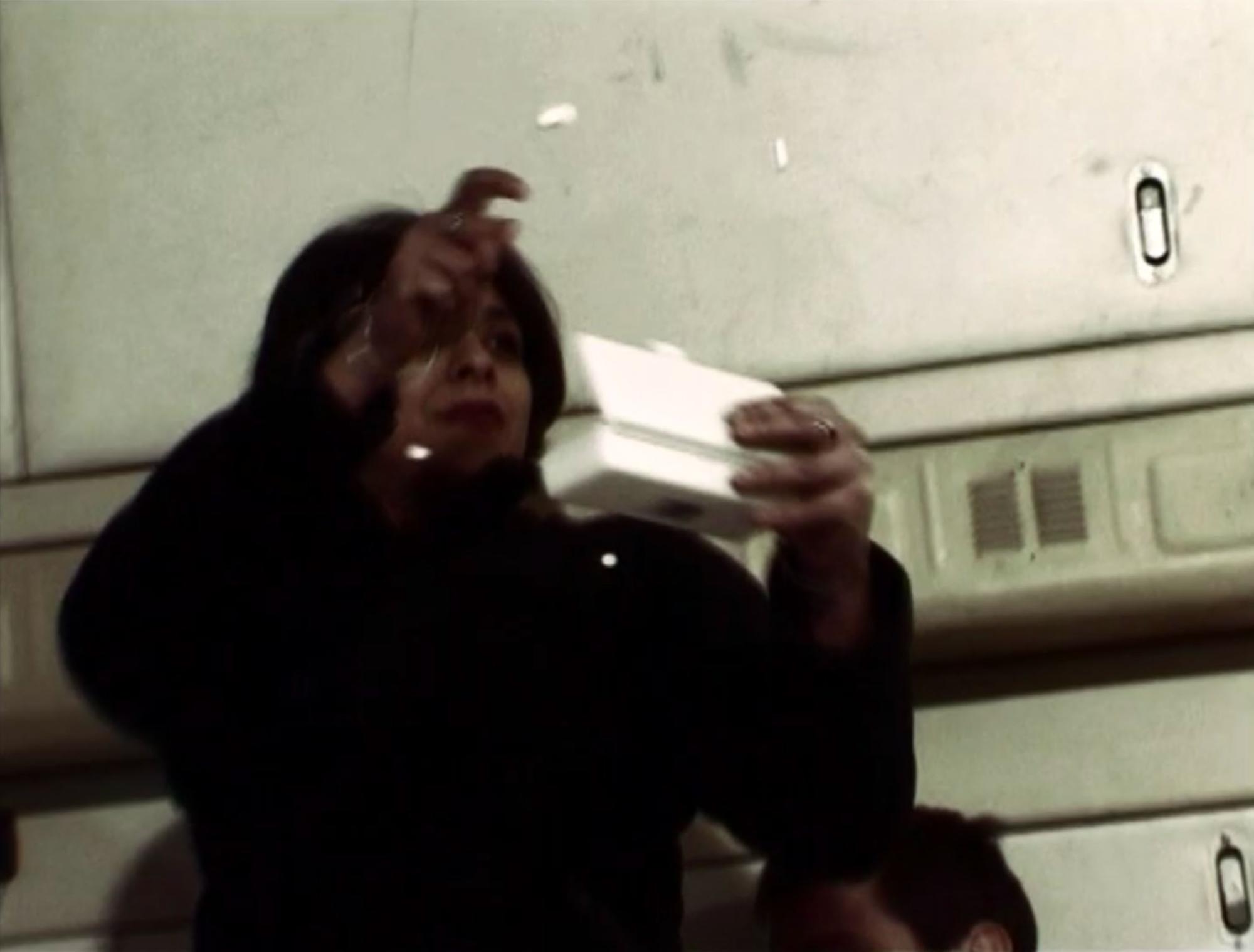
The granddaughter’s own historical moment seems considerably less open. She joins the February 2003 demonstrations against the imminent invasion of Iraq, knowing, or believing, that the war will go ahead. The narrator calls the mobilisation “a protest for the right to protest,” as though its unprecedented scale could make the inevitable briefly possible to avert. Anjalika subsequently travels to Russia to experience microgravity. The flight that offers a new sense of bodily freedom is enabled by a military aircraft; the space programmes that once promised collective emancipation have been inseparable from geopolitical rivalry, weapons and commerce. The century of space exploration also produced the atomic bomb. Technological progress, then, neither guarantees political emancipation nor necessarily betrays its promise.