By their very nature, archival images do not lend themselves to easy interpretation; they are at once too conspicuous and too ambiguous to be read straightforwardly. Temporal distance is the most obvious obstacle to interpreting archival images, whose ambiguities demand both intellectual and perceptual labour to unravel. Although they have been absorbed into the digital sphere, where they circulate mostly as facsimiles and are counterfeited by artificial intelligence, they continue to persist and resist. They unsettle viewers in a productive way, forcing them to actively question their ways of seeing and of relating to others.
Curated by Inge Coolsaet for argos, the programme “une place vide dans un paysage” presents archival imagery as a gateway between collective memory and personal experiences. In both films, conversation acts as a mnemonic catalyst. Despite their mutual resonance, both works are laden with absences, gaps and unresolved tensions, particularly in the context of countries whose national histories are scarred by colonial oppression, forced displacement and exile.
Initially conceived as a three-channel video installation, Amina Menia’s National Liberation Football (2022) examines the politico-symbolic role football played in the Algerian struggle for independence from France. While the politicisation of football as a form of soft power in our neoliberal, capitalist world might be a phenomenon to frown upon, the buoyant warmth conveyed by the filmmaker’s voice—as she tells her daughter about the happiness she felt when Algeria won a qualifying match against Egypt in 2009—attests to a deeper, visceral attachment that extends beyond contemporary geopolitics. As one of many manifestations of the postcolonial condition, this patriotic surge of emotion, which she shared with hundreds of thousands of Algerians, leads Menia to explore its historical roots.
The triptych creates a visual balance between the film’s interview and archival components, often displaying footage across two of its three screens simultaneously. Its emotional weight is concentrated on the right side of the screen, where Menia’s conversation with Rachid Mekhloufi unfolds. An important figure in the history of A.S. Saint-Étienne until the late 1960s, Mekhloufi is best known for being one of the ten footballers who clandestinely left their French clubs to form the National Liberation Front’s football team in an effort to support the Algerian cause. This conversation alternates with Slimane Zeghidour’s commentary, more detached and analytical, and providing broader context on how football and its signifiers helped consolidate Algerian national identity despite the ethnic, religious, and cultural divisions that characterise its society.
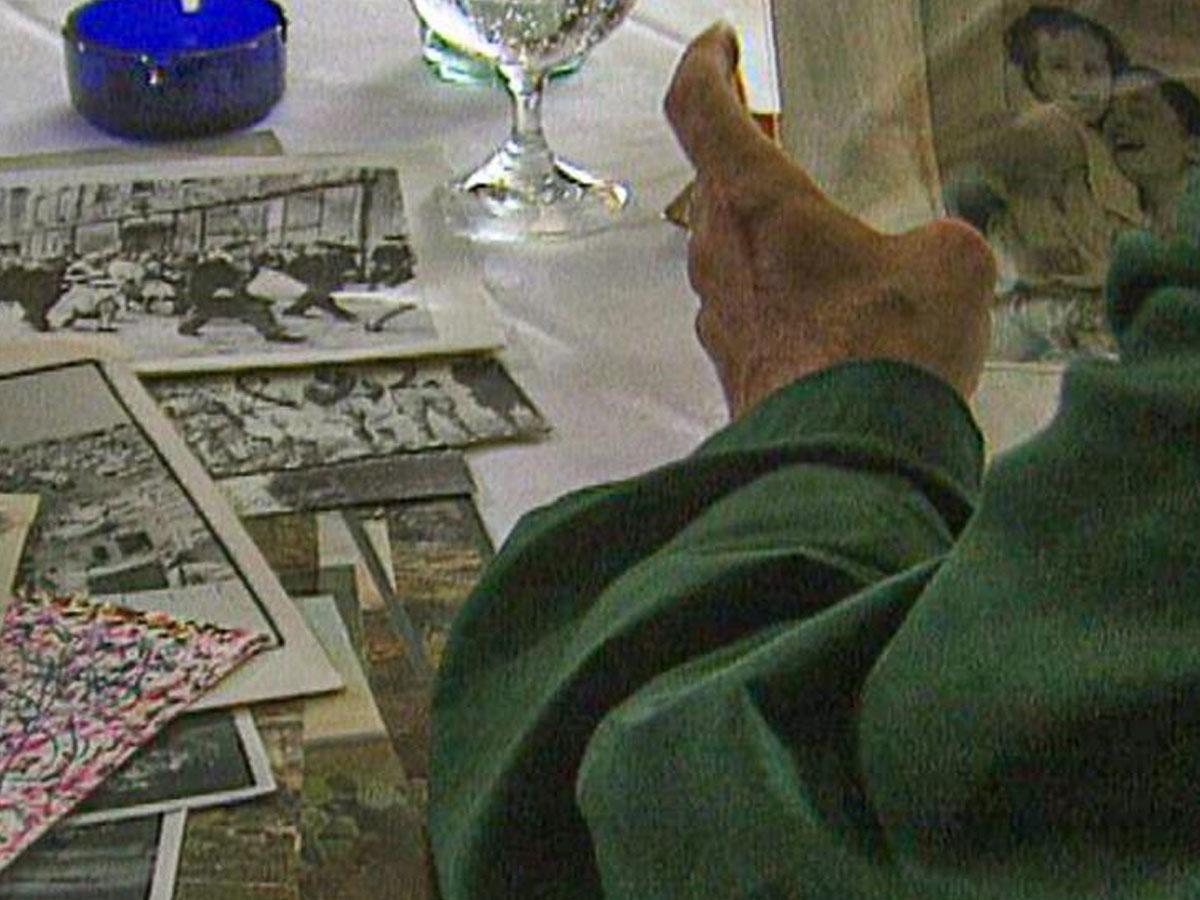
In her exchanges with Mekhloufi, Menia’s questions guide the conversation, tracing—in broad brushstrokes and more or less chronologically—the years from Mekhloufi and his teammates’ audacious venture into the FLN team to his post-independence career as a coach. At first glance, the archival material in the central section might seem merely illustrative. Its heterogeneity, however, resists the tendency of official narratives to impose a false sense of historical uniformity. Photographs, posters, film reels, newspaper excerpts, and TV footage aptly demonstrate the inadequacy of official history as a discursive tool, since the post-colonial subject, whose existence is rooted in the in-betweenness of languages, cultures, and countries, requires a multitude of polyphonic and transgenerational histories to express itself.