yanco Home
Menu
  • Home
  • watch
  • magazine
  • calendar
  • index
  • Subscribe
Search Log in
  • nl
  • en
You are here
  • Home
  • Magazine
  • Flickering Memories
Old Child (Elettra Bisogno & Hazem Alqaddi, 2019)

Flickering Memories

Elettra Bisogno & Hazem Alqaddi’s Old Child

essay by
Savina Petkova
10.05.2025

For a refugee or an immigrant, memories of a prior life are not simply broken; they are snapped in two, three, four, or more pieces and doomed to exist separately. These split memories can emit a particular shine, as attested by Elettra Bisogno and Hazem Alqaddi’s short Old Child. The film dwells in the paradox of its title, where old age and childhood are readily coupled, as if there were no time or space in between these two ends of a human life spectrum. Of course, the title also holds melancholy, which is only one feeling in the vast emotional landscape of Old Child.

While not explicitly stated as such, the film serves as a meeting point between Italian-born Elettra Bisogno and Hazem Alqaddi, who arrived in Belgium in 2018, after a long and terrible journey from Gaza. Belgium and art become two fractured homes for those two people, as the camera draws and redraws the map of one’s own borders and boundaries. This is perhaps why the camera is handheld at all times, unstable and mobile to the point that the human hand is very much imprinted in every flickering, uneven pan. As for the images the camera is drawn to, they are scattered and far from linear in their storytelling, as blurry faces, groups of old and young men, close-ups of hands spread on the floor all assemble themselves around Hazem’s narration. Off screen, his words conjure a journey we are invited to relate to the (seemingly random) images on screen.

“I wake up. What is this smell?,” Hazem wonders with a poetic lull. “Embers everywhere. It burns,” he continues as the frame we see fills with smoke. Alas, no embers in sight, but the sensory appeal to his narration already allows the viewer to join in, to borrow a point of view. Old Child unfolds with a concealed pathos that de-centers the trivial first-person shots and sequences one may be accustomed to. Subjectivity reigns as the narrator’s stream of consciousness pours on screen (and through the subtitles), and its hold is so strong I don’t feel the need to ground the words into the images I see. But their visible pixels and slightly skewed perspectives seem to bother me.

Occasionally, I’d spot a lens flare and a reflection, what looks like dust superimposed over those picturesque images of clouds and skies. Is my own screen too dusty, or am I seeing a camera recording of another screen? The camera in Old Child is certainly human (human-held), but as it pans, tilts, tracks, and circles around men, always in brief sequences, it seems like it’s searching for something lost.

Hazem’s camera, mouse cursor, and hand are all grasping at the pieces of memory. A photo of his father with Yasser Arafat, a Google Maps satellite view of Shokat as-Sufi (a Palestinian town in the Gaza strip under Israeli occupation) and its destroyed airport, a Google Earth version of our planet that turns with the click and drag.“I move the world,” he exclaims jubilantly, laughing at this possibility to virtually align himself with God. It is funny to think that in filmmaking jargon, the shot from above is called ‘God’s eye view’, yet that’s a promise a camera can never fully deliver.

In another sequence, Hazem’s hand enters the frame and clasps its fingers over the red buds of a blossoming tree. The slow-motion and intentional camera movements recording his hand remind me of The Gleaners and I, in which Agnès Varda captures her ageing palm by holding the digital camera with the other hand. Similarly, Old Child radiates a sensual glow even at its most pixelated. Overexposed images occasionally fade to white. The bodies of men holding machine guns swing in and out of view as much as the bodies of young girls rollerblading—two more ways to mark the memory-fragments as part of lives lived. It is in the recording, the counting and categorising of things seen and felt, that filmmakers can find solace and the hope that not all is lost: at least not when it’s filmed.

watch now

Read more

Old Child

Elettra Bisogno, Hazem Alqaddi, Belgium, Palestine, 2019, 16’

Old Child depicts the fragmented story of Hazem, who had to flee Gaza. Throughout this stream-of-consciousness montage of dreams and reminiscences, he searches for order but also for the beauty he left behind.

Read more

    read more

    © Ethereal Rhythms, Everything Rhymes (Brecht Vanhoutte, 2025)
    interview
    Read more

    Welkom, welkom in mijn hoofd

    Brecht Vanhoutte over Ethereal Rhythms, Everything Rhymes

    Flo Vanhorebeek
    13.02.2025

    Brecht Vanhouttes masterfilm is een abstract beestje, dat de LUCA-alumnus zelf beschrijft als een koortsdroom die zijn gevoelswereld vertaalt naar het zilveren scherm. De film construeerde hij door tekst, beeld en audiofragmenten in een AI-generator te gieten en hierover met de bot in gesprek te gaan. Zijn werk bracht hem tot op het Internationaal Filmfestival van Rotterdam (IFFR).

    Read more
    Saute ma ville (Chantal Akerman, 1968)
    Saute ma ville (Chantal Akerman, 1968)
    artikel
    Read more

    Preludes van een visionair

    Chantal Akermans La Chambre (1972) en Saute ma ville (1968)

    Inge Coolsaet
    27.05.2021

    In haar vroege kortfilms tekende Chantal Akerman, moedwillig maar ook onbewust, de contouren van haar eigen toekomst uit. Alle fundamenten van haar oeuvre, vormelijk en inhoudelijk, werden er gezet.

    Read more
    Oh Willy... (Emma De Swaef & Marc James Roels, 2011)
    Oh Willy... (Emma De Swaef & Marc James Roels, 2011)
    article
    Read more

    Woolen Horizons

    Emma De Swaef & Marc James Roels’ Oh Willy... (2001)

    Sven Hollebeke
    03.12.2023

    Willy’s roots can also be found in the main character of De Swaef’s graduating film Soft Plants (2008). The short documentary follows an old and lonely officer who finds refuge in his thoughts and fantasies of a dark and magical forest. This longing for safety, a stubborn passivity, or even feigned innocence is woven into the duo’s oeuvre.

    Read more
    © La Chambre (Chantal Akerman, 1972)
    La Chambre (Chantal Akerman, 1972)
    article
    Read more

    A Room of Her Own

    Chantal Akerman’s La Chambre

    Öykü Sofuoğlu
    17.11.2024

    Lounging on a small bed, Chantal Akerman’s posture seems casual and relaxed at first glance, but the repetitive tilts of her head—to the left and then back to center—contrasting with the smooth glide of the camera suggest otherwise. Restlessness is in the air, yet before we can discern it, the image is already on the move, retracing its steps for a second time.

    Read more
    Sirens (Raoul Servais, 1968)
    Sirens (Raoul Servais, 1968)
    essay
    Read more

    A Complaint

    Raoul Servais’ Sirens (1968)

    Charlotte Timmermans
    01.10.2022

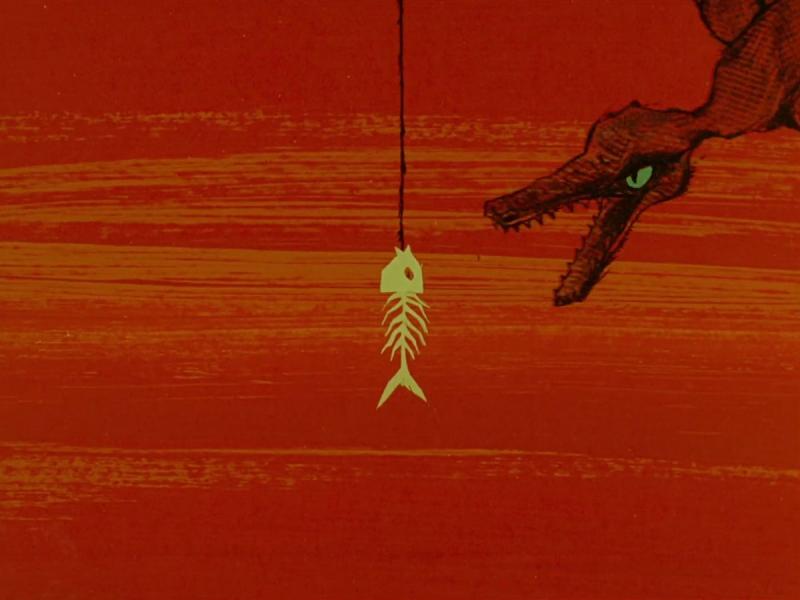
    Early on in the film, Servais employs the boundless possibilities of animated film to portray a surreal scene: two cranes squabbling over a wooden container. The container drops and breaks. Its content: a pile of rocket bombs. War is the central theme in many of Servais’ films (Chromophobia, Operation X-70, Tank); here, however, it seems to only casually add to the dystopian world. The future has been devoured by war and industry. Literally devoured: a lonely fisherman catches nothing but fish bones. He looks deeply saddened.

    Read more
    © White Cloud / 白云 (Emmanuel Van der Auwera, 2023)
    White Cloud / 白云 (Emmanuel Van der Auwera, 2023)
    article
    Read more

    White Clouds in a Dark Age

    Emmanuel Van der Auwera’s White Cloud / 白云

    Ive Stevenheydens
    28.07.2025

    In this so-called post-truth era, the line between fact and fiction has blurred into a matter of style: what appears plausible is accepted as real. The rise of generative artificial intelligence has not merely accelerated this disintegration but formalised it. Truth is no longer something to be discovered, but something to be produced. Within this context, White Cloud / 白云 by Emmanuel Van der Auwera functions as a case study of the destabilisation of truth, image, and representation.

    Read more
    Lettre à Mohamed (Christine Moderbacher, 2013)
    Lettre à Mohamed (Christine Moderbacher, 2013)
    essay
    Read more

    An Archaeology of Moments

    Christine Moderbacher’s Lettre à Mohamed

    Alonso Aguilar
    30.04.2025

    Christine Moderbachers Lettre à Mohamed (2013) is een audiovisuele brief in de puurste vorm. Door gebruik te maken van de grenzeloze mogelijkheden van het format, lijkt de film op geen enkele andere manier te kunnen bestaan. Wij, als kijkers, weten nauwelijks iets over de titulaire Mohamed. Hij heeft Tunesië verlaten, zoveel is duidelijk, en nu krijgt hij de veranderingen te zien die sindsdien in zijn land hebben plaatsgevonden, vanuit het perspectief en de opnames van zijn bevriende filmmaker.

    Read more
    Waithood (Louisiana Mees-Fongang, 2019)
    Waithood (Louisiana Mees-Fongang, 2019)
    essay
    Read more

    In limbo

    Louisiana Mees-Fongang’s Waithood

    Benjamin Antonissen
    02.02.2022

    Athens often is perceived as the ideal holiday destination. It is the birthplace of democracy, overflowing with culture, and has exceptional cuisine and countless picturesque squares to spend time carelessly. This, however, isn’t the image the five twentysomethings in Waithood have of the Greek capital. For them, Athens feels like a prison where they are forced to kill time together. Christos, the only one in the group with a stable job, cleans up luxurious Airbnbs. When the tourists leave, he and his friends take over the apartments. And then the waiting takes over. Christos and his friends are insecure about their future. Waithood refers to the stagnation recent graduates can find themselves in, especially in economically challenged regions.

    Read more

    Subscribe to our monthly newsletter for updates on new releases, publications, and events!

    Subscribe

    yanco is a magazine and streaming library for short-form moving image

    kortfilm.be vzw
    Boondaalse Steenweg 249
    1050 Elsene
    BE 0478 441 315
    info@yanco.be

    with the support of the Flanders Audiovisual Fund (VAF) of the Flemish Government

    VAF
    • about
    • colophon
    • privacy policy
    Facebook Instagram LinkedIn YouTube Letterboxd
    design by de Ronners
    website by eps en kaas