When I came across an undeveloped roll of film in a camera I’d purchased at a flea market years ago, I took it to a development lab, hoping it hadn’t expired to the point of invisibility. A couple of days later, the film came back, revealing family holiday pictures. I couldn’t help but wonder what the lives of these strangers must have been like—the purpose of their trip, the connection between themselves and the places they were visiting. I found the photographs somewhat paradoxical: both very personal and at the same time, very anonymous. It’s striking how most people frame similar compositions—posing in front of historical landmarks, group pictures during dinnertime gatherings—making souvenir films adhere to a certain form of visual stereotyping. All of our intimate archives look somewhat alike.
Vicarious Recollections
Felipe Casanova’s Loveboard

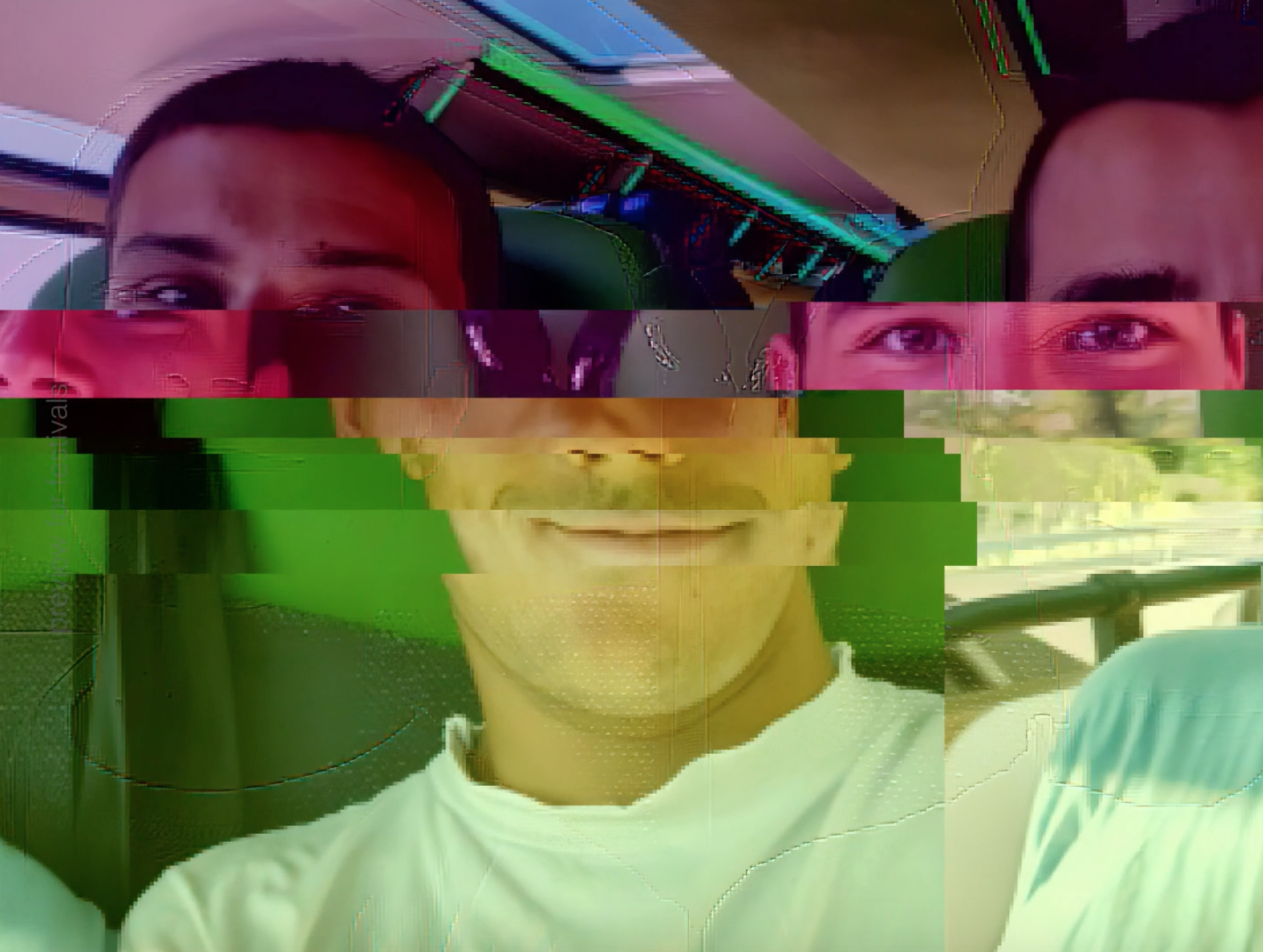
The film speaks to an era in which relationships are increasingly preserved through digital archives and the large amount of digital detritus this generates. Our personal troves of images have grown significantly in recent decades. The availability and cost of film stock constrained people to choose what to archive, and therefore, to also curate the image of their past. In this sense, digital media is counterintuitive, even antithetical to curatorship: it has the ability to seemingly conserve everything, including moments that seem utterly inconsequential, even banal, that are valued only in retrospect (if at all). Near the film’s end, one of the men confesses to having “read the text messages again” (in the aftermath of a fight, one presumes: one sequence illustrates a desperate series of unanswered calls and messages that read “answer me please”), apologising for not having realised that the other was “really struggling”—an afterthought that only digital media’s vast conservation allows.
The more traces and materials of our lives we can preserve and archive, the more devastating their loss, be it through accident or obsolescence, is perceived to be. I recall how heartbreaking it was to lose a hard drive that contained all the photos of my early adolescence, or how friends had told me of their despair at losing WhatsApp archives that contained the last vestiges of relationships, marking their definitive, irredeemable loss. Just like one might have lost the written correspondences of yesteryear to fire or water, yet differently.
Still, another paradox arises: given how easily digital data can be destroyed, why wasn’t this phone “wiped” clean of the files that retained the relationship? An act that is instant, and in most cases irreversible: deleting is certainly much easier than ripping letters apart, burning photos, or cutting people out of them—yet, one could change their mind about it: those letters and cut-up figures could be pasted back, the photos saved from the fire before it fully consumes them. The coldness (if not, outright brutality) of how digital data is parsed brings me to another thought: if physical memories used to be read and analysed by historians, now, our correspondences will increasingly be parsed by various programmes and large language models—rendering even the act of remembrance, of analysing the past, into a digital process. Casanova’s act, as a director, is both to take note of this reality and to subtly oppose it: his gesture of reconstruction is ultimately, profoundly humanistic.
Despite the damage, the relationship between Hugo and Hendrik remains preserved in time, like a mantis in amber: Casanova shines a light through its golden molasses, projecting its image onto other screens. It’s what the French film critic André Bazin would have called the mummy complex, multiplied ad infinitum by digital proliferation: each of us is now carrying around bits of “embalmed time”, images, videos, and sounds of so many things that have been lost to time —be it past selves, deceased loved-ones, or broken relationships.