yanco Home
Menu
  • Home
  • watch
  • magazine
  • calendar
  • index
  • Subscribe
Search Log in
  • nl
  • en
You are here
  • Home
  • Magazine
  • Dreaming Adrift
elephantfish (Meltse Van Coillie, 2018)

Dreaming Adrift

Meltse Van Coillie’s elephantfish

essay by
Mariana Hristova
01.10.2022

Darkness can be mysterious and scary but also mind-provoking and triggering for one’s fantasy. elephantfish, a film as unusual as its title, starts by describing an equally peculiar dream narrated by a quiet voice in the background of the black frame: an elephant in the sea greedily drinks the water as if trying to swallow it all. As the dreamer approaches the monster, it gets smaller and smaller, no bigger than a fish. Instead of turning into a Leviathan1 as the quasi-mythological premise of the tale suggests, it eventually dies, and the film itself unfolds in a hardly expected way.

This parable-like story is a departure point for Meltse Van Coillie’s film, which, in combination with the darkness of the black screen, becomes a clean slate on which one can invent an ample of fantastic scenarios. The images generated by the viewers in those unlit opening minutes will accompany them throughout the further perception process, mixing imaginary pictures with what happens on screen. elephantfish invents a liberating space for personal interpretation of the oddities that will occur next.

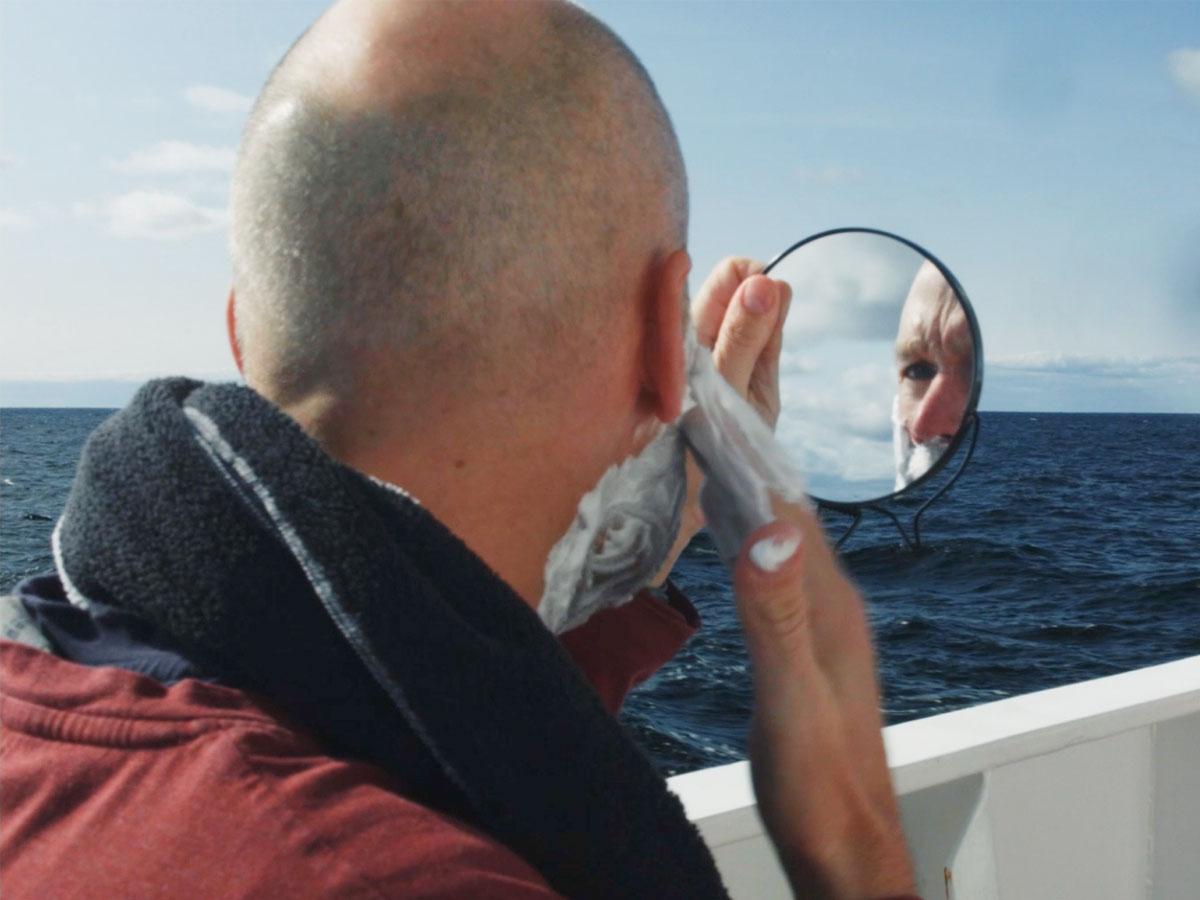
The action is now visually, not only virtually, taking place on a heavily loaded industrial ship, and the camera generously lets the spectators in so that they feel part of the crew. That’s actually how the film team set it up for themselves as well: the “boutique” environment aboard is recreated en petit comité—the director Meltse Van Coillie and the cameraman Harm Dens (also life partners), just the two of them, merged with the sailors by starting living side by side with them in the middle of the sea, to experience their journey from within, and to persuade them to participate in the cinematic adventure, which happens to be Van Coillie’s graduation film. Such an approach explains the conquering identification one can feel with the authors’ ambiguous eyes. Eyes of observers who constantly step in and out of the ship’s inhabitants’ shoes without necessarily imposing a clear viewpoint on those watching from the other side of the screen.

I also identified immediately with the environment in a semi-conscious, irrational way. As if I jumped into the viewpoint of a prisoner for whom outdoor freedom is equally desirable and useless because it remains untouchable. The isolation within the vessel is striking and captivating; only the pictures of a newborn a sailor looks at on his cell phone remind him of the busy life buzzing outside. Two other sailors, identically equipped in yellow smocks, execute tedious, repetitive tasks in line with the blue monotony around them. Their mission is to constantly paint the deck to prevent the rust from “eating” their living space and taking over. However, not rust but another more powerful force will conquer them from within and will liberate them from the prison of the pointless Sisyphean labor. Is it the providence that arrives to save the sailors, or their boredom of contemplating life instead of living it, that provokes the swelling mass of sand to erupt from the bowels of the ship and fill in the voids of their solitude? Is the Fabula what matters most when interpreting the film, or rather its hypnotic instrumentation in the first place, using the oscillating sea as a pendulum?

From the first sequence, after the dark opening, one’s gaze is invited to wander around this floating surface of the ocean. A limited area amidst enormity, while the waterscape out there, with the unreachable horizon, suggests infinity and eternity, both scary and mysterious, like the impenetrable darkness at the start. The sight of something immense and unruly such as the water element in all its glory, together with the phantasmagoric creatures that might be hiding beneath its surface whose imagery has been nurtured by myths and legends over the centuries, calls out cosmogonic associations.

At the same time, the cinematic mise-en-scene is a space of contrasts. Incommodious and stuffed ship cabins oppose the frightening freedom оutside—claustrophobia and agoraphobia go hand in hand. The visual purity in the clean exteriors and the asceticism of the interiors are impactful; only the most necessary is disposable. The pacing allows enough time to explore each detail without rationalizing. Those objects, people, or movements inhabiting the space are part of the film’s texture and mood—like in an expressionist painting.

Horror vacui is a Latin expression signifying the fear of empty spaces, like the one that ancient Greeks must have experienced when facing those large areas waiting to be filled with buildings. The term refers specifically to leaving a gap in artistic composition. Here, exploration of the void, on the one hand, implies emotions such as fear and anxiety. In their minds, the characters might have invented the Big Bang on their ship, a little private apocalypse that they prefer to the mundane reality and the never-ending exhausting routine. On the other hand, Van Coillie does not forget that a void can lead to possibilities too. Getting immersed into the void can be an exciting challenge for the imagination to originate various realities, a different one in each viewer’s head.

From the black screen beginning to the multi-interpretable ending, empty spaces fill this slow cinematic piece of art. Van Coillie doesn’t care about stuffing the gaps with answers, nor does she ask questions. Dreaming is a priority, an exercise for which empty spaces are more than welcome.

Read more

elephantfish

Meltse Van Coillie, Belgium, 2018, 27’

A ship drifts in the middle of an endless sea. Aboard is a crew of five. They all cope with boredom — some by trying to overpower it; others by escaping into a parallel world guided by dreams.

Read more

    read more

    © O Rio de Janeiro continua lindo (Felipe Casanova, 2025)
    O Rio de Janeiro continua lindo (Felipe Casanova, 2025)
    article
    Read more

    Rhythms as Reclamations

    Felipe Casanova’s O Rio de Janeiro continua lindo

    Alonso Aguilar
    10.10.2025

    From afar, Rio’s Carnival often seems the quintessential expression of everything Brazilian. The intense and relentless rhythms incite a trance-like celebration, where song and dance amplify the joyful aura to its utmost hypnotising. The foreign onlooker gawks at the carnival because of its enthralling release from the usual reign of restraint and rationality. To them, it plays as a sensorial reverie whose exuberant exterior embodies the “exotic”, but beyond the initial flash and pan, there’s a communal force deeply ingrained in the event.

    Read more
    © Ramallah, Palestine, décembre 2018 (Juliette Le Monnyer, 2025)
    Ramallah, Palestine, décembre 2018 (Juliette Le Monnyer, 2025)
    article
    Read more

    Agents of Control

    Juliette Le Monnyer’s Ramallah, Palestine, décembre 2018

    Ren Scateni
    16.09.2025

    Juliette Le Monnyer’s Ramallah, Palestine, décembre 2018 (2025) wants us to bear witness. Within a tight ten-minute running time, this minimalist film unfolds as a controlled documentation of one moment of colonial violence during Israel’s occupation of Palestine—almost unremarkable in its sickening mundanity, even tame when compared to the genocidal atrocities livestreamed over the last twenty-three months.

    Read more
    Katherine May Fannon (Helga Dorothea Fannon, 2025)
    Katherine May Fannon (Helga Dorothea Fannon, 2025)
    essay
    Read more

    The Amateur and the Archive

    On “Glued & Screwed #33 (Meditation)”

    Arta Barzanji
    14.09.2026

    Love and respect for an archive cannot mean approaching it so delicately that one refuses to act upon it: every selection, montage, recollection or speculation transforms what it touches. Nor does openness mean withholding commitment. It means committing strongly enough for an encounter to answer back—for an image, voice or vanished life to resist the meaning prepared for it and perhaps alter the form built around it.

    Read more
    © BAN♡ITS (Omar Chowdhury, 2024)
    BAN♡ITS (Omar Chowdhury, 2024)
    article
    Read more

    Why So Serious?!

    On Omar Chowdhury’s BAN♡ITS

    Ren Scateni
    12.02.2025

    “There’s a reason why everybody hates Batman in those movies,” comments one of the titular protagonists in Omar Chowdhury’s BAN♡ITS. Set in a liminal space between Bangladesh and India, the film follows a group of self-proclaimed “destitutes” who rob the rich to give to the poor and are obsessed with Heath Ledger, because “he died for his art.” Inhabiting a lawless limbo where radical credos coexist with state-sanctioned anarchic stances these outlaws are as porous and opaque as Chowdhury’s film itself.

    Read more
    © HERMAN ASSELBERGHS
    verslag
    Read more

    Aandacht voor aandacht

    Time Wasted in argos

    Gilles Vandaele
    18.03.2024

    Nog tot 30 juni is in argos, het Brusselse centrum voor audiovisuele kunst, een videotentoonstelling van Herman Asselberghs te zien. In Time Wasted focust de Belgische filmmaker en kunstdocent op de plaatsen die hij het best kent: de filmzaal en het klaslokaal.

    Read more
    © Bamssi (Mourad Ben Amour, 2024)
    Bamssi (Mourad Ben Amour, 2024)
    essay
    Read more

    An Outstretched Hand

    Mourad Ben Amor’s Bamssi

    Öykü Sofuoğlu
    12.05.2025

    Animals no longer live in nature; they now exist first and foremost on our screens. While each new internet-based encounter with them still feels as surprising and delightful as ever, the obsessive relationship with animal imagery often remains limited to fulfilling our emotional needs—rarely do we question the underlying motives. Mourad Ben Amor’s Bamssi (2024)—a diary film made alongside a pack of animal protagonists—hints that our fascination may sometimes be less about the animals themselves than about the spontaneity and impulsivity that emerge from their most routine gestures.

    Read more
    © In Flanders Fields (Sachin, 2024)
    In Flanders Fields (Sachin, 2024)
    article
    Read more

    A Voice For The Ghosts

    Sachin’s In Flanders Fields

    Eneos Çarka
    13.08.2025

    In Flanders Fields is a ghost story. Directed by Rajasthan-based filmmaker Sachin, the short film is a poetic meditation on war, colonial erasure, and ancestral presence in foreign land. The director introduces us to a rarely acknowledged fact in dominant historical narratives: during the First World War, as many as 1.4 million Indians were conscripted by the British and sent to the frontlines in Flanders. This revelation sets the stage for a cinematic elegy to those forgotten men.

    Read more
    Noonlight (Kayt Schneider, 1991)
    Noonlight (Kayt Schneider, 1991)
    essay
    Read more

    Wandering through the Intimate Public

    Kayt Schneider’s Noonlight (1991)

    Tianyu Jiang
    15.09.2025

    There’s something mesmerising about a bustling open-air market in a metropolis. Its space is shaped by loudness, tangled in the flux of languages and accents. Visually, colours spill across the full spectrum, as their vibrancy fuels commerce and connection. In Noonlight (1991), Kayt Schneider turns an ordinary walk through Brussels’s Zuidmarkt into a quiet study of the subtle dynamics between people, the city, and time. The gritty 16mm imagery, layered over the market’s constant white noise, leads us into a past that feels uncannily familiar.

    Read more

    Subscribe to our monthly newsletter for updates on new releases, publications, and events!

    Subscribe

    yanco is a magazine and streaming library for short-form moving image

    kortfilm.be vzw
    Boondaalse Steenweg 249
    1050 Elsene
    BE 0478 441 315
    info@yanco.be

    with the support of the Flanders Audiovisual Fund (VAF) of the Flemish Government

    VAF
    • about
    • colophon
    • privacy policy
    Facebook Instagram LinkedIn YouTube Letterboxd
    design by de Ronners
    website by eps en kaas