
Subscribe for €30 and get one-year access to the 70+ films in our streaming library. This supports not only our magazine but also the filmmakers we represent.
part of
double bill #36
Sylvia Kristel – Paris
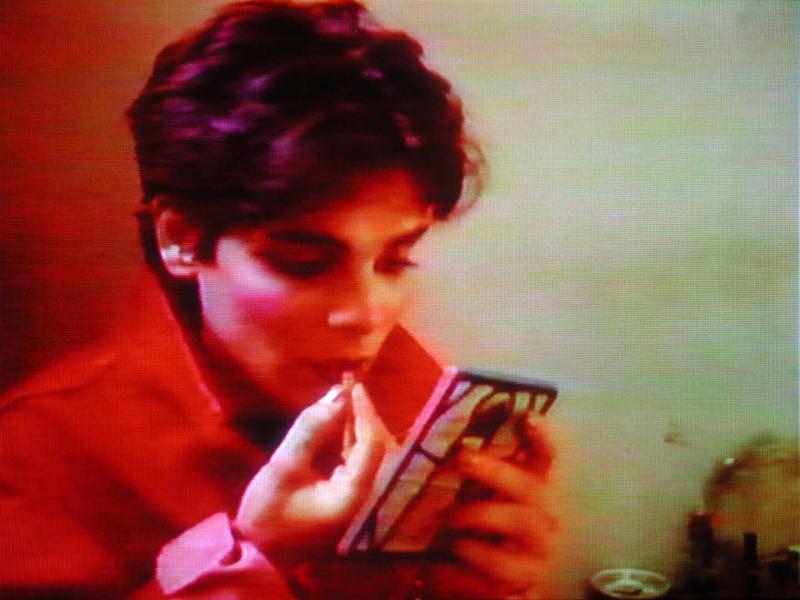
Sylvia Kristel – Paris is a portrait of Sylvia Kristel, best known for her role in the 1970’s erotic cult classic Emmanuelle, as well as a film about the impossibility of memory in relation to biography. Between November 2000 and June 2002, Manon de Boer recorded the stories and memories of Kristel. At each recording session she asked her to speak about a city where Kristel has lived: Paris, Los Angeles, Brussels or Amsterdam; over the two years she spoke on several occasions about the same city. At first glance, the collection of stories appears to make up a sort of biography, but over time it shows the impossibility of biography: the impossibility of ‘plotting’ somebody’s life as a coherent narrative.
After having recorded different stories, Manon de Boer decided to use only two stories about the period that Kristel lived in Paris. In the course of the montage, she decided not to show the two stories in their chronological order. In other words: to show first the story recorded in 2002 and after that the story recorded in 2001. This was done because the story which she tells first, ergo the one that you hear as the second one, provides far fewer details. In that way, not only the memory of Sylvia Kristel is questioned but also the memory of the viewer, and an element of doubt is introduced.
Kristel’s stories wander through some of the key points in her life, fluidly forming and reforming the narrative elements. The city itself is rarely described directly. She speaks of her films, her love affairs, and how these have influenced her life’s trajectory. The cities are coordinates to which her memories move to, find themselves within, and move away from. This finds a parallel in the image. These images are filmed from high up and at street level, moving over the cities’ skin: their roofs, apartment buildings and boulevards, intercut by shots of cinemas, publicity images and people. The architecture appears as an interface between interiority and exteriority. Old Paris is intercut with images of architecture from the 1970’s; buildings that didn’t exist when she lived there, but which are as iconic of the period as she is herself.
Bio Manon de Boer
The experience of time is central to Manon de Boer’s work. Her films create an expanded sense of time, rooted in the conditions of their making. Rather than conforming to normative notions of time as functional and productive, they allow a sense of the present to emerge and unfold. De Boer works primarily with moving images, but increasingly explores sculpture and installation in relation to her films. In 2021, she also made the performance Ghost Party (1), in collaboration with Latifa Laâbissi.
Credits
Cast
Sylvia Kristel
Camera
Editor
Inneke Van Waeyenberghe, Manon de Boer
Sound
George van Dam, Manon de Boer
Distributor
Auguste Orts