yanco Home
Menu
  • Home
  • watch
  • magazine
  • calendar
  • index
  • Subscribe
Search Log in
  • nl
  • en
You are here
  • Home
  • Magazine
  • Sound Bath
+6 Gain (Jorn Plucieniczak, 2019)

Sound Bath

Jorn Plucieniczak’s +6 Gain (2019)

article by
Ben Flanagan
20.02.2024

It usually takes a single warning, but this film has two. First, “This film contains stroboscopic effects.” Meaning, shield your eyes and brace yourself; a migraine is incoming. Do you have a glass of water handy? The other, “Luca School of Arts Campus Sint-Lukas Brussel”, is perhaps more ominous; beware of the student filmmaker’s naivety and conformity with the prevailing euro-art-house style. But you know what? These art school kids, mentored by renowned Bas Devos, know how to throw a party.

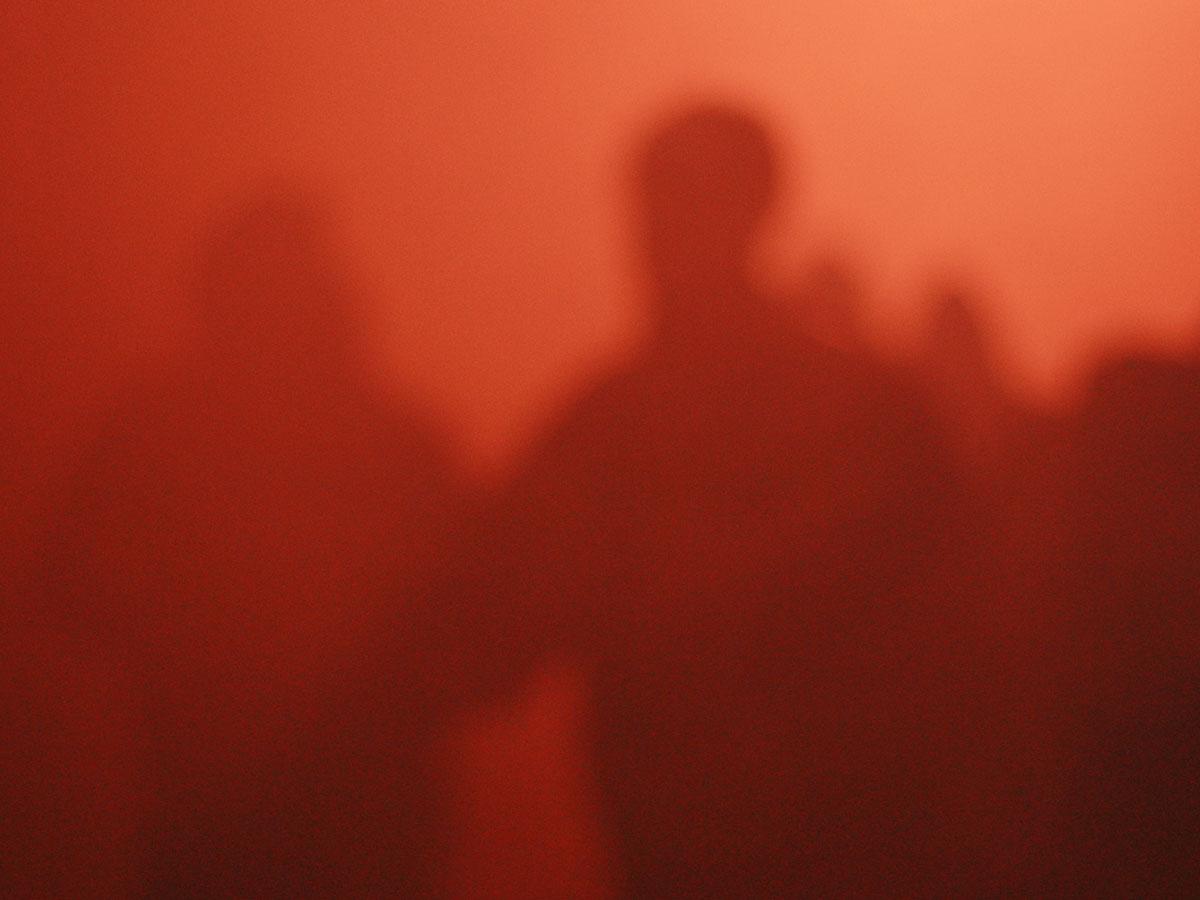
So when +6 Gain opens, anticipation is in the air. The sky is a pinkish blood moon, a shepherd’s delight, an evening like no other. We hear nothing. Genk-born filmmaker Jorn Plucieniczak starts his film with an aesthetically pleasing image, trees, and that rich sky, and then questions what’s underneath. We cut to a blurred, fumbled tracking shot of quiet suburban roads, street lights, with no sound. The post-industrial landscapes that characterise the Flanders cinema you often see on the international festival circuit are eschewed, merely glanced at in passing. The camera points upward in fear of pylons, as if they were the tripods from War of the Worlds, before running for safety toward the even more terrifying forest, where green leaves threaten to poke through all that pink. A figure cuts through the strobe within, resembling the creepypasta Internet meme Slender Man, a tormenter. Then the title card hits to wake us up.

The Slender Man—actor/subject Symen Martens—also awakens as the camera slowly finds focus—sweater draped off one shoulder, stretchers in his ears. Head shaved, though he would rock a widow’s peak haircut. Skater, footy on the weekend, chill out after work with a few tins and a bit of Family Guy. Martens is an instantly recognisable type and, like so many Belgians, absurdly chiseled—something in the beer, I’m sure. He’s pensive, even though his friend Sam talks his ear off about Frenchcore, an obnoxious Gabber subgenre. It’s the morning after a rave, their raison d’être, and Plucieniczak captures their gloaming. Martens has to work tomorrow, so no drink, he says, as Sam scoffs.

Another red street. A larger group of lads in their shell suits, at a half distance, chatting, smoking fags. It’s last night’s—now Martens is mournful, out of focus again. Sam recalls Dour Festival, of leaving their suburban sprawl where daylight never quite breaks, where children and grown-ups are absent. Since coming home from the festival, he can’t stop watching clips of the experience on YouTube—the festival mindset of creating party memories is about the only thrill this pair can chase.

Martens’ parents are never home, and that’s where Plucieniczak takes us next, filming the mere corners of its exterior like it’s a place he would rather not capture. Martens, in his Adidas tracksuit, sat on a bench, looking into the kitchen. He hits the vape, and smoke wafts around his legs. In its duration, the following close-up breaks reality: Martens is no Lee Kang-sheng, Tsai Ming-liang’s fetish actor, but his lack of interiority betrays the larger mindset here. He answers a cell phone call. “What’s the location?”

Plucieniczak is searching for the spiritual in the notion of Living For The Weekend, and as it gets closer, the colours are further enveloping, pink turning to red. Strobes flicker on Martens’ bald head. His body is out of focus, camera swerving left and right; it’s full Irréversible; the music begins to swoosh in, a trance banger waiting patiently to drop. But instead, we cut into the lounge. On-screen: Call of Duty, a sniper. The camera pans left from the screen to the Jarman-blue walls of Stretch’s house. Sounds of the console fan, the disc tray whirring, and his friend checking Google Street View for the location. It’s a forest with some acoustically friendly-looking caves.

Now, they have arrived at their destination. Darkness, behind, “Do you hear it?” We hear nothing. Torchlight leads their Dickies backpacks. They trudge through, sizing it up. Is this space enough for Hardcore? By morning, they’re napping there. The camera floats by them, like a poltergeist checking out the new prey. Philippe Grandrieux’s figural images linger somewhere above us. It’s time.

A black screen for a long while, though length in this film’s terms is relative. It’s maybe thirty seconds. Then, the repetitive Gabber beat hammers. Do you like this? You shouldn’t. It builds, the sound of slaps on metal—more bass. Hardcore takes the intellectual out of Industrial Techno, reducing the liquid cool to pure noise and negative energy. Red flickers, out-of-focus bodies sway, camera dollies in as laser abrasions take the music someplace else, suddenly sharp focus, moving past the people so it’s a strobe, it’s all strobe, flickering like Brakhage, like a film reel spooling, reminding this digital production of its lineage. Glitches on screen—the Vimeo link? My fibre connection? No, it’s real; we’re leaving Earth behind. That’s what Gabber does, not that anyone in their right mind would enjoy it, but Martens reaches a peak in this ADHD music, this aural stim, and now the screen is barely colours at all, just abrasions of light and dark.

Read more

+6 Gain

Jorn Plucieniczak, Belgium, 2019, 26’

Symen and Sam pass their time in the monotony of a post-industrial suburb. They seem to linger in a kind of perpetual twilight countered by the invisible presence of ‘hardcore’. While gaming, they end up searching for the core of their desires.

Read more

    read more

    À Gis (Thiago Carvalhaes, 2017)
    À Gis (Thiago Carvalhaes, 2017)
    essay
    Read more

    The Freedom One Does Not Allow Oneself

    Thiago Carvalhaes’ À Gis

    Michaël Van Remoortere
    30.04.2023

    Gisberta’s murder holds an important, symbolic place in Portuguese LGBTQIA+ history, similar to the murder of Ihsane Jarfi in Belgian history—a no pasarán after which society decided to enact new laws. Luckily for us (and for her), this film, this short requiem, does not attempt to convince us of the horror by reenacting Gisberta’s death in horrific detail and length, like Animals early last year deemed necessary.

    Read more
    Because We Are Visual (Olivia Rochette & Gerard-Jan Claes, 2010)
    Because We Are Visual (Olivia Rochette & Gerard-Jan Claes, 2010)
    essay
    Read more

    Together, Alone

    Olivia Rochette & Gerard-Jan Claes’s Because We Are Visual (2010)

    Dora Leu
    09.03.2025

    Inevitably, some fourteen years after its making, Olivia Rochette and Gerard-Jan Claes’ Because We Are Visual (2010) now feels like it covers a time long gone by, one when we still said video blog instead of vlog. In this collection of video diaries garnered from online public sources and then organised into chapters, Rochette and Claes provide no audio commentary on the material but make implicit remarks solely through editing.

    Read more
    © Lights (Marie Menken, 1966)
    verslag
    Read more

    Cinema-explosies op witte muren

    Filmkunst barst uit zijn voegen bij Eye tentoonstelling Underground American Avant-Garde Film in the 1960s

    Hugo Emmerzael
    09.12.2024

    In een groots opgezette tentoonstelling brengt het Amsterdamse filminstituut Eye de iconen van de Amerikaanse undergroundfilm uit de jaren zestig onder één dak samen. De avant-gardistische vormexperimenten van pioniers als Jonas Mekas, Maya Deren en Stan Brakhage staan er naast werk van bijvoorbeeld Bruce Conner, Yayoi Kusama, Yoko Ono en Andy Warhol. Blijft die vooruitstrevende filmkunst van die tijd nu nog overeind bij een overzichtstentoonstelling?

    Read more
    The Jungle Knows You Better Than You Do (Juanita Onzaga, 2017)
    The Jungle Knows You Better Than You Do (Juanita Onzaga, 2017)
    essay
    Read more

    Enduring Spirits

    Juanita Onzaga’s The Jungle Knows You Better Than You Do

    Alonso Aguilar
    01.05.2023

    With inequality as rampant as it can get and failed political structures eroding more and more as time shows their inherent futility, the milieu of the Latin American urban center has truly evolved into a no man’s land, a non-place of sheltered privilege juxtaposed to chaotic urgency, a “phantom city” as the initial narrator of Juanita Onzaga’s The Jungle Knows You Better Than You Do calls what she used to think as her hometown of Bogotá. The past tense of the latter statement has to do with her moving on from the Colombian capital, a setting that for her can only evoke violence and forgotten bodies, a sense of phantasmagoria close-knit with her family history.

    Read more
    Noonlight (Kayt Schneider, 1991)
    Noonlight (Kayt Schneider, 1991)
    essay
    Read more

    Wandering through the Intimate Public

    Kayt Schneider’s Noonlight (1991)

    Tianyu Jiang
    15.09.2025

    There’s something mesmerising about a bustling open-air market in a metropolis. Its space is shaped by loudness, tangled in the flux of languages and accents. Visually, colours spill across the full spectrum, as their vibrancy fuels commerce and connection. In Noonlight (1991), Kayt Schneider turns an ordinary walk through Brussels’s Zuidmarkt into a quiet study of the subtle dynamics between people, the city, and time. The gritty 16mm imagery, layered over the market’s constant white noise, leads us into a past that feels uncannily familiar.

    Read more
    Henry is a Girl Who Likes to Sleep (Marthe Peters, 2026)
    Henry is a Girl Who Likes to Sleep (Marthe Peters, 2026)
    article
    Read more

    In the Bosom of Images

    Marthe Peters’ Henry is a Girl Who Likes to Sleep (2026)

    Öykü Sofuoğlu
    31.03.2026

    Henry is a Girl Who Likes to Sleep finds the filmmaker once again looking back at herself, this time by orienting her gaze toward her beloved cat, the titular Henry—a chubby white feline with tricoloured splotches on her fur. Throughout the film, Marthe Peters delivers a playful voice-over addressed to Henry, drawing comparisons between their bodies, their unique habits and traits, while also questioning the love and affection she may be burdening her cat with.

    Read more
    Sirens (Raoul Servais, 1968)
    Sirens (Raoul Servais, 1968)
    essay
    Read more

    A Complaint

    Raoul Servais’ Sirens (1968)

    Charlotte Timmermans
    01.10.2022

    Early on in the film, Servais employs the boundless possibilities of animated film to portray a surreal scene: two cranes squabbling over a wooden container. The container drops and breaks. Its content: a pile of rocket bombs. War is the central theme in many of Servais’ films (Chromophobia, Operation X-70, Tank); here, however, it seems to only casually add to the dystopian world. The future has been devoured by war and industry. Literally devoured: a lonely fisherman catches nothing but fish bones. He looks deeply saddened.

    Read more
    À l’usage des vivants (Pauline Fonsny, 2019)
    À l’usage des vivants (Pauline Fonsny, 2019)
    essay
    Read more

    In the Margins

    Pauline Fonsny’s À l’usage des vivants

    Inge Coolsaet
    11.11.2022

    On September 22, 1998, the young Nigerian asylum seeker Semira Adamu died during a violent deportation attempt. Fleeing a forced marriage, she arrived in Belgium, where she was detained for several months. Searching for the right formal fit for the story Adamu can no longer tell herself, Pauline Fonsny meticulously strings together archival material with contributions from other artists. It can be said to a certain extent that A l’usage des vivants, by gleaning input within a small community of mourning artists and activists, is an example of collective filmmaking.

    Read more

    Subscribe to our monthly newsletter for updates on new releases, publications, and events!

    Subscribe

    yanco is a magazine and streaming library for short-form moving image

    kortfilm.be vzw
    Boondaalse Steenweg 249
    1050 Elsene
    BE 0478 441 315
    info@yanco.be

    with the support of the Flanders Audiovisual Fund (VAF) of the Flemish Government

    VAF
    • about
    • colophon
    • privacy policy
    Facebook Instagram LinkedIn YouTube Letterboxd
    design by de Ronners
    website by eps en kaas