yanco Home
Menu
  • Home
  • watch
  • magazine
  • calendar
  • index
  • Subscribe
Search Log in
  • nl
  • en
You are here
  • Home
  • Magazine
  • Love Under Surveillance
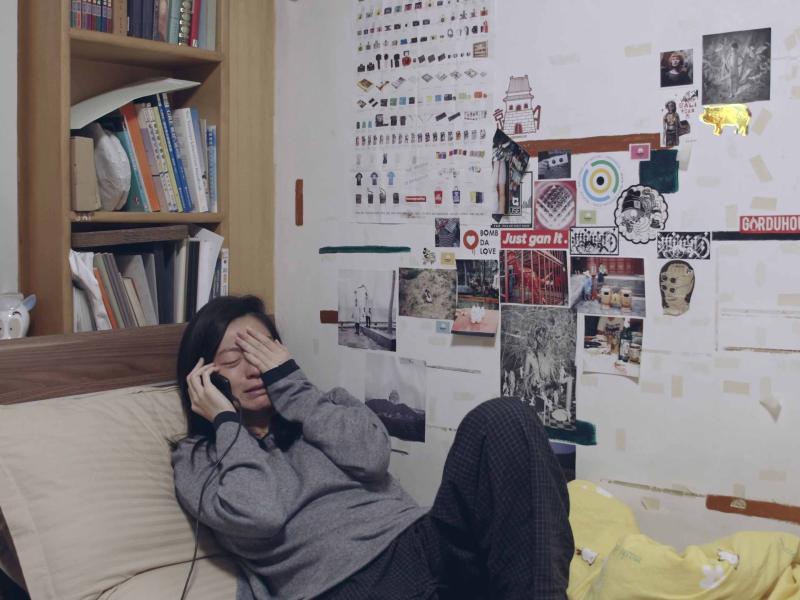
© As If Mother Cried That Night (Hoda Taheri, 2023)
As If Mother Cried That Night (Hoda Taheri, 2023)

Love Under Surveillance

A Conversation with filmmaker Hoda Taheri

interview by
Jori(k) A. Galama
12.02.2025

Over the past few years, Hoda Taheri (Tehran, 1992) has toured many a film festival with her short films Mother Prays All Day Long (2022), As If Mother Cried That Night (2023), and Mother is a Natural Sinner (2024), the first of which you can watch via yanco’s streaming library. In this “mother trilogy”, Taheri zooms in on relevant issues such as the right to abortion and the treatment of refugees in Europe. She takes on the lead role herself, cunningly and humorously dramatising her own biography.

The influence of citizenship on relationships is a common thread throughout your work. In As If Mother Cried That Night, for example, we see the struggle of an Iranian couple trying to gain asylum by becoming pregnant from a German man. What brought you to that subject matter?

Around the age of 18, I left Iran for Malaysia, to eventually end up in Berlin. The bureaucracy in Germany surprised me—at first, positively. In Iran, corruption is widespread: if you don’t know or bribe the right people, you won’t get much done. Because of the complex procedures and paperwork in Germany, the rule of law is more substantial. But gradually, my admiration crumbled. I began to see how the government extensively penetrates the private lives of individuals—specifically those without German passports. Who you go to bed with can make a difference in whether you are allowed to stay in Germany or not.

The government has a rule, for example, that if you want to marry to get citizenship, you have to sleep under the same roof at least five nights a week. During interviews with the Federal Bureau of Migration and Flüchtlinge, very intimate questions are asked, such as: “When did your girlfriend last menstruate?” These rules reflect a heteronormative framework in which non-traditional relationships are often ignored or made difficult. It always involves two people, and when two women have a child, the non-biological mother must initiate adoption proceedings. But when a man and a woman are married, any child the woman has—even if conceived by another man—is automatically her husband’s child. Moreover, the non-European partner is made dependent on the European one. This leads to situations where a European partner abuses a non-European partner by threatening to block the path to citizenship.

How do you view the changing climate around migration in Europe?

In many parts of Europe, there is a rising trend of right-wing, anti-immigrant views, with some people calling for stricter policies. These ideas overlook the fact that many countries have aging populations, and immigrants play an important role in their economies. At the same time, I try not to polarise in my work. I mostly morph the cliché image of the migrant in the European imagination, such as the mistaken notion that progressive values only exist in Europe.

In Mother is a Natural Sinner, the dialogue between the Iranian couple, led by the female character, addresses issues of gender and sexuality in a way that feels progressive, even by European standards. She challenges traditional views and pushes for a more open, inclusive perspective. Her views are bold and confrontational, questioning societal norms in radical and necessary ways, not just within the context of Iranian culture but also in broader global discussions.

Mother Prays All Day Long ends with a very intimate shot, Mother is a Natural Sinner starts from that same perspective. Why?

I am very interested in exploring feminine bodies in ways that break free from patriarchal ideas and the common forms of censorship often imposed on them. I aim to portray the feminine body with honesty, respect, and care. These particular scenes attempt to view feminine bodies from a perspective that highlights their unique strengths and possibilities. I believe that motherhood is one of these profound possibilities, and it has always been something that deeply fascinates me. Through these shots, I also hope to draw attention to the potential next generation and the conditions we choose to invite them into this world.

Pregnancy also plays an essential role in the trilogy.

Having a child within a heterosexual relationship has never attracted me. While the process in itself can be very beautiful, within our patriarchal world, it quickly feels like you are some kind of reproductive machine. This can either empower women or make them more vulnerable, and I think that’s one of the questions raised in As If Mother Cried That Night. In Mother Prays All Day Long, pregnancy is seen more as a question that the main character should deal with, while in Mother is a Natural Sinner, pregnancy becomes a turning point, making the protagonist question her position in her relationship.

Pregnancy also always comes with another side of the coin, which is abortion. I have had my own experiences with it, and I often draw from my life when working on my films. However, my personal stories don’t completely match what I show on the screen. Instead, I mix parts of my autobiography with fictional elements to build stories that explore situations I feel are important to understand and share.

In Mother Prays All Day Long, you frequently video call your mother. Those conversations seem to contribute to the documentary feel of your films. How does your mother relate to your work?

The mother is the first being we come in contact with as children. That has always fascinated me. My mother and I had a complicated relationship for a long time because, at the slightest criticism, she started crying. I didn’t want to pressure her anymore, let alone break her, but at the same time, I wanted to give space to my own desire to be able to communicate directly with her about how I felt. So, instead of telling her things directly, I incorporate them into the dialogue for the films.

For example, she believes that abortion is a sin. Playfully and gently, I let her know in my films that I think differently. After such a dialogue scene, she senses that it also revolves a bit about us.

Do you try to portray your mother in a specific way?

In the past, I used to portray her in a way that aligns more closely with the cliché image of the Iranian mother and that European audiences tend to accept easily. In real Iran, the position of women is more complex than the media portrays it. I sometimes play with these expectations. When, for example, my mother suddenly puts on a hijab for the camera at home—which she would never normally do—and says, “This is what those Europeans expect of me, right?”

She sometimes forgets her lines but generally enjoys contributing to my films. We haven’t seen each other for a long time and miss each other greatly; filmmaking is one of the things we can still do together remotely. In doing so, I am lucky that she is also a good film character; she is a vessel of progressive and conservative contradictions.

Can you tell me something about transitioning from a short film to a feature film?

In a short film, there is much more freedom because there is usually less at stake, and the shorter production time allows you to focus on pressing issues more efficiently. Because you often don’t need the approval of multiple backers, you don’t have to think as much about an intended audience—you can focus on what you actually want to express artistically. It is unfortunate that very few people go to see short films and that the only way I can get a theatrical release is with a feature film. I’m very much against that hierarchy, and I think the future belongs to short films, especially because our arc of concentration is getting shorter and shorter.

Regarding the transition from short to feature film, I noticed that I can now pay more attention to the secondary characters. In my short films, they had relatively little to say. For example, my mother has a much more layered role in my first feature film. Now she finally gets the space to really respond to me!

Read more

Mother Prays All Day Long

Hoda Taheri, Germany, 2022, 24’

Confused about German bureaucracy and questioning her sexuality, Hoda, an Iranian asylum seeker in Berlin, finds herself hooked on Magdalena, who promised to ensure her asylum by marrying her. Due to changes in Magdalena’s private life, her decision to marry Hoda becomes more complex.

Read more

    read more

    © Perpetual Night (Pedro Peralta, 2020)
    artikel
    Read more

    Choreografie met lens en licht

    Pedro Peralta’s Perpetual Night

    Inge Coolsaet
    04.02.2021

    De technische uitdaging die de jonge Portugese filmmaker aangaat in zijn kortfilm Perpetual Night getuigt van onverbiddelijke bekwaamheid.

    Read more
    Kaalkapje (Marthe Peters, 2024)
    Kaalkapje (Marthe Peters, 2024)
    artikel
    Read more

    Tedere pijn

    Marthe Peters’ Kaalkapje (2024)

    Michiel Philippaerts
    29.03.2024

    Al wat de pas afgestudeerde filmstudent Marthe Peters nodig heeft om te reflecteren op de spanningen en tegenstrijdigheden tussen het verleden en het heden, zijn verloren video-opnames uit haar jeugd. Aangevuld met nieuwe, poëtische beelden (handen die tekenen, een kat aaien, of met kaarsenvet spelen) en een doordachte voice-over, verkent Peters de littekens van een vergeten tijd uit haar leven.

    Read more
    © Portrait d’une paresseuse (Chantal Akerman, 1986)
    Portrait d’une paresseuse (Chantal Akerman, 1986)
    article
    Read more

    The Filmmaker Is Present

    Chantal Akerman’s Portrait d’une paresseuse

    Öykü Sofuoğlu
    17.11.2024

    Portrait d’une paresseuse seems one of Chantal Akerman’s more playful and lighter works—a skit in which she acts out a filmmaker’s creative process of attempting (and failing) to make a film about being lazy.

    Read more
    Old Child (Elettra Bisogno & Hazem Alqaddi, 2019)
    Old Child (Elettra Bisogno & Hazem Alqaddi, 2019)
    essay
    Read more

    Flickering Memories

    Elettra Bisogno & Hazem Alqaddi’s Old Child

    Savina Petkova
    10.05.2025

    For a refugee or an immigrant, memories of a prior life are not simply broken; they are snapped in two, three, four, or more pieces and doomed to exist separately. These split memories can emit a particular shine, as attested by Elettra Bisogno and Hazem Alqaddi’s short Old Child. The film dwells in the paradox of its title, where old age and childhood are readily coupled, as if there were no time or space in between these two ends of a human life spectrum. Of course, the title also holds melancholy, which is only one feeling in the vast emotional landscape of Old Child.

    Read more
    Speech for a Melting Statue (Collectif Faire-part, 2023)
    Speech for a Melting Statue (Collectif Faire-part, 2023)
    article
    Read more

    Beyond Leopold II’s Empty Pedestal

    Collectif Faire-part’s Speech for a Melting Statue (2023)

    Nadia Nsayi Madjedjo
    14.09.2026

    Speech for a Melting Statue by Collectif Faire-part examines a social issue that has long been a concern in Belgium—in part due to activist campaigns—but only truly made its way onto the political agenda around the time of the Black Lives Matter movement: how should we best deal with colonial monuments in public spaces?

    Read more
    © Meltse Van Coillie
    Portretfoto © Meltse Van Coillie
    interview
    Read more

    “Film moet een kunst blijven, geen consumptiemiddel”

    Meltse Van Coillie over elephantfish

    Michiel Philippaerts
    12.05.2019

    Meltse Van Coillie over het moedige maakproces van haar docufictie elephantfish, bekroond met een VAF Wildcard.

    Read more
    I Don’t Feel at Home Anywhere Anymore (Viv Li, 2020)
    I Don’t Feel at Home Anywhere Anymore (Viv Li, 2020)
    essay
    Read more

    No Place Like Home

    Viv Li’s I Don’t Feel at Home Anywhere Anymore

    Bo Alfaro Decreton
    22.02.2025

    Li’s I Don’t Feel at Home Anywhere Anymore begins at the Beijing airport and ends in a grey Brussels shopping street where the word ‘home’ is ostentatiously and tackily displayed on a large shop window. She frames her return with the cold presence of non-lieux: places that, according to French anthropologist Marc Augé, have no history or identity and do not encourage interaction. Here, everyone remains anonymous. Li places these non-lieux in stark contrast to the home. A home that is not merely synonymous with the parental home or the city where she grew up, but also arises from friendships, memories, and familiar sights and views.

    Read more
    +6 Gain (Jorn Plucieniczak, 2019)
    +6 Gain (Jorn Plucieniczak, 2019)
    article
    Read more

    Sound Bath

    Jorn Plucieniczak’s +6 Gain (2019)

    Ben Flanagan
    20.02.2024

    Plucieniczak is searching for the spiritual in the notion of Living For The Weekend, and as it gets closer, the colours are further enveloping, pink turning to red. Strobes flicker on Martens’ bald head. His body is out of focus, camera swerving left and right; it’s full Irréversible; the music begins to swoosh in, a trance banger waiting patiently to drop. But instead, we cut into the lounge.

    Read more

    Subscribe to our monthly newsletter for updates on new releases, publications, and events!

    Subscribe

    yanco is a magazine and streaming library for short-form moving image

    kortfilm.be vzw
    Boondaalse Steenweg 249
    1050 Elsene
    BE 0478 441 315
    info@yanco.be

    with the support of the Flanders Audiovisual Fund (VAF) of the Flemish Government

    VAF
    • about
    • colophon
    • privacy policy
    Facebook Instagram LinkedIn YouTube Letterboxd
    design by de Ronners
    website by eps en kaas