yanco Home
Menu
  • Home
  • watch
  • magazine
  • calendar
  • index
  • Subscribe
Search Log in
  • nl
  • en
You are here
  • Home
  • Magazine
  • The Filmmaker Is Present
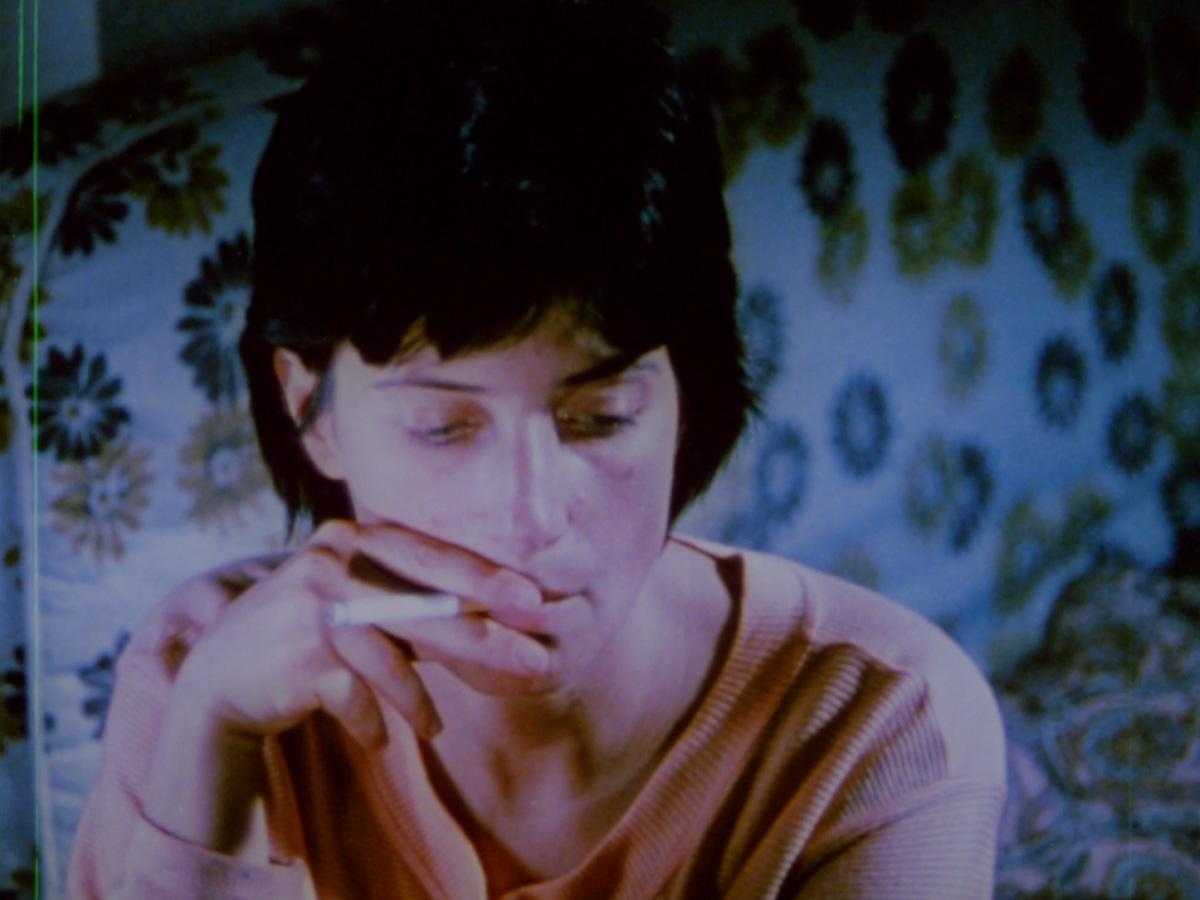
© Portrait d’une paresseuse (Chantal Akerman, 1986)
Portrait d’une paresseuse (Chantal Akerman, 1986)

The Filmmaker Is Present

Chantal Akerman’s Portrait d’une paresseuse

article by
Öykü Sofuoğlu
17.11.2024

“Today is Saturday, and I’m going to write a text on a film about laziness!” I’ve stopped counting how many Saturdays have passed while I was staring at a blank page since I first uttered this phrase. Portrait d’une paresseuse seems one of Chantal Akerman’s more playful and lighter works—a skit in which she acts out a filmmaker’s creative process of attempting (and failing) to make a film about being lazy.

Self-reflexivity and humorous distance toward the subject matter are, of course, the driving forces of the entire bit. To what extent Akerman’s struggle against inaction is staged or merely an act, remains unclear. The constant blurring between the fictive and the authentic makes the film as relevant today as ever—even inspiring this film critic to mimic the very same thing in her own writing, as a way of hiding her irresponsibility behind a stylistic device. (Or does it really?)

From the moment she wakes up to her alarm clock and throughout the entire film, the filmmaker looks and talks directly to the camera, announcing her imminent actions, some of which she never carries out. With a witty yet discreet smile in her eyes, Akerman indulges in delusive self-reassurance and procrastination. “I'll take some vitamins, then I’ll clear the table,” or, “I'll have a cigarette, then I’ll make the bed,” she says, fully aware that she won’t. Her gaze invites the audience to join her playful deviations, while the static long takes stretch time on and on.

A feeling of uneasiness begins to arise—not only because her inaction feels disturbingly familiar but also because another person is present: the verbally silent yet physically and musically loud Sonia Wieder-Atherton—Akerman’s real-life partner with whom she lives and whose evocative scores would become the distinctive voice of her cinema. The entire being of this roommate contrasts sharply with the prevailing inertia. Performing the self is one thing; doing so in the company of another person, especially someone with whom you share a domestic space, is quite another. This is why the film’s theatrics go beyond unilateral, self-absorbed, isolated expressivity, considering the boundaries and pressures that come with an interpersonal spatial setting.

Given the filmmaker’s predisposition to repetition and rumination, it’s no surprise that Portrait d’une paresseuse recycles some themes and concepts from Lettre d’une cinéaste: Chantal Akerman (1984). Both films contribute to the self-proclaimed larger tapestry of “same old Chantal, same old ideas.” It’s curious how contemporary, diverse audiences perceive Akerman’s self-image. Today, performativity and self-awareness are staples of both the art world and social media. Creating art while venting one’s difficulties in doing so seems like a banal and, indeed, lazy practice.

With Akerman’s cinema increasingly discovered by younger, often queer and/or female viewers, a posthumous reinterpretation of her work seems inevitable. Although the ultimate impact of mainstream culture reappropriating Akerman’s more austere and unfathomable films is yet to be measured, a collateral (and beneficial) outcome already emerging is that films like Portrait d’une paresseuse, once deemed minor, sloppy, or unserious, are now put under the spotlight and become as one says nowadays, so damn relatable.


    Bio Öykü Sofuoğlu

    Öykü Sofuoğlu is a Turkish film critic and journalist based in Paris. Her film-related writings have been published in various outlets, including International Documentary Magazine, Screen Slate, and Letterboxd Journal. She is also one of the co-editors of Outskirts Film Magazine. 

    read more

    © Wank Stallions (Alison Murray, 1993)
    Wank Stallions (Alison Murray, 1993)
    essay
    Read more

    Tales of Longing

    “solitude au masculin”

    Savina Petkova
    27.10.2025

    In “solitude au masculin”, curated by Inge Coolsaet for argos, the emotional struggles of men passed down from generation to generation are observed through the queer and feminist lenses of three films, spanning from the 90s through today. The internal battles of the characters reveal discrepancies, conflicting masculinities, and a distressing solitude. Savina Petkova unravels a tale of longing throughout the short film programme.

    Read more
    Old Child (Elettra Bisogno & Hazem Alqaddi, 2019)
    Old Child (Elettra Bisogno & Hazem Alqaddi, 2019)
    essay
    Read more

    Flickering Memories

    Elettra Bisogno & Hazem Alqaddi’s Old Child

    Savina Petkova
    10.05.2025

    For a refugee or an immigrant, memories of a prior life are not simply broken; they are snapped in two, three, four, or more pieces and doomed to exist separately. These split memories can emit a particular shine, as attested by Elettra Bisogno and Hazem Alqaddi’s short Old Child. The film dwells in the paradox of its title, where old age and childhood are readily coupled, as if there were no time or space in between these two ends of a human life spectrum. Of course, the title also holds melancholy, which is only one feeling in the vast emotional landscape of Old Child.

    Read more
    Tukuleur (Brahim Tall, 2022)
    Tukuleur (Brahim Tall, 2022)
    artikel
    Read more

    Toucouleur

    Brahim Talls Tukuleur (2022)

    Orlando Verde
    17.04.2023

    De titel van de film speelt met de naam van een 19de-eeuws West-Afrikaans keizerrijk. Toucouleur is ook een van de namen van een volk uit wat vandaag Senegal heet. Maar Tall speelt ook bewust met de verwijzing naar ‘kleur’. Het is belangrijk dat de titel van betekenis verandert afhankelijk van de context waarin die uitgesproken wordt, want ook huidskleur krijgt in verschillende contexten een andere betekenis. Zo ook worden mensen met gemengde etniciteit vaak gezien als van hier noch van daar. Of juist van overal, maar dan anders, zoiets.

    Read more
    Saute ma ville (Chantal Akerman, 1968)
    Saute ma ville (Chantal Akerman, 1968)
    artikel
    Read more

    Preludes van een visionair

    Chantal Akermans La Chambre (1972) en Saute ma ville (1968)

    Inge Coolsaet
    27.05.2021

    In haar vroege kortfilms tekende Chantal Akerman, moedwillig maar ook onbewust, de contouren van haar eigen toekomst uit. Alle fundamenten van haar oeuvre, vormelijk en inhoudelijk, werden er gezet.

    Read more
    Portret van Marcel Broodthaers (1972, Düsseldorf) © Joaquim Romero Frías
    artikel
    Read more

    Ceci ne serait pas du cinéma: de films van Marcel Broodthaers

    Jan Sulmont
    24.05.2023

    Een inkijk in het filmische werk van de Belgische poëet en kunstenaar Marcel Broodthaers (1924-1976), dit jaar postuum een eregast van het Internationale Kurzfilmtage Oberhausen.

    Read more
    +6 Gain (Jorn Plucieniczak, 2019)
    +6 Gain (Jorn Plucieniczak, 2019)
    article
    Read more

    Sound Bath

    Jorn Plucieniczak’s +6 Gain (2019)

    Ben Flanagan
    20.02.2024

    Plucieniczak is searching for the spiritual in the notion of Living For The Weekend, and as it gets closer, the colours are further enveloping, pink turning to red. Strobes flicker on Martens’ bald head. His body is out of focus, camera swerving left and right; it’s full Irréversible; the music begins to swoosh in, a trance banger waiting patiently to drop. But instead, we cut into the lounge.

    Read more
    © MISTY PICTURE (Christoph Girardet & Matthias Müller, 2021)
    Misty Picture (Christoph Girardet & Matthias Müller, 2021)
    essay
    Read more

    Cinematic Ghosts

    On Christoph Girardet and Matthias Müller’s Misty Picture

    Oana Ghera
    09.12.2024

    Through association, repetition, and accumulation, Christoph Girardet and Matthias Müller showcase the inventory of Hollywood formal clichés that contributed to the creation of the Twin Towers’ symbolic capital, reflecting at the same time on the power of those images to haunt our collective imagination to this day.

    Read more
    © Neighbours (Norman McLaren, 1952)
    artikel
    Read more

    De vernieuwende animatietechnieken van McLaren

    Norman McLarens Neighbours

    Benjamin Antonissen
    27.05.2020

    De Schots-Canadese animator Norman McLaren experimenteerde al van jongs af met verschillende filmtechnieken.

    Read more

    Subscribe to our monthly newsletter for updates on new releases, publications, and events!

    Subscribe

    yanco is a magazine and streaming library for short-form moving image

    kortfilm.be vzw
    Boondaalse Steenweg 249
    1050 Elsene
    BE 0478 441 315
    info@yanco.be

    with the support of the Flanders Audiovisual Fund (VAF) of the Flemish Government

    VAF
    • about
    • colophon
    • privacy policy
    Facebook Instagram LinkedIn YouTube Letterboxd
    design by de Ronners
    website by eps en kaas