yanco Home
Menu
  • Home
  • watch
  • magazine
  • calendar
  • index
  • Subscribe
Search Log in
  • nl
  • en
You are here
  • Home
  • Magazine
  • The In-Between
Meander (Joke Liberge, 2005)

The In-Between

Joke Liberge’s Meander (2005)

essay by
Boet Meijers
Translated by
Flo Vanhorebeek
20.07.2026

As you approach your twelfth birthday, you are inevitably split in two; one half is still a child—dependent on your parents, interested in Beyblades, licorice, scented felt-tip pens and sticks that look like weapons. The other half begins to see itself as a sovereign being, carefully shaping an identity, its sights set on a hazy goal that has suddenly appeared on the horizon: adulthood.

Joke Liberge’s short film Meander is set on a summer afternoon and follows a group of boys and girls who find themselves in said transitional phase, on the cusp of puberty. With rubber rings and towels around their necks, they cycle to a pier on the Dutch Meuse to swim in the river and laze about in the blissful emptiness of their summer holidays. Cow parsley and rapeseed, having reached their midsummer height, offer shelter from the outside world and enclose a testing ground where the children can dip their toes into adult life without hindrance.

As on any successful summer’s day, close to nothing happens. The boys compete for the girls’ attention, while the girls, for their part, see them as nothing more than little brothers. Still, they do steal glances from one another. This emptiness contrasts with a wealth of sensory experiences: gentle breezes rustling through the treetops, feet on wooden decking and a summer sun generously casting its light over everything—all of which make the season feel like the protagonist, so tangibly rendered on the big screen. But unlike how such an afternoon would actually sound, Meander is devoid of dialogue. Apart from the occasional exclamation, the children do not speak. Pointing and gesturing are enough to make themselves understood. As a result, they seem to symbolise their age group rather than being individuals. In this way, the depicted summer afternoon belongs a little bit to everyone: a shared memory of days that, when looked back on, feel like nothing but bliss, even though they were, above all, coloured by sweaty uncertainty.

Liberge manages to portray believable characters remarkably well, despite the lack of dialogue. Not only are the children left undisturbed within the narrative, indeed the entire film crew seems to have blended into the background, hidden among the vegetation on the riverbank. Such is the naturalness of the actors’ performances. The children pick at their belly buttons and chew on their fingers as if no one were watching. The camera observes almost invisibly. It just peeks in.

Usually, the voyeur does not belong to the world he is spying on. He is unwelcome and therefore forced to gain access from a distance. Just like the adult viewer who can enjoy a bygone era of which they are no longer a part, but to which they still want to belong in some way. Because once they were just like them, and the years depicted were so formative that it still feels as though they belong to them in some way. However, even the voyeur needs an anchor—a point of entry into the world onscreen, a mooring post around which to throw a rope.

Read more

Meander

Joke Liberge, Belgium, 2005, 15’

On a hot summer day, five teenagers go to a river to cool off. They swim, they sleep, they eat snacks and ice cream. As music and dialogue are missing, everyday sounds attract attention: bicycles riding on gravel, feet gliding through water, gasps and splutters.

Read more

Apart from the occasional exclamation, the children do not speak. Pointing and gesturing are enough to make themselves understood. As a result, they seem to symbolise their age group rather than being individuals.

Boet Meijers

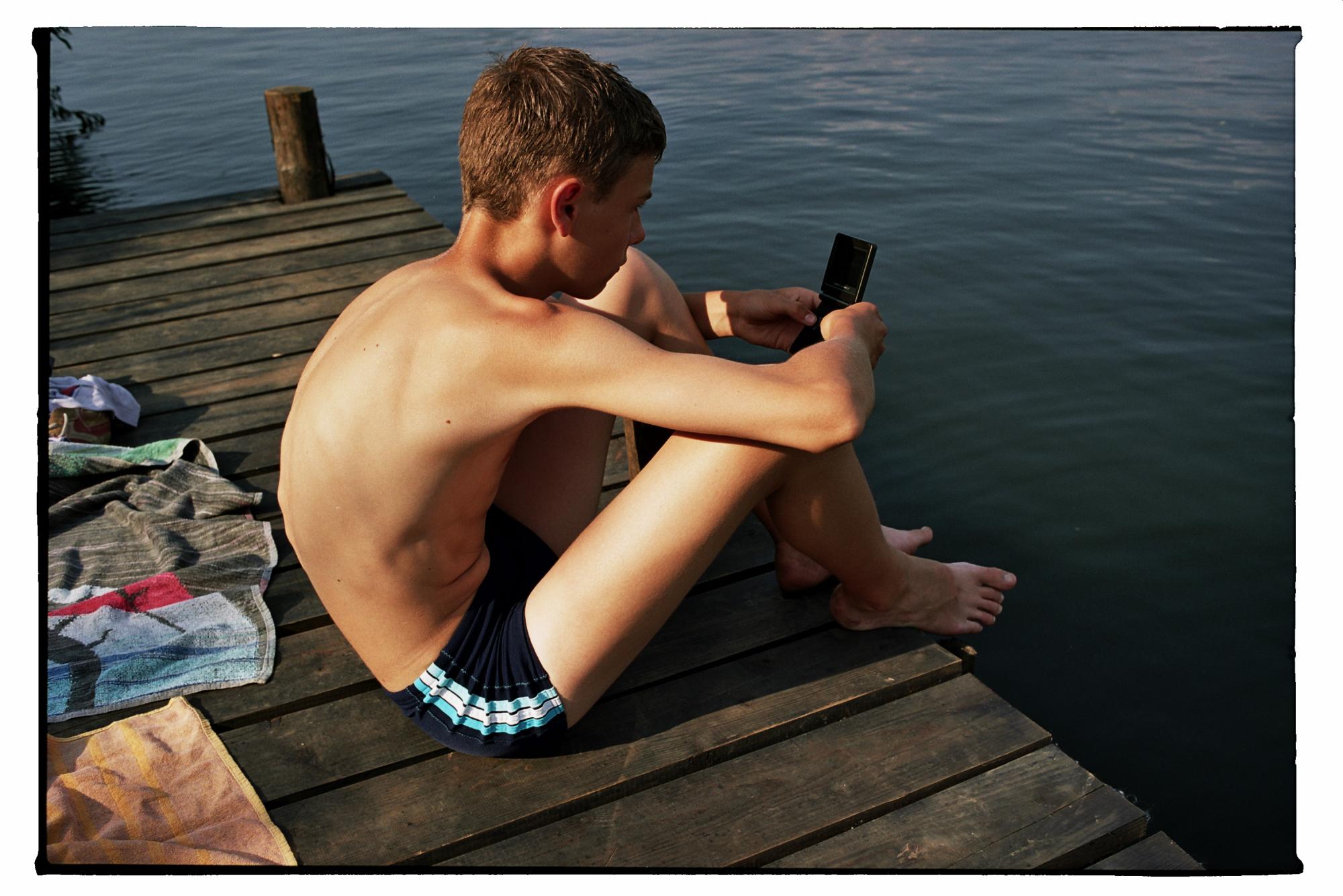
We find this anchor point in one of the boys. He already stands out in the opening scene. He’s the only one sitting on the back of someone else’s bike, with his nose buried in his Game Boy screen. Later, on the pier, he’s still playing, his knees tucked up and still fully dressed. He is the last to jump into the water, and does so without splashing about or showing off like the others, but rather timidly, driven more by the fear of being left out of the group. The fun is overshadowed by his pale-faced hesitation, his quiet deliberation that must remain hidden from the mocking gaze of his peers. When an inland vessel sails past, the children climb onto the deck, only to jump back off a few seconds later. Once again, our boy is the last to stay behind. Hesitantly, he stands on the edge and watches the dark water flow past. The tactile quality the film has evoked so far takes on a different feel; without any direct visual cue, you can sense how the ship’s propeller cuts through the water with eerie, relentless force.

It feels as though someone must be punished for that leap. It is the gaze of an adult looking at children and dictating that making the right choice means not succumbing to herd mentality and acting according to one’s own judgement, daring to take a different path when the risk of going along with the crowd is too great. “And if your friend were to jump off a building, would you do the same?”: a favourite rhetorical weapon for many parents to bring their child to their senses after they’ve done something foolish. But is there no value to be found in dangerous, irresponsible behaviour? Isn’t it important to go with the flow, to discover what the world and others want and expect of you, and what happens when you give in to that? Secretly, you want to be proven right; you wish something terrible would happen to the boy—out of a thirst for excitement, to be freed from the tension, and perhaps also to justify all those times you decided not to jump off the boat.

It’s a rather gloomy train of thought on a lovely summer’s day, when almost nothing happens. By the end of the day, everything is still exactly as it was, and this will continue for another six blissful weeks.

    read more

    © O Rio de Janeiro continua lindo (Felipe Casanova, 2025)
    O Rio de Janeiro continua lindo (Felipe Casanova, 2025)
    article
    Read more

    Rhythms as Reclamations

    Felipe Casanova’s O Rio de Janeiro continua lindo

    Alonso Aguilar
    10.10.2025

    From afar, Rio’s Carnival often seems the quintessential expression of everything Brazilian. The intense and relentless rhythms incite a trance-like celebration, where song and dance amplify the joyful aura to its utmost hypnotising. The foreign onlooker gawks at the carnival because of its enthralling release from the usual reign of restraint and rationality. To them, it plays as a sensorial reverie whose exuberant exterior embodies the “exotic”, but beyond the initial flash and pan, there’s a communal force deeply ingrained in the event.

    Read more
    All We Ever Wanted Was Everything (Enzo Smits, 2014)
    All We Ever Wanted Was Everything (Enzo Smits, 2014)
    essay
    Read more

    Absent but Present

    Enzo Smits’s All We Ever Wanted Was Everything

    Hanne Schelstraete
    20.11.2022

    Those moments between a first date and kiss, between a goodbye and a funeral, between a final exam and a proclamation are seemingly empty. With All We Ever Wanted Was Everything, Enzo Smits zooms in on this idea. What he finds is a beauty that is not easily discovered. Rather than a clear narrative structure, Smits’ debut film presents itself as a stream of impressions. A group of friends pass time together. They talk, walk, and play video games. They stare into nothingness and wander off. What are they waiting for? The first days of school? A taxi? The dawn of their adulthood? In the background, a clock is ticking while one of the boys prepares a cup of tea. Time is slipping by, but nobody’s in a hurry. Growing up is a lesson in patience.

    Read more
    © MISTY PICTURE (Christoph Girardet & Matthias Müller, 2021)
    Misty Picture (Christoph Girardet & Matthias Müller, 2021)
    essay
    Read more

    Cinematic Ghosts

    On Christoph Girardet and Matthias Müller’s Misty Picture

    Oana Ghera
    09.12.2024

    Through association, repetition, and accumulation, Christoph Girardet and Matthias Müller showcase the inventory of Hollywood formal clichés that contributed to the creation of the Twin Towers’ symbolic capital, reflecting at the same time on the power of those images to haunt our collective imagination to this day.

    Read more
    Water and Salt (Luisa Mello, 2019)
    Water and Salt (Luisa Mello, 2019)
    essay
    Read more

    Watery tensions

    Luisa Mello’s Water and Salt

    Kathy Vanhout
    03.04.2022

    Apart from water, salt, and clouds, Mello’s work often features young and older people, artists, animals, and cities; these things are the source of her documentaries. Her films always leave room for fictive contemplation and interpretations. Water and Salt, for that matter, hardly reads as a documentary. In these reflective ten minutes, she attempts to translate a thought, a feeling, an observation. In situations like this, where words are insufficient, and the outside world offers few answers, Mello constructs her own images. Or she turns to archival ones.

    Read more
    La Chute (Sebastian Schaevers, 2022)
    La Chute (Sebastian Schaevers, 2022)
    article
    Read more

    When the Sky Falls

    Sebastian Schaevers’ On Its Way Down

    Jannes Callens
    10.10.2025

    Sebastian Schaevers constantly seeks visual and narrative strategies to capture a man-made problem that has become so overwhelming it exceeds human capacity to cope. We are heading for an almost sublime aesthetic experience of our own demise. On Its Way Down leaves no scene unused to launch metaphors about human attitudes toward the impending ecological disaster.

    Read more
    Lettre à Mohamed (Christine Moderbacher, 2013)
    Lettre à Mohamed (Christine Moderbacher, 2013)
    essay
    Read more

    An Archaeology of Moments

    Christine Moderbacher’s Lettre à Mohamed

    Alonso Aguilar
    30.04.2025

    Christine Moderbachers Lettre à Mohamed (2013) is een audiovisuele brief in de puurste vorm. Door gebruik te maken van de grenzeloze mogelijkheden van het format, lijkt de film op geen enkele andere manier te kunnen bestaan. Wij, als kijkers, weten nauwelijks iets over de titulaire Mohamed. Hij heeft Tunesië verlaten, zoveel is duidelijk, en nu krijgt hij de veranderingen te zien die sindsdien in zijn land hebben plaatsgevonden, vanuit het perspectief en de opnames van zijn bevriende filmmaker.

    Read more
    © Past Perfect (Jorge Jácome, 2019)
    artikel
    Read more

    Lijden in verleden tijd

    Jorge Jácome’s Past Perfect

    Bo Alfaro Decreton
    22.01.2020

    Leed neemt verschillende vormen aan. Het filmisch essay Past Perfect duwt ons, vanuit een ontreddering, kopje onder het verleden in.

    Read more
    Loveboard (Felipe Casanova, 2023)
    Loveboard (Felipe Casanova, 2023)
    essay
    Read more

    Vicarious Recollections

    Felipe Casanova’s Loveboard

    Flavia Dima
    24.01.2026

    Loveboard speaks to an era in which relationships are increasingly preserved through digital archives and the large amount of digital detritus this generates. Our personal troves of images have grown significantly in recent decades. The availability and cost of film stock constrained people to choose what to archive, and therefore, to also curate the image of their past. In this sense, digital media is counterintuitive, even antithetical to curatorship: it has the ability to seemingly conserve everything, including moments that seem utterly inconsequential, even banal, that are valued only in retrospect (if at all).

    Read more

    Subscribe to our monthly newsletter for updates on new releases, publications, and events!

    Subscribe

    yanco is a magazine and streaming library for short-form moving image

    kortfilm.be vzw
    Boondaalse Steenweg 249
    1050 Elsene
    BE 0478 441 315
    info@yanco.be

    with the support of the Flanders Audiovisual Fund (VAF) of the Flemish Government

    VAF
    • about
    • colophon
    • privacy policy
    Facebook Instagram LinkedIn YouTube Letterboxd
    design by de Ronners
    website by eps en kaas