yanco Home
Menu
  • Home
  • watch
  • magazine
  • calendar
  • index
  • Subscribe
Search Log in
  • nl
  • en
You are here
  • Home
  • Magazine
  • Who’s Still Standing?
10th of November | 09:05 (Els Opsomer, 2008)

Who’s Still Standing?

Els Opsomer’s 10th of November | 09:05

essay by
Öykü Sofuoğlu
10.11.2025

Taking in the first images of Els Opsomer’s 10th of November | 09:05 (2008) leaves me deeply puzzled. The blurry silhouettes of cars, buses, and people moving in and out of the frame come across like a memory on the tip of my tongue, but altered by time and distance. Not knowing on what grounds I harbour a sense of familiarity with this urban scene is precisely the reason it feels so foreign. The bustling square is unmistakably situated in Istanbul. Not only in architecture but also on a symbolic level, no other cityscape is layered with such disparate, dense, and contrasting elements. No other city pulses with such passive-aggressive noises—the incessant hum of traffic, police whistles, horns, sirens, and equally loud, fervent people.
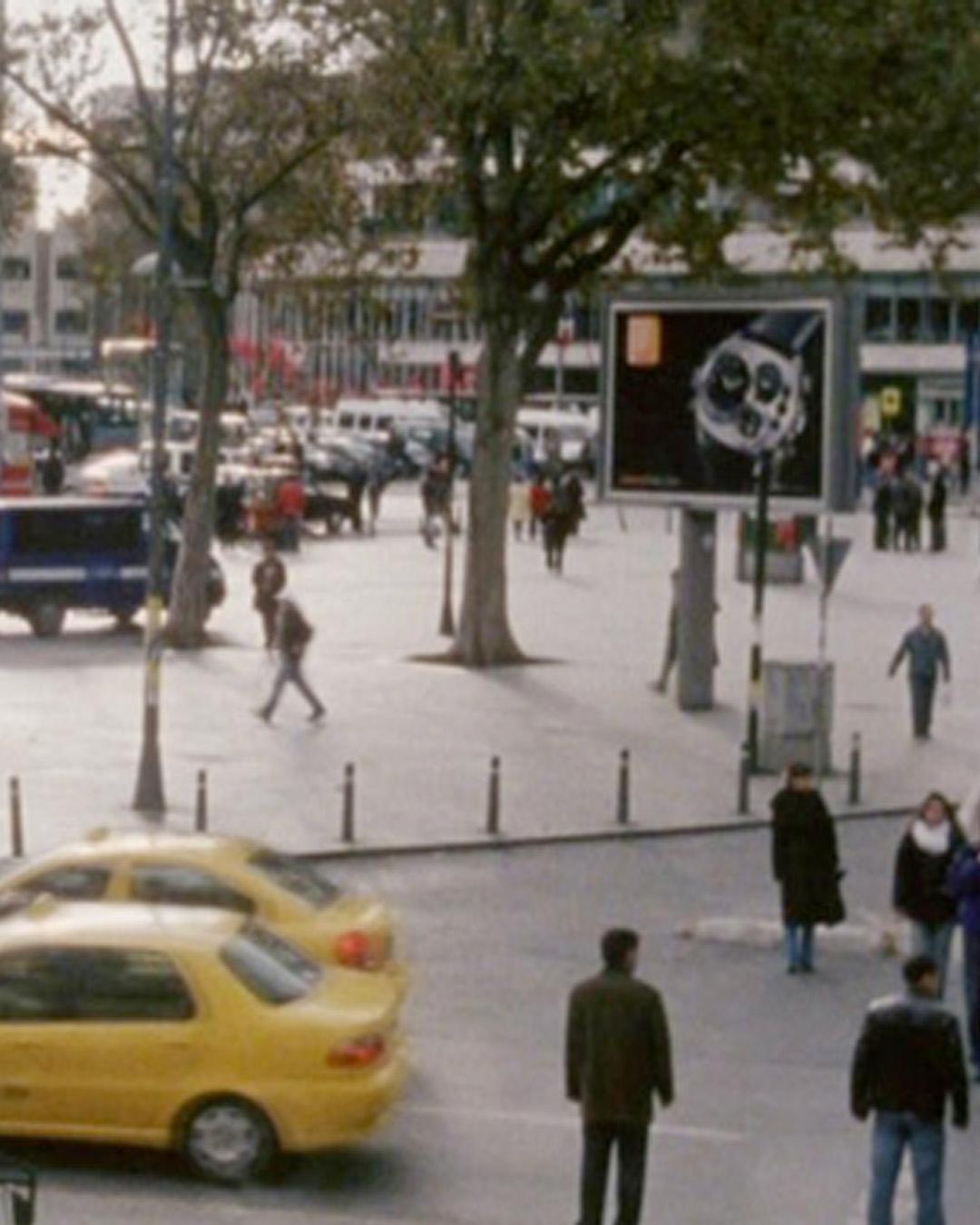
Suddenly, blaring sirens bring this monotonous vignette of urban life to a halt. Every moving figure in the shot sinks into an eerie stillness, except for a man in a white shirt, who looks around, either in bafflement or indifference, before quickly exiting the frame, as if aware of the disturbance he causes. This pause marks the one-minute silence that Turkish people observe every year to commemorate Mustafa Kemal Atatürk, the founder of the Republic of Turkey, on the day and at the very minute of his passing.

It is an impressive image to behold: for one minute, the world stands still—or at least that’s what Turkish people want to believe. Throughout the seven-minute static shot that Opsomer reiterates twice—first with ambient sound, then with a whistling white noise—movement is never truly absent from the frame. Scattered around the square, people dutifully stop and stand; even the bus driver pulls over. But, indifferent to political or social gravitas, sunshine breaks free from the clouds, and birds keep flying. A Turkish flag lowered to half-mast dances in the background, and billboard ads move up and down. After this quasi-silent suspension, the scene immediately returns to normal, as if nothing had happened; the only exception being the faint sound of the national anthem playing in the background. Life goes on, and Atatürk remains dead.

watch now

Read more

10th of November | 09:05

Els Opsomer, Belgium, Turkey, 2008, 14’

Every year on the 10th of November, at 09:05 in the morning, individuals across Turkey cease all activities. Cars pull over, and pedestrians stop and stand still, in remembrance of Mustafa Kemal Atatürk (founder and first president of the Republic of Turkey), who died on this day and time in 1938. Els Opsomer captures such a moment on film.

Read more

Watching a film about your home country through a foreign gaze is always a startling experience. The images appear uncannily alien, akin to a non-native speaking in your mother tongue.

Öykü Sofuoğlu

The foreigner as a monolithic, distant, and domineering entity has never existed. Foreignness always operates in varying degrees and can easily be internalised as self-exoticisation or through voluntary and involuntary alienation. Nevertheless, watching a film about your home country through a foreign gaze is always a startling experience. The images appear uncannily alien, akin to a non-native speaking in your mother tongue: no matter how impeccable their linguistic knowledge and proficiency, their intonations inevitably inhabit an absence, turning familiar words into strange, peculiar objects.

As a social phenomenon, this commemoration of the national leader—whose cult still binds an entire nation decades after his death—intrigues the external eye. Opsomer’s film was one of several Western works, such as Cynthia Madansky’s Devotion (2003) or John Smith’s Flag Mountain (2010), that position Atatürk as the linchpin between cultural, social, and political dualities: the Ottoman Empire versus the Republic of Turkey, East versus West, modernity versus tradition, religion versus secularism, and many more. The idolised and imagined figure of Atatürk offered the most immediate pathway for navigating between these tensions.

Since the early 2000s, this paradigm has been gradually shifting due to the utter tyranny under the 23-year-long rule of Recep Tayyip Erdoğan and his right-wing conservative party. New forms of political engagement are both blindly embraced by fanatics and aggressively imposed on those who stand against them. Performative adoration and enforced abidance—gestures once projected onto Turkish society and especially overblown by the Western imagination—now seem to be a dark, increasingly suffocating reality. Meanwhile, visions of the past, even when laden with these unresolved conflicts of the 20th century, convey a strange sense of nostalgia.

This single shot, the one minute of silence, is populated with cultural and urban signifiers that especially resonate among audiences familiar with the country’s recent past: municipal police cars ominously crowding the square, now-discontinued green public buses unaware of their fate, or an ad promoting a music channel whose clips from that era would no longer make it to air today.

But Opsomer’s work doesn’t attempt to incorporate these burgeoning changes, since their latent forms are discernible only in retrospect. Her film is more interested in social norms viewed through a broader lens, using cinematic duration to meditate on them and reveal their arbitrariness. The temporal stretch both accentuates and deconstructs them as they are abided by the people and observed by the viewer. As provocative as it may sound, when viewed through the optics of symbolic authority, there is no big distance between stopping at a red light and standing still on the 10th of November—but only the latter offers a chance to indulge in the image of the Other.

watch now

Read more

Devotion

Cynthia Madansky, Turkey, 2003, 34’

A sparing and minimal travelogue of Istanbul. A foreigner meditates on the unraveling of a relationship while moving from hotel room to hotel room. In a city simultaneously devoted to Islam and secular nationalism, she finds refuge in the frailty and severity of rituals.

Read more

    Bio Öykü Sofuoğlu

    Öykü Sofuoğlu is a Turkish film critic and journalist based in Paris. Her film-related writings have been published in various outlets, including International Documentary Magazine, Screen Slate, and Letterboxd Journal. She is also one of the co-editors of Outskirts Film Magazine. 

    Subscribe to our monthly newsletter for updates on new releases, publications, and events!

    Subscribe

    yanco is a magazine and streaming library for short-form moving image

    kortfilm.be vzw
    Boondaalse Steenweg 249
    1050 Elsene
    BE 0478 441 315
    info@yanco.be

    with the support of the Flanders Audiovisual Fund (VAF) of the Flemish Government

    VAF
    • about
    • colophon
    • privacy policy
    Facebook Instagram LinkedIn YouTube Letterboxd
    design by de Ronners
    website by eps en kaas