yanco Home
Menu
  • Home
  • watch
  • magazine
  • calendar
  • index
  • Subscribe
Search Log in
  • nl
  • en
You are here
  • Home
  • Magazine
  • Watery tensions
Water and Salt (Luisa Mello, 2019)

Watery tensions

Luisa Mello’s Water and Salt

essay by
Kathy Vanhout
Translated by
Laïka Planchenault
03.04.2022

Luisa Mello’s Water and Salt depicts two resources with a prominent place in film history. Think of the ocean, the ocean as the source of everything. And think of a tiled bathtub in a small apartment, where loss and love often coexist. Or think of a space in between these two. With some salt stuck between their teeth, Mello searches for peace and answers in a third and more uncanny place.

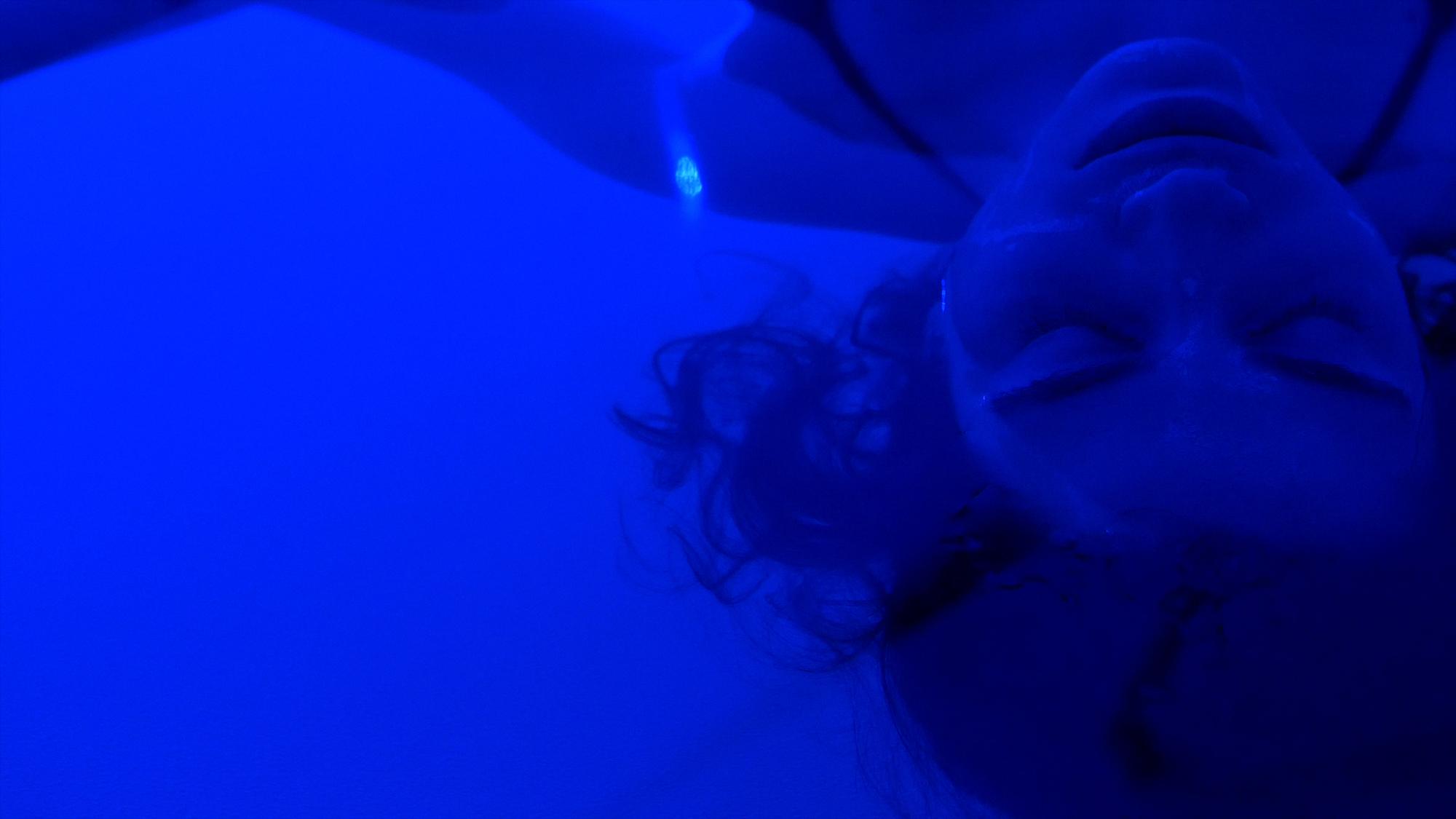
At the film’s start, it is unclear how vast the body of water carrying Water and Salt’s protagonist stretches. She is totally peaceful, though her thoughts find a way to escape through the waves. Can anybody hear her? A voice murmurs everything is ok; it is just water. She’s testing to see how far the blue liquid will carry her words, how often and fast their echoes return to her. The water warmly and gently cradles her. The young woman appears to be at sea, gazing at clouds, only this isn’t the case. She’s in a spaceship of sorts, in a quiet room lit with blue LEDs. She allowed herself forty minutes of relaxation and is looking towards the sky, though clouds were nowhere to be found. Like that, the first ounces of surrealism find their way into the film.

Maybe she’s a futurist, like the poet Majakovski, quoted at the end of the film. Perhaps she is a space traveler from a humbly optimistic time in the future. Whatever the case, she’s floating far away from the reactionary ideas overpowering a phone call with her mother in Rio de Janeiro. The disruptor? The droning voice of Jair Bolsonaro, rising to power in Brazil. Her (faith in the) motherland trembles and quakes. At times, the distance between revolting and caring for oneself is little; at times, it is larger, like ebb and flood. Leaving town for a while, making art, studying philosophy… These are Mello’s choices. Her short films always allow space for big questions and fragile ideas. In Water and Salt, both the room and the camera are quiet. The minimal editing and ditto score build up tension. A tension that at first feels vague or unheimlich but eventually is linked to Bolsonaro’s reign.

Some things are uncertain and difficult to understand; words are needed. The mother’s voice on the phone contrasts sharply with the tyrannical one coming from national television. One doubtful and full of love, the other wholly convinced of itself. And yet both voices can be traced back to the same water. Todo o mundo vem da água, together with Botticelli 's Venus. But this water reaches far and wide. Like Majokoviski writes: “The sea of history is rough”. Wild waters, peaceful waters. In her film, Mello looks for a balance between these two: quietly, estranged, movingly, softly. Because that is how Majokivski’s poem starts: “We’re not happy, of course, but also, why should we be sad?”.

Water has been of importance in Mello’s previous work. In Semi úmido (2019), an extremely thirsty country has only a minuscule amount of water. Here, water brings life and unites people. In this film, clouds take on the shape of clouds. That is to say: we are all equal, and anyone deserves to be recognised as a cloud amongst clouds. No matter how many ideas a tyrant might have about the sky, he cannot simply change the makeup of a cloud.

Apart from water, salt, and clouds, Mello’s work often features young and older people, artists, animals, and cities; these things are the source of her documentaries. Her films always leave room for fictive contemplation and interpretations. Water and Salt, for that matter, hardly reads as a documentary. In these reflective ten minutes, she attempts to translate a thought, a feeling, an observation. In situations like this, where words are insufficient, and the outside world offers few answers, Mello constructs her own images. Or she turns to archival ones. Some of Water and Salt’s images are found footage of the turbulent life underwater. Simultaneously, we hear Bolsonaro reporting back on his actions. When the silence eventually returns, the young woman exits the tub and leaves the bathroom, fully naked. The door slamming shut and the droplets on the floor's smooth surface sound much harsher than her own voice. Internal waters prove to be more trustworthy.

Meanwhile, it appears that Bolsonaro will remain present in media and politics. Majakovski’s history clatters on. The water floods the stairs of the parliament building in Brasilia and spills into the city. Bolsonaro’s followers do not accept defeat. Hopefully, the water washes them all back to the sea, where they can enjoy forty minutes of relaxation before the water retreats, leaving nothing but salt on their lips.

Read more

Water and Salt

Luisa Mello, Belgium, Brazil, 2019, 10’

A journey through the consciousness of a woman whose country is under threat from a fascist government.

Read more

    read more

    Atopia (Olivier De Vos, 2021)
    Atopia (Olivier De Vos, 2021)
    essay
    Read more

    De stranden van Atopia

    Olivier De Vos’s Atopia (2021)

    Ren Scateni
    20.12.2023

    Through a multilayered construction of archive materials, digitised as well as contemporary pictures, and original footage, De Vos charts their journey to the beaches of Atopia—a placeless place, brimming with both mesmerising potentiality and impossibility, a place you could be homesick for without being able to locate it exactly. As elusive as this promised land it invites viewers to, Atopia refuses easy classifications and finds a transitory place between fiction and documentary, between imagined ethnographic investigation and a research-led use of archival videos and photos to back up De Vos’s personal cognitive meanderings.

    Read more
    Speech for a Melting Statue (Collectif Faire-part, 2023)
    Speech for a Melting Statue (Collectif Faire-part, 2023)
    article
    Read more

    Beyond Leopold II’s Empty Pedestal

    Collectif Faire-part’s Speech for a Melting Statue (2023)

    Nadia Nsayi Madjedjo
    14.09.2026

    Speech for a Melting Statue by Collectif Faire-part examines a social issue that has long been a concern in Belgium—in part due to activist campaigns—but only truly made its way onto the political agenda around the time of the Black Lives Matter movement: how should we best deal with colonial monuments in public spaces?

    Read more
    © Untitled III (Sarah Pucill, 2001)
    Untitled III (Sarah Pucill, 2001)
    interview
    Read more

    Folding Time

    On Sarah Pucill’s Surrealism

    Laura Stoeckler
    23.08.2025

    Over the last thirty years, Sarah Pucill’s films have shown a sustained engagement with feminist politics, surrealist aesthetics, and the material language of cinema. Her work is connected by a visual and conceptual vocabulary that keeps evolving. Figures, motifs, and techniques reemerge—the principle of continuity is key to understanding how the artist’s work coheres, drawing strength from its self-reflection.

    Read more
    © Gente del Po (Michelangelo Antonioni, 1947)
    artikel
    Read more

    Een eerste Antonioni

    Benjamin Antonissen
    27.05.2020

    De eerste kenmerken van Michelangelo Antonioni's filmtaal zijn al terug te vinden in het vroeg neorealistische Gente del Po (1947).

    Read more
    © La Chambre (Chantal Akerman, 1972)
    La Chambre (Chantal Akerman, 1972)
    article
    Read more

    A Room of Her Own

    Chantal Akerman’s La Chambre

    Öykü Sofuoğlu
    17.11.2024

    Lounging on a small bed, Chantal Akerman’s posture seems casual and relaxed at first glance, but the repetitive tilts of her head—to the left and then back to center—contrasting with the smooth glide of the camera suggest otherwise. Restlessness is in the air, yet before we can discern it, the image is already on the move, retracing its steps for a second time.

    Read more
    © Ethereal Rhythms, Everything Rhymes (Brecht Vanhoutte, 2025)
    interview
    Read more

    Welkom, welkom in mijn hoofd

    Brecht Vanhoutte over Ethereal Rhythms, Everything Rhymes

    Flo Vanhorebeek
    13.02.2025

    Brecht Vanhouttes masterfilm is een abstract beestje, dat de LUCA-alumnus zelf beschrijft als een koortsdroom die zijn gevoelswereld vertaalt naar het zilveren scherm. De film construeerde hij door tekst, beeld en audiofragmenten in een AI-generator te gieten en hierover met de bot in gesprek te gaan. Zijn werk bracht hem tot op het Internationaal Filmfestival van Rotterdam (IFFR).

    Read more
    The List is Black
    opinion
    Read more

    The List is Black

    Greg de Cuir Jr
    02.02.2026

    What are we looking to replicate or reflect when we construct a list of the “greatest films of all time”? The canon is encoded in many of our educations and structures many of our discussions about film—whether we are anti-canon or not. So with exercises such as this newest effort, we are telling ourselves what we already know.

    Read more
    +6 Gain (Jorn Plucieniczak, 2019)
    +6 Gain (Jorn Plucieniczak, 2019)
    article
    Read more

    Sound Bath

    Jorn Plucieniczak’s +6 Gain (2019)

    Ben Flanagan
    20.02.2024

    Plucieniczak is searching for the spiritual in the notion of Living For The Weekend, and as it gets closer, the colours are further enveloping, pink turning to red. Strobes flicker on Martens’ bald head. His body is out of focus, camera swerving left and right; it’s full Irréversible; the music begins to swoosh in, a trance banger waiting patiently to drop. But instead, we cut into the lounge.

    Read more

    Subscribe to our monthly newsletter for updates on new releases, publications, and events!

    Subscribe

    yanco is a magazine and streaming library for short-form moving image

    kortfilm.be vzw
    Boondaalse Steenweg 249
    1050 Elsene
    BE 0478 441 315
    info@yanco.be

    with the support of the Flanders Audiovisual Fund (VAF) of the Flemish Government

    VAF
    • about
    • colophon
    • privacy policy
    Facebook Instagram LinkedIn YouTube Letterboxd
    design by de Ronners
    website by eps en kaas