yanco Home
Menu
  • Home
  • watch
  • magazine
  • calendar
  • index
  • Subscribe
Search Log in
  • nl
  • en
You are here
  • Home
  • Magazine
  • De stranden van Atopia
Atopia (Olivier De Vos, 2021)

De stranden van Atopia

Olivier De Vos’s Atopia (2021)

essay by
Ren Scateni
20.12.2023

For gender non-conforming people, the rigid normative cage of gender binarism means a continuous fight against ever-tightening ropes, ever-crushing cogs, and ever-dimming hopes. Legal documents parade deadnames and assigned-at-birth genders, access to gender-affirming care is limited, and daily microaggressions spell out society’s necessity to uphold exclusionary standards. However, resilience is innate to queer individuals. To succumb would mean for cis-heteronormativity to win. To resist means to reappropriate our own narratives and, through it, to carve out pockets of reality for us to be free. Olivier De Vos’s meditative and reflexive video poem Atopia exemplifies this radical and affirmative posture.

Through a multilayered construction of archive materials, digitised as well as contemporary pictures, and original footage, De Vos charts their journey to the beaches of Atopia—a placeless place, brimming with both mesmerising potentiality and impossibility, a place you could be homesick for without being able to locate it exactly. As elusive as this promised land it invites viewers to, Atopia refuses easy classifications and finds a transitory place between fiction and documentary, between imagined ethnographic investigation and a research-led use of archival videos and photos to back up De Vos’s personal cognitive meanderings.

Interestingly, Atopia draws from the beach as a crucial locus for queer communities. Traditionally associated with spaces for gay men to meet and cruise, beaches have long been featured as queer places in art, film, and photography alike. In British painter Henry Scott Tuke’s work, for instance, the beach exists as a homo-utopian space where the bodies of young men are crystallised in a never-withering beauty that is at the same time immobile, vigorous, and disturbingly melancholic. In Atopia, however, the patch of sand and water allows for wider body representations and gender fluidity to seep through. During a magnetic, slightly blurred seaside sequence, the beach of Atopia manifests an alternative to the gender binary—a porous, in-between or all-encompassing understanding of liquid gender identity captured in a suggestive circular frame.

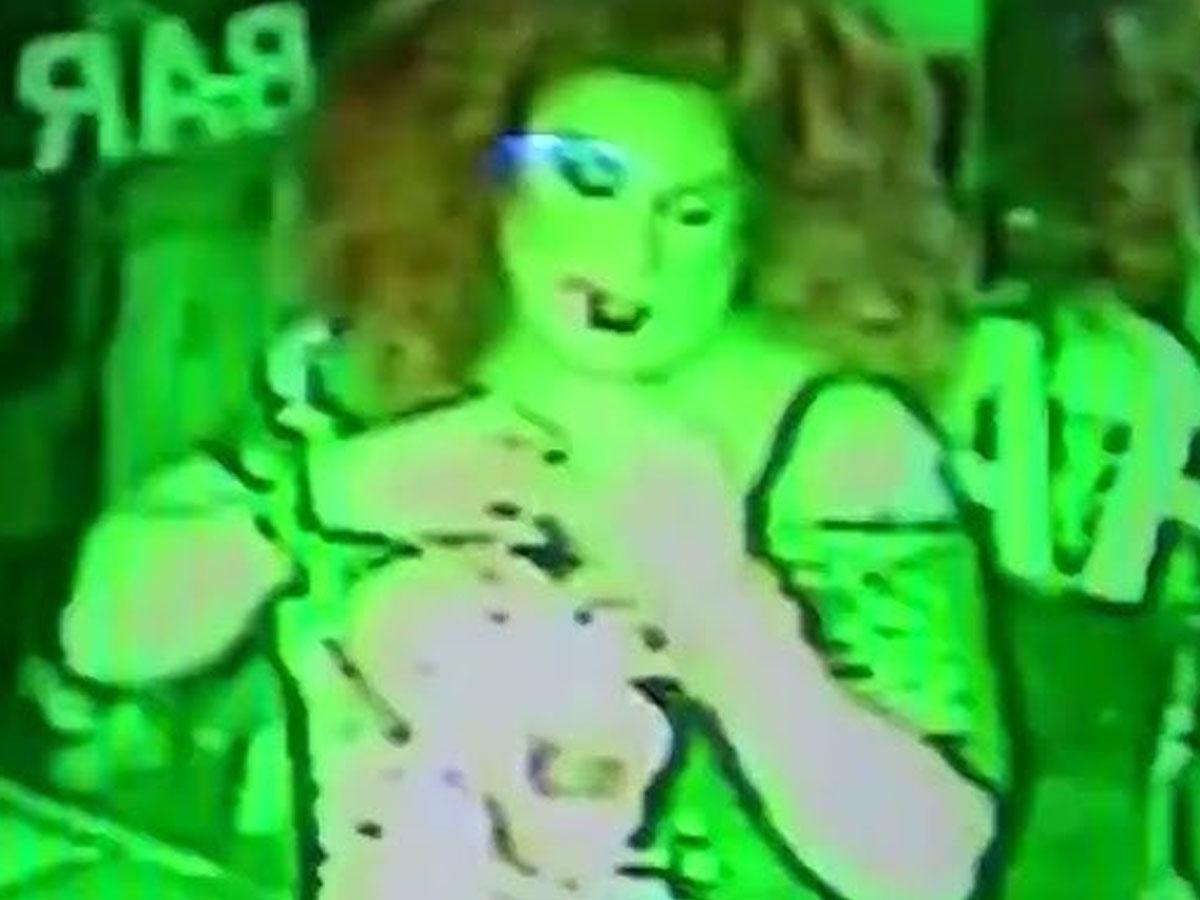
“Words do not look like the things they designate,” reads a quote from French philosopher Maurice Merleau-Ponty opening Atopia. Moving from here, De Vos’s astute use of archival materials—pictures and recorded interviews of unspecified sources—invites an onto-epistemological reading of the film. That is, De Vos’s film balances between polarised realms—in this case, the ontological, what a thing is, and the epistemological, what we understand a thing to be—alternatively seeking connections and disconnections. These reflections culminate in the film’s most achingly beautiful sequence featuring De Vos themself naked, their genitals tucked, wearing only some makeup and an azure wig while they confidently and sensually sit on the floor. Mere moments before, another person, naked and tucked, similarly sitting in their wig and makeup, accompanies De Vos’s commentary, “I’m making the man clear that the person on the screen is not a ‘dude’ but a woman, or not even that. Afraid of my cover being blown and revealing to him my longing for fluidity, I just sigh.”

The perceived incongruence between what society wants us to think our body signifies and our personal reading of our own gender as a superimposing marker disconnected from flesh and bones ultimately harbours Atopia’s meaning. Through archival manipulation and a visionary quest to find a place that is other, ineffable, and idealised, De Vos embarks on an experiment akin to myth-making. When language oppresses, resisting classification means ultimately resisting control.

Read more

Atopia

Olivier De Vos, Belgium, 2021, 18’

An introspective essay about the search for a place between reality and imagination: a placeless place made up out of dreams and a longing for fluidity. Slowly, the grains of the compressed image become the sands of the atopic beach, revealing an imaginary place.

Read more

    Bio Ren Scateni

    Ren Scateni is a film curator and writer whose practice embraces experimental works and artists’ moving image that explore the interstices of political, disruptive, and liminal identities. His writing has appeared in various art and film magazines, including ArtReview, Hyperallergic, and Sight and Sound. Ren is currently Curatorial Lead at Glasgow Short Film Festival and has been/is working across curation, consulting, editing, mentoring, and PR for festivals, cultural organisations, and companies, including Berwick Film & Media Arts Festival, Queer East, Festival du Nouveau Cinéma, BFI Doc Society, and Square Eyes. Ren is a Trustee of Alchemy Film & Arts.

    read more

    what else grows on the palm of your hand? (Dhiaa Biya, 2023)
    what else grows on the palm of your hand? (Dhiaa Biya, 2023)
    essay
    Read more

    Whispering Hands

    Dhiaa Biya’s what else grows on the palm of your hand? (2023)

    Bo Alfaro Decreton
    01.05.2026

    In a series of intimate, domestic scenes that interweave the present with the past, Dhiaa Biya honours the weathered hands of a (deceased) grandmother. Through repetition of the same gestures, the hands of three generations of women merge, free from any obstacles posed by the passage of time. Is there a more beautiful part of the body than the hands to reflect on in order to rekindle the extinguished connection between head and body, a characteristic of these frenzied times?

    Read more
    © COMBAT DE BOXE (1927)
    artikel
    Read more

    Fundamenteel dynamisch

    Over Charles Dekeukeleire en de essentie van film

    Bjorn Gabriels
    04.04.2023

    Charles Dekeukeleire ging de geschiedenis in als een van de grondleggers van de experimentele en documentaire cinema in België. Vandaag vindt vooral zijn (korte) avant-gardewerk nog weerklank.

    Read more
    The Girl Chewing Gum (1976)
    The Girl Chewing Gum (1976)
    essay
    Read more

    Als beelden sprekend liegen

    John Smiths The Girl Chewing Gum (1976)

    Bjorn Gabriels
    31.03.2026

    Op het eerste gezicht bevestigt The Girl Chewing Gum (1975) – Smiths beroemdste film in een oeuvre van vijftig jaar experimentele korte films waarin hij op speelse wijze het dagelijks leven verkent – de bijna rituele afwijzing van de voice-over door het opzichtig autoritaire karakter ervan te ondermijnen met hilarisch ingetogen humor, die doet denken aan de observerende ironie van Monty Python’s Flying Circus (1969-1974).

    Read more
    Old Child (Elettra Bisogno & Hazem Alqaddi, 2019)
    Old Child (Elettra Bisogno & Hazem Alqaddi, 2019)
    essay
    Read more

    Flickering Memories

    Elettra Bisogno & Hazem Alqaddi’s Old Child

    Savina Petkova
    10.05.2025

    For a refugee or an immigrant, memories of a prior life are not simply broken; they are snapped in two, three, four, or more pieces and doomed to exist separately. These split memories can emit a particular shine, as attested by Elettra Bisogno and Hazem Alqaddi’s short Old Child. The film dwells in the paradox of its title, where old age and childhood are readily coupled, as if there were no time or space in between these two ends of a human life spectrum. Of course, the title also holds melancholy, which is only one feeling in the vast emotional landscape of Old Child.

    Read more
    © O Rio de Janeiro continua lindo (Felipe Casanova, 2025)
    O Rio de Janeiro continua lindo (Felipe Casanova, 2025)
    article
    Read more

    Rhythms as Reclamations

    Felipe Casanova’s O Rio de Janeiro continua lindo

    Alonso Aguilar
    10.10.2025

    From afar, Rio’s Carnival often seems the quintessential expression of everything Brazilian. The intense and relentless rhythms incite a trance-like celebration, where song and dance amplify the joyful aura to its utmost hypnotising. The foreign onlooker gawks at the carnival because of its enthralling release from the usual reign of restraint and rationality. To them, it plays as a sensorial reverie whose exuberant exterior embodies the “exotic”, but beyond the initial flash and pan, there’s a communal force deeply ingrained in the event.

    Read more
    La Chute (Sebastian Schaevers, 2022)
    La Chute (Sebastian Schaevers, 2022)
    article
    Read more

    When the Sky Falls

    Sebastian Schaevers’ On Its Way Down

    Jannes Callens
    10.10.2025

    Sebastian Schaevers constantly seeks visual and narrative strategies to capture a man-made problem that has become so overwhelming it exceeds human capacity to cope. We are heading for an almost sublime aesthetic experience of our own demise. On Its Way Down leaves no scene unused to launch metaphors about human attitudes toward the impending ecological disaster.

    Read more
    © In Flanders Fields (Sachin, 2024)
    In Flanders Fields (Sachin, 2024)
    article
    Read more

    A Voice For The Ghosts

    Sachin’s In Flanders Fields

    Eneos Çarka
    13.08.2025

    In Flanders Fields is a ghost story. Directed by Rajasthan-based filmmaker Sachin, the short film is a poetic meditation on war, colonial erasure, and ancestral presence in foreign land. The director introduces us to a rarely acknowledged fact in dominant historical narratives: during the First World War, as many as 1.4 million Indians were conscripted by the British and sent to the frontlines in Flanders. This revelation sets the stage for a cinematic elegy to those forgotten men.

    Read more
    © Self-Portrait (Jonas Mekas, 1980)
    Self-Portrait (Jonas Mekas, 1980)
    essay
    Read more

    Here I Am

    Jonas Mekas’ Self Portrait (1980)

    Gerard-Jan Claes
    20.06.2025

    “We’re running?” Mekas asks the cameraman. “We’re running!” replies the latter. Mekas repeats the question, as if he’s not quite sure. Then he pulls out a watch. “It’s a quarter to two, Saint Paul time. We should be finished by five minutes after two.” So begins Jonas Mekas’s Self Portrait from 1980. Despite the title, Mekas is not filming himself. A cameraman captures him standing in a garden in front of a friend’s cottage in Saint Paul, Minnesota, drinking a can of beer.

    Read more

    Subscribe to our monthly newsletter for updates on new releases, publications, and events!

    Subscribe

    yanco is a magazine and streaming library for short-form moving image

    kortfilm.be vzw
    Boondaalse Steenweg 249
    1050 Elsene
    BE 0478 441 315
    info@yanco.be

    with the support of the Flanders Audiovisual Fund (VAF) of the Flemish Government

    VAF
    • about
    • colophon
    • privacy policy
    Facebook Instagram LinkedIn YouTube Letterboxd
    design by de Ronners
    website by eps en kaas