yanco Home
Menu
  • Home
  • watch
  • magazine
  • calendar
  • index
  • Subscribe
Search Log in
  • nl
  • en
You are here
  • Home
  • Magazine
  • An Outstretched Hand
© Bamssi (Mourad Ben Amour, 2024)
Bamssi (Mourad Ben Amour, 2024)

An Outstretched Hand

Mourad Ben Amor’s Bamssi

essay by
Öykü Sofuoğlu
12.05.2025

Animals no longer live in nature; they now exist first and foremost on our screens. While each new internet-based encounter with them still feels as surprising and delightful as ever, the obsessive relationship with animal imagery often remains limited to fulfilling our emotional needs—rarely do we question the underlying motives. What exactly in these images never fails to feed our curiosity? What makes us continue to watch sprinting dogs and grooming cats as if we’ve never seen them before?

Mourad Ben Amor’s Bamssi (2024)—a diary film made alongside a pack of animal protagonists—hints that our fascination may sometimes be less about the animals themselves than about the spontaneity and impulsivity that emerge from their most routine gestures. It proves a dizzying audiovisual experience.

The anticipation of a breach, a clash in the state of things—even something as minimal as a dog’s wagging tail or a cat’s pinned-back ears—might be the reason we find ourselves swiping from one video to the next. Perhaps it’s also the reason Ben Amor chose to film around his home in Tunisia, where he lives with the titular canine Bamssi, joined by several cats, dogs, chickens, and sheep—named Saïda, Queen, Princess, Kenza, Wazgha, and Bianco, among others.

Characterised by the animal-like, raw, energetic quality of the digital format he uses, the everyday moments Amor captures from their shared lives give the film a sense of marvel that transcends the simplicity of its form and expression. Amor’s gaze roams around casually, yet always attuned to the movements of the animals and the nature surrounding him. The agency suggested by the verb “directing” doesn’t fully capture his approach to the images, for his camera moves as though the outside world itself is drawing it.

He’s more of an explorer, a wanderer than a director. Olive trees, the endlessly stretching sea, train whistles from the rails, or Bamssi, with his larger-than-life personality, always running a step ahead—all become magnetic forces that pull him and us as viewers along. “I continue to dream of traveling. To take a risk for a future,” we hear him say, addressing a recipient in absentia—namely, his filmmaker cousin Fairuz Ghammam, who lives in Belgium and engages in a dialogue with Mourad throughout the film.

Bamssi is infused with a constant tension between stillness and movement—one we can sense Amor himself struggles with. Like his animal companions, who exist at a perpetual threshold—always just one step away from either strayness or domestic life, moving in and out at their leisure—his vision carries both a need for belonging and a desire for freedom. While the joyful immediacy of the digital format, with all its imperfections, predominantly leans toward the latter, there are moments of stillness that interweave analogue photographs, where the images slow down, stop, and take root in time.

Yet no matter how safe or idyllic a home may seem, how could one remain indifferent to the ever-humming, ever-buzzing outside world? Because life goes on—puppies learn to walk, new kittens are born, clear skies turn jet-black with storm. As time passes, the film displays more and more restlessness, with reports of deaths, massacres, and genocide from Gaza reaching us through television reports.

Unpredictable and spontaneous like its protagonists, Bamssi’s narrative turns the film into a strange, cross-breed creature that epitomises our current audiovisual landscape. The perceptual proximity with which the film positions the ordinary and the extraordinary, or safety and danger, reflects the defining trait of how we look at and experience the world today.

It takes courage to engage with images these days, knowing that there is often just one frame or one click needed to swipe from hope to despair, life to death. But it takes even more courage to live. The poem recited by Ben Amor at the end of the film is a poignant reminder of that. Addressing the camera directly, with Bamssi by his side, this final offering is “an outstretched hand”—inviting us, no matter what, to look, to dream, and to live.

    Bammsi is part of Avila’s short film programme Fires, which includes three short films that deal with displacement and the longing for a home. The programme is presented as part of Avila, present!, in collaboration with Courtisane, yanco, and KVS.

    Bio Öykü Sofuoğlu

    Öykü Sofuoğlu is a Turkish film critic and journalist based in Paris. Her film-related writings have been published in various outlets, including International Documentary Magazine, Screen Slate, and Letterboxd Journal. She is also one of the co-editors of Outskirts Film Magazine. 

    read more

    © Dimensions of Dialogue (Jan Švankmajer, 1983)
    artikel
    Read more

    Dialoog doorgelicht

    Jan Švankmajers Dimensions of Dialogue

    Michiel Philippaerts
    28.12.2017

    In deze kortfilmklassieker bestudeert Jan Švankmajer de verschillende aspecten van ‘dialoog’ op een ludieke en verrassend pessimistische manier.

    Read more
    Like An Event In A Dream Dreamt By Another - Rehearsal (Firas Shehade, 2023)
    Like An Event In A Dream Dreamt By Another - Rehearsal (Firas Shehade, 2023)
    interview
    Read more

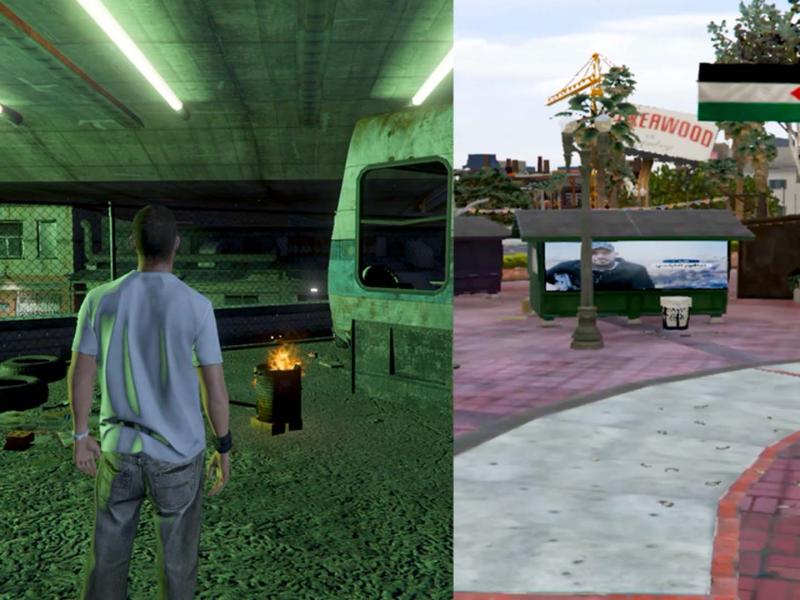
    Machinima: the Metamorphosis of Mapping

    A Conversation with Dmitry Frolov and Vladimir Nadein

    Xinyi Wang
    31.10.2026

    Born on the threshold between game and cinema, “machinima”—films made within the world of video games—is a rapidly expanding genre. Dmitry Frolov and Vladimir Nadein have been co-curating machinima for over four years. This time invited by yanco, they bring a new selection of machinima to Antwerp, as part of the Breedbeeld Kortfilmfestival. “Ludic Cartographies” is a beautiful example of machinima’s aesthetic methods and political potential. Spanning essay film, artist moving image, and research videos, it has a formal fluidity and inherently carries a “documentary quality that gazes at the past”.

    Read more
    Old Child (Elettra Bisogno & Hazem Alqaddi, 2019)
    Old Child (Elettra Bisogno & Hazem Alqaddi, 2019)
    essay
    Read more

    Flickering Memories

    Elettra Bisogno & Hazem Alqaddi’s Old Child

    Savina Petkova
    10.05.2025

    For a refugee or an immigrant, memories of a prior life are not simply broken; they are snapped in two, three, four, or more pieces and doomed to exist separately. These split memories can emit a particular shine, as attested by Elettra Bisogno and Hazem Alqaddi’s short Old Child. The film dwells in the paradox of its title, where old age and childhood are readily coupled, as if there were no time or space in between these two ends of a human life spectrum. Of course, the title also holds melancholy, which is only one feeling in the vast emotional landscape of Old Child.

    Read more
    © The Vampires of Poverty (Carlos Mayolo, Luis Ospina, 1977)
    artikel
    Read more

    Porno miseria: het begin van een einde?

    Over The Vampires of Poverty van Luis Ospina en Carlos Mayolo

    Bo Alfaro Decreton
    14.11.2019

    In The Vampires of Poverty uiten Luis Ospina en Carlos Mayolo kritiek op exportdocumentaires die ellende verheerlijken.

    Read more
    © Atopia (Olivier De Vos, 2021)
    interview
    Read more

    Queerness is geen status-quo

    Olivier De Vos en Pol Merchan over queer cinema

    Laïka Planchenault
    15.05.2024

    Met de essayistische kortfilms Atopia en Pirate Boys werpen Olivier De Vos en Pol Merchan een licht op queer thema’s. Hoe belangrijk is die representatie? De filmmakers delen hun bedenkingen over de verhouding tussen het medium film en de industrie daarrond.

    Read more
    © 0.2 MILLIGRAMS OF GOLD (DIEGO QUINDERÉ DE CARVALHO, 2021)
    0.2 Milligrams of Gold (Diego Quinderé de Carvalho, 2021)
    interview
    Read more

    From the Ardennes to the Amazon

    A Conversation About Eco-Activism in Cinema

    Jannes Callens
    13.01.2025

    Diego Quinderé de Carvalho’s 0.2 Milligrams of Gold and Andrés Jurado’s Yarokamena invite us to reconsider our relationship with nature, history, and the systems that shape our lives. In conversation, both filmmakers talk about their filmmaking process and the question of activism in art.

    Read more
    © Plot Point (Nicolas Provost, 2007)
    Plot Point (Nicolas Provost, 2007)
    essay
    Read more

    (Re)framing Tension

    “Why Don’t the Cops Fight Each Other?”

    Tianyu Jiang
    02.09.2025

    Curated by Inge Coolsaet for argos, the short film programme “Why Don’t the Cops Fight Each Other?” responds to the ever-present police brutality by rejecting futile rhetoric and underlining the urgency and affective power of audio-visual art. This potentially intimidating viewing experience may unsettle viewers’ expectations, but it can also transform the apathetic spectator into an active, reflexive watcher.

    Read more
    © The End of Suffering (A Proposal) (Jacqueline Lentzou, 2020)
    essay
    Read more

    Troostende sterrenbeelden

    Jacqueline Lentzou’s The End of Suffering (A Proposal)

    Michiel Philippaerts
    17.03.2025

    Het is verleidelijk om de esthetiek van de Griekse filmmaker Jacqueline Lentzou, die al enkele jaren een begrip is binnen het kortefilmcircuit, te reduceren tot louter meanderend. Haar werk tast doorgaans wat in het rond, meer op zoek naar de texturen van haar protagonisten dan naar enige plot of narratieve logica. Lentzou is geïnteresseerd in de manier waarop het zonlicht door een vuil raam binnenvalt en hoe de gebroken stralen langzaam een huilend gezicht onthullen, niet zozeer in waarom er wordt gehuild.

    Read more

    Subscribe to our monthly newsletter for updates on new releases, publications, and events!

    Subscribe

    yanco is a magazine and streaming library for short-form moving image

    kortfilm.be vzw
    Boondaalse Steenweg 249
    1050 Elsene
    BE 0478 441 315
    info@yanco.be

    with the support of the Flanders Audiovisual Fund (VAF) of the Flemish Government

    VAF
    • about
    • colophon
    • privacy policy
    Facebook Instagram LinkedIn YouTube Letterboxd
    design by de Ronners
    website by eps en kaas