yanco Home
Menu
  • Home
  • watch
  • magazine
  • calendar
  • index
  • Subscribe
Search Log in
  • nl
  • en
You are here
  • Home
  • Magazine
  • Against a Hierarchy of Images
Our Legacy (Caroline Poggi & Jonathan Vinel, 2016)

Against a Hierarchy of Images

Interview with Caroline Poggi & Jonathan Vinel

interview by
Maike Höhne, Flo Vanhorebeek
11.11.2026

Love is in short supply in our current zeitgeist: it’s easy to deny or reject. Giving and receiving love is a much harder task. It almost sounds revolutionary to go the extra mile to connect with another human being. According to Kurzfilm Festival Hamburg, cinema can help deepen that feeling. With “Provoke Love” as their slogan, it was the central theme of their 2025 edition.

The festival approached acclaimed French filmmaking duo Caroline Poggi (Corsica, 1990) and Jonathan Vinel (Toulouse, 1988) to visualise this motto as a festival trailer. With an arsenal of archival internet footage, their signature dystopian wit and a killer soundtrack, they ask a simple question: How do we find a way to be together again? Festival artistic director Maika Mia Höhne sat down with Vinel and Poggi to dissect this universal desire through the lens of their own artistic careers, exploring themes such as small-town boredom, growing up with the internet, and the terrible beauty inherent in all of this.

First things first: you’ve been working together since 2012. How did your collaboration start?

Poggi: I met Jonathan in 2011 at the University of Paris VII, although we both grew up in the South of France. We weren’t really making films yet, but we really wanted to be part of the world of cinema. Later, Jonathan stayed in Paris to study editing at La Fémis. I went back to Corsica to follow a more specialised course in film directing. We both started making our first individual shorts here and gave feedback on each other's work continuously.

We eventually directed As Long As Shotguns Remain (2014) together. It never felt like a conscious decision to collaborate, though. It really sprang from a shared taste in cinema and an intimate connection with the places we grew up in. We developed the same interest for certain stories and characters quite naturally.
Are there certain films that impressed you both while you were at film school?

Vinel: It was basic cinephilia in the beginning: Andrei Tarkovsky, Béla Tarr, Robert Bresson. The common thread running through all our inspirations was a cinema driven by feeling rather than by storytelling and narrative. That’s what we wanted to achieve with As Long As Shotguns Remain as well. We tried to evoke the boredom that comes with growing up in a small, sleepy town in Southern France. It’s easy to give in to a desire for violence here because there’s nothing to do. It becomes a way to exist, to face the trials of the world.

Poggi: When you grow up there, you want to break out of this inherent emptiness. Violence, then, can feel like the sole solution. We try to think about the origins of this without condemning it in our stories.

It’s not a spoiler when I say that the kind of violence discussed in As Long As Shotguns Remain stems from the suicide of a friend.

Poggi: Yes, the idea for the film started with a letter Jonathan received from his mother. In it, she wrote that someone from his village, roughly the same age as him, had died by suicide, which made her very sad. This wasn’t an isolated event. We felt that we were constantly surrounded by news of this kind, so we wanted to find a cinematic form to examine this.

Vinel: I think we felt the need to explore this more closely in the suburbs and neighbourhoods we come from. Its modes of living actively contribute to a special kind of despair. There’s no one in the streets. The houses are all isolated from one another. Communal spaces in which people can come together don’t really exist.

You won the Golden Bear with this film in 2014. What did this do or change for you?

Poggi: I think that our film was quite radical then and it still is in some sense, so winning a Golden Bear for it was a massive encouragement. I don’t think we would be here today without it. It motivated us to continue developing a very specific aesthetic that isn’t the easiest to produce.

We actually rewatched the film at the beginning of this year. When it ended, I told Jonathan that we wouldn’t be able to make this film again now that we’re both 35. It really speaks to a state of mind in which we were still very attached to our youth and our hometown. It’s difficult, really. There is this violence present that we hate, but it’s also just the place where we grew up, where we learned to love. I think the film contains both extremes at once.

Vinel: Our work has become a lot more hybrid, but I feel that our debut still flows through it in many ways. We still research the fight against violence and how this manifests in the body, but we do try to make it more joyful now. In As Long As Shotguns Remain, our characters had simply accepted the apocalypse. The only solution for them was to die. It was much colder, much harder.

Read more

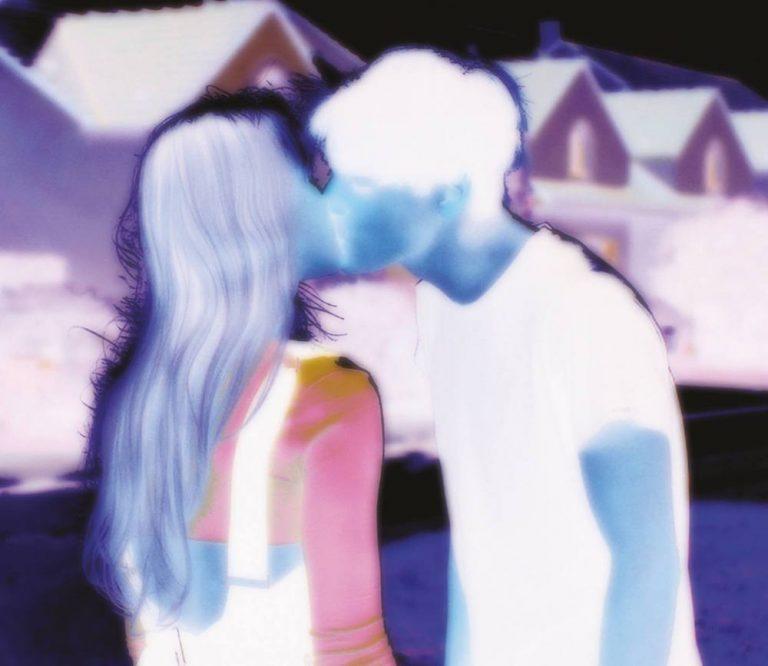
Our Legacy

Caroline Poggi, Jonathan Vinel, France, 2016, 24’

Lucas invites his girlfriend Anäis to visit him at home. His father is Pierre Woodman, a famous porn director. Between computer games and pornographic archive material, a fictional story unfolds.

Read more
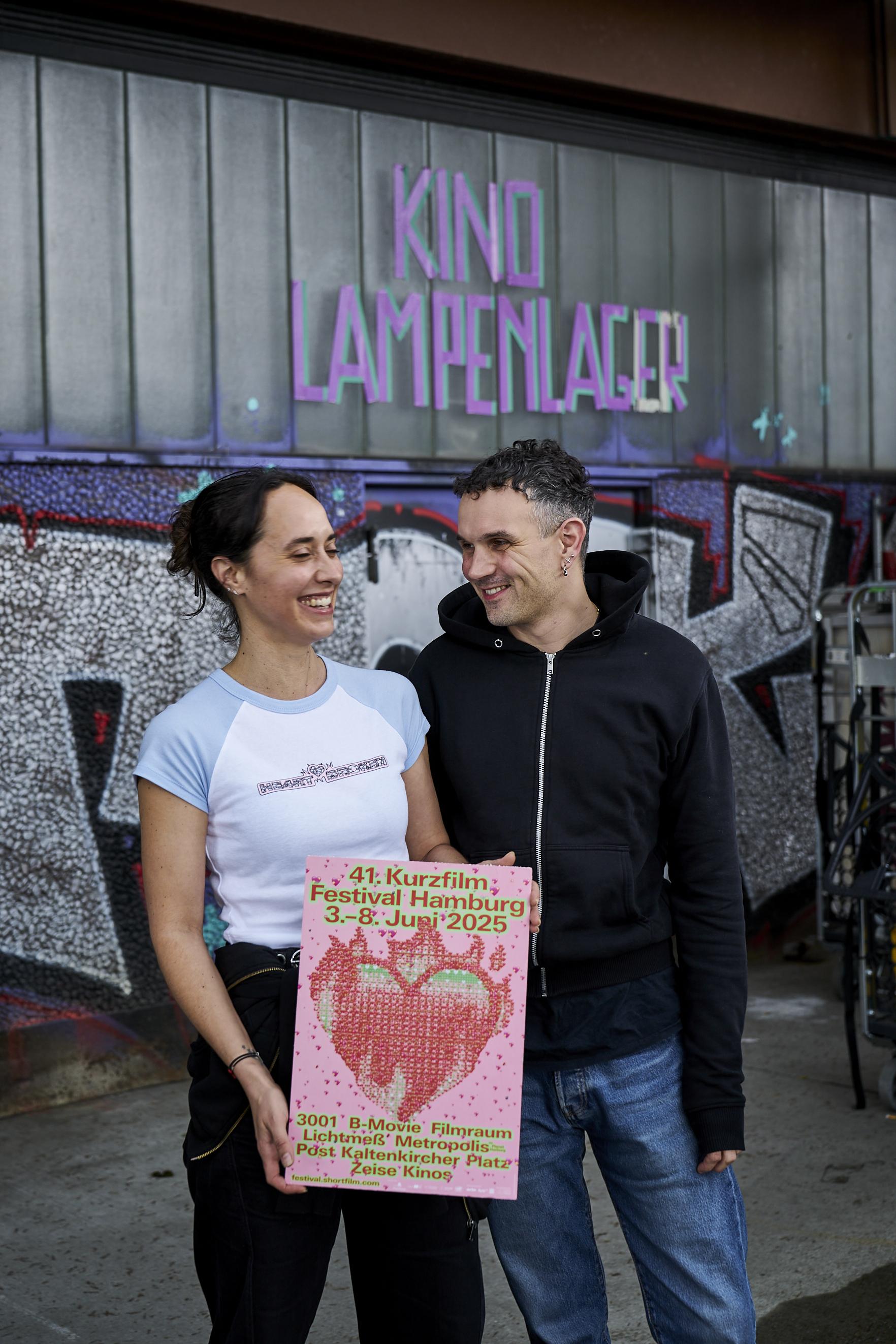
Caroline Poggi & Jonathan Vinel at Kurzfilm Festival Hamburg © Claudia Höhne (2025)

Music plays a crucial role in all of your films. It is used vigorously. Can you elaborate on that?

Vinel: Starting out, we wanted to use music that you normally never hear. Out of personal joy, really. I used to be in a metal band back home. We made screamo, which is both very melancholic and very violent. It’s full of contrasts. I think this sensibility has carried into the films we make as well, because it brings something special to the characters.

Do you compose the music you use yourself?

Poggi: We collaborated with a composer for the first time for Eat The Night (2024), our latest feature film. But most of the time, we pick existing music from a lot of different sources and genres. The search always starts from a love for something hybrid. We like making uncomfortable choices that somehow undermine our images. Or when a character struggles to express themselves, the music helps them out. It isn’t just there as a transition between scenes. We treat it like dialogue. It’s there to be listened to.

Our trajectory is defined by a search for giving [the internet] a rightful place within cinema as a medium. When you go to film school, there is a certain classification, a hierarchy of images: some are seen as noble and cinematic and others as “lower class”. (...) Now I know this “low-class” imagery is important because it speaks to the times we live in now in so many different ways.

Jonathan Vinel

The internet plays a major role in your films too.

Vinel: I think our trajectory really is defined by a search for giving this a rightful place within cinema as a medium. When you go to film school, there is a certain classification, a hierarchy of images: some are seen as noble and cinematic and others as “lower class”. I was really obsessed with video games in my first year of film school, for example, but I felt like I needed to give this up to watch more films because their imagery wasn’t noble enough to be used. Now I know this “low-class” imagery is important because it speaks to the times we live in now in so many different ways.

Poggi: Our first film was made when Tumblr was still a big thing. The internet has always influenced our work in many different ways. Using it as a starting point feels very natural. It’s like having a third arm that you use instinctively.

With Notre Heritage (2016), the internet was at the centre of our film for the first time. In it, we used real footage of Pierre Woodman, who became famous in the nineties with porn castings he shot in Eastern Europe after the fall of the Berlin Wall. His videos were all over the internet back then. Through the story of his fictional son, who wonders if his father was ever in love with one of the girls in the videos, we try to question the weight of pornography on our generation. How can we still love when we grew up with imagery like this?

Vinel: Woodman’s pornographic images were solely created to masturbate to. The idea for us was to place them in a different context and strip them of their initial purpose. We wanted to notice the violent power dynamics behind it.

Cinema is considered noble, and pornography is not. That’s what I love about your work: you challenge the myth of the “hierarchy of images”—there is none. Is that also why animation entered your universe, such as in Comment ça va? (2025).

Vinel: Animation came to us through video games; we repurpose images on the internet to express something new. It lets us collaborate with friends on a smaller scale.

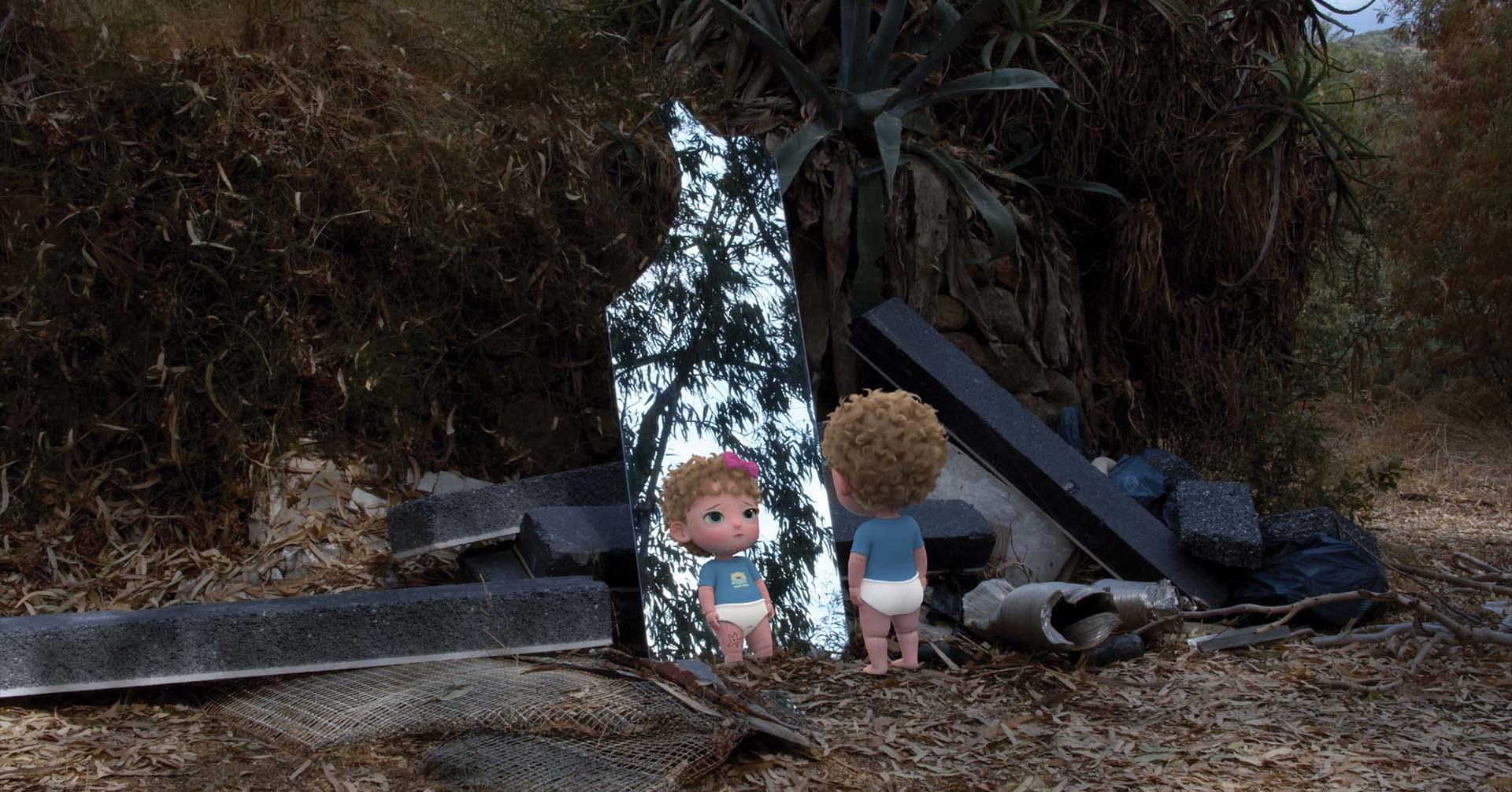
Poggi: It can be really frustrating to wait on financing while the rest of the world keeps moving, so using animation gives us a way to keep working. But because we don’t have major-studio resources, we have to work within our own limitations. This tends to welcome imperfections like bugs and glitches, but in the end it’s about the stories you tell with it. Machinima and pornography are also ways for us to talk about more violent or radical things, while keeping a distance. It’s so different to have an animated 3D baby talk to you about political things than to watch a real actor.

Read more

How Are You?

Caroline Poggi, Jonathan Vinel, France, 2025, 31’

In this hybrid 3D animated film, a pseudo-intellectual menagerie reflects on the contemporary political landscape on the other side of the Corsican Sea through dry wit and Disney fonts.

Read more
Baby Anger (Caroline Poggi & Jonathan Vinel, 2020)

The characters in your films speak in a very poetic way. How do you write?

Poggi: None of our characters are where they are supposed to be. They all feel like they don’t fit into the world they live in, so they look for the right words to feel okay. This makes them speak in very calculated ways. They don’t make small talk and don’t use ordinary words. They really speak from the heart. It’s up to us to find the exact words they can use to express themselves.

Vinel: This way of working really comes from a shared love of literature and poetry. I grew up reading Bernard-Marie Koltès. He’s been really important to me because he has a very lyrical way of describing a hyper-violent society. It’s aggressive poetry with a certain distance built into it. We try to work with the same sentiments. There’s a love for people who don’t know how to speak to anyone except themselves, as if writing in a diary.

What’s next? Which images are you curious about now, and how do you want to excavate them and bring them into cinema?

Poggi: We’re watching a lot of older films now, like David Lynch’s Mulholland Drive (2001) and Robert Altman’s Short Cuts (1993). It’s really fun to examine their dramaturgy, ask how they’re made, and wonder whether they would still get financed today.

With our own films, there are often a lot of short-film ideas that eventually merge into one feature film. That makes for a very generous, [hybrid] project that wants to be many things at the same time. We’re writing a love story right now, but I don’t think there is just one thing we want to talk about or are inspired by. It’s the people we meet, a sentence we hear, a place we visit. But of course, cinema is always there.

Finally, let’s go back to the first thing that was shown today, which is the festival trailer. One of the images that stands out is that of Palestinian pediatrician Hussam Abu Safiya, walking away through the rubble in a picture that now belongs to our collective memory. You mentioned the “hierarchy of images” before. How does this relate to the images you used in the trailer?

Poggi: Showing what the world is like in just one minute is very difficult. But as filmmakers, it’s our duty to talk about Palestine, among so many other things.

Vinel: This relates exactly to how we always work: trying to relate to the world that surrounds us and make sense of it. Showing the world as it is today, in this case using internet images only. Some images are forbidden or more difficult to show, so we found ways around that without making the trailer too violent. The idea was: what does it mean to be on the internet today? The trailer is a kaleidoscopic answer to that question.

Read more about

#516 Comment ça va?
#559 Notre héritage

    This conversation took place on June 6, 2025, during the 41st edition of Kurzfilm Festival Hamburg, and we present it here in collaboration with the festival.

    Kurzfilm Festival Hamburg

    Bio Maike Höhne

    Since studying at the Academy of Fine Arts in Hamburg and Havana, Maike Höhne has worked in film as an author and director, a curator and producer, and a lecturer. Höhne’s artistic and curatorial practice is characterised by a discursive, political, and communicative approach. From 2007 to 2019, she headed the Berlinale Shorts section of the Berlin International Film Festival and significantly raised its profile. Since 2019, she has been the artistic director of the Hamburg Short Film Festival. With PINKMOVIES, she and her partner produce, among other things, the television format KURZSCHLUSS - COURT-CIRCUIT. Her next feature film will tell the story of the Bonn Republic shortly before the German Autumn. Höhne’s films are distributed by the Arsenal Institute for Film and Video Art in Berlin and the Short Film Agency in Hamburg. She lives in Hamburg with her children.

    read more

    © COMBAT DE BOXE (1927)
    artikel
    Read more

    Fundamenteel dynamisch

    Over Charles Dekeukeleire en de essentie van film

    Bjorn Gabriels
    04.04.2023

    Charles Dekeukeleire ging de geschiedenis in als een van de grondleggers van de experimentele en documentaire cinema in België. Vandaag vindt vooral zijn (korte) avant-gardewerk nog weerklank.

    Read more
    Water and Salt (Luisa Mello, 2019)
    Water and Salt (Luisa Mello, 2019)
    essay
    Read more

    Watery tensions

    Luisa Mello’s Water and Salt

    Kathy Vanhout
    03.04.2022

    Apart from water, salt, and clouds, Mello’s work often features young and older people, artists, animals, and cities; these things are the source of her documentaries. Her films always leave room for fictive contemplation and interpretations. Water and Salt, for that matter, hardly reads as a documentary. In these reflective ten minutes, she attempts to translate a thought, a feeling, an observation. In situations like this, where words are insufficient, and the outside world offers few answers, Mello constructs her own images. Or she turns to archival ones.

    Read more
    © MISTY PICTURE (Christoph Girardet & Matthias Müller, 2021)
    Misty Picture (Christoph Girardet & Matthias Müller, 2021)
    essay
    Read more

    Cinematic Ghosts

    On Christoph Girardet and Matthias Müller’s Misty Picture

    Oana Ghera
    09.12.2024

    Through association, repetition, and accumulation, Christoph Girardet and Matthias Müller showcase the inventory of Hollywood formal clichés that contributed to the creation of the Twin Towers’ symbolic capital, reflecting at the same time on the power of those images to haunt our collective imagination to this day.

    Read more
    Ours is a Country of Words (Mathijs Poppe, 2017)
    Ours is a Country of Words (Mathijs Poppe, 2017)
    article
    Read more

    Recurring Dreams

    Mathijs Poppe’s Ours is a Country of Words (2017)

    Yara Yuri Safadi
    20.09.2025

    The voice-over of a man with a Palestinian accent informs viewers that they are watching a “film”, highlighting the artifice of the images while also linking it to the reality of the Nakba. The man’s voice situates us as viewers within an imagined future, one “in which Palestine is free again.” Ironically, we watch this film in 2025, amidst the ongoing genocide in Gaza and the ethnic cleansing and apartheid in the West Bank. Juxtaposed with the harsh realities of the genocidal present, Ours is a Country of Words’s sci-fi-like imagination shows the desire for a future that is increasingly fought for. As the first dialogue unfolds, we are invited into this brighter future: Palestine is liberated, and refugees can return.

    Read more
    Mars, Oman (Vanessa del Campo, 2019)
    Mars, Oman (Vanessa del Campo, 2019)
    essay
    Read more

    Between Worlds

    Vanessa del Campo’s Mars, Oman

    Dora Leu
    20.04.2025

    Mars, Oman alternates between sympathy for the scientists and scenes that underline their blindness caused by the excitement for space, leading to a colonial dilemma. With exploration, there’s always an admirable desire for progress, a thirst to venture where no man has been. History has taught us, however, that this is liable to corruption, and progress has much to do with politics. This dynamic between innocent dreams and obtuse greed lingers throughout the film, making you wonder what the astronaut’s position is in the goal of conquering Mars.

    Read more
    I Don’t Feel at Home Anywhere Anymore (Viv Li, 2020)
    I Don’t Feel at Home Anywhere Anymore (Viv Li, 2020)
    essay
    Read more

    No Place Like Home

    Viv Li’s I Don’t Feel at Home Anywhere Anymore

    Bo Alfaro Decreton
    22.02.2025

    Li’s I Don’t Feel at Home Anywhere Anymore begins at the Beijing airport and ends in a grey Brussels shopping street where the word ‘home’ is ostentatiously and tackily displayed on a large shop window. She frames her return with the cold presence of non-lieux: places that, according to French anthropologist Marc Augé, have no history or identity and do not encourage interaction. Here, everyone remains anonymous. Li places these non-lieux in stark contrast to the home. A home that is not merely synonymous with the parental home or the city where she grew up, but also arises from friendships, memories, and familiar sights and views.

    Read more
    © Dimensions of Dialogue (Jan Švankmajer, 1983)
    artikel
    Read more

    Dialoog doorgelicht

    Jan Švankmajers Dimensions of Dialogue

    Michiel Philippaerts
    28.12.2017

    In deze kortfilmklassieker bestudeert Jan Švankmajer de verschillende aspecten van ‘dialoog’ op een ludieke en verrassend pessimistische manier.

    Read more
    © La Chambre (Chantal Akerman, 1972)
    La Chambre (Chantal Akerman, 1972)
    article
    Read more

    A Room of Her Own

    Chantal Akerman’s La Chambre

    Öykü Sofuoğlu
    17.11.2024

    Lounging on a small bed, Chantal Akerman’s posture seems casual and relaxed at first glance, but the repetitive tilts of her head—to the left and then back to center—contrasting with the smooth glide of the camera suggest otherwise. Restlessness is in the air, yet before we can discern it, the image is already on the move, retracing its steps for a second time.

    Read more

    Subscribe to our monthly newsletter for updates on new releases, publications, and events!

    Subscribe

    yanco is a magazine and streaming library for short-form moving image

    kortfilm.be vzw
    Boondaalse Steenweg 249
    1050 Elsene
    BE 0478 441 315
    info@yanco.be

    with the support of the Flanders Audiovisual Fund (VAF) of the Flemish Government

    VAF
    • about
    • colophon
    • privacy policy
    Facebook Instagram LinkedIn YouTube Letterboxd
    design by de Ronners
    website by eps en kaas