Pining has gone out of style. Longing is frowned upon, but togetherness (as a couple) still seems to be the most desired goal, or at least the highest rated one in our heteronormative societal structure. Feelings? Ew. Some cold-hearted viewers might even equate men “in their feels” with an Ick. In this context, to stumble across a line so disarmingly direct as “it was sweet for him to suffer” can be disorienting. The phrase appears in the middle of Pierre Voland’s Signal GPS perdu (2022), narrated by Voland himself, describing a knight’s devotion to his Lady even as his hands and knees bleed from the challenges he faces. First in the “solitude au masculin” programme curated by Inge Coolsaet for argos , Signal GPS perdu weaves a tale of longing that would resonate as a defiant, erratic strive for connection in Alison Murray’s Wank Stallions (1993), to then reverberate in melancholic echoes through La mécanique des fluides (2022) and its attempts to figuratively touch those young men whose notions of intimacy can have lethal consequences.
The visuals of Signal GPS perdu alternate between sights of nature paired with a voiceover and a black screen with elements suggestive of a dating app called Bellow, designed to “meet gay guys easily around you.” These are two chronotopes, one timeless and the other timely; one voiced with yearning and the other full of interrupted chats, glued together by a sense that such feelings are ever-present and the search for someone or something is an emotional necessity. So, Voland’s film invites you to journey inwards, even though the images you see are of nival landscapes—peaks, forests, and slopes in the Jura mountains. The glossy, virginal snow is then pressed for texture through the 8mm film, with its occasional jolts preventing a smooth viewing experience, even if the framing suggests a first-person perspective.
A twig snaps as footsteps advance, a deep exhale follows the sound of snow crunching under the weight of one’s foot: a hunter stalking his prey. “I see a hind,” the hunter says at one point, but do you? Mesmerised by the winter scenery, the viewer can forget they too inhabit the point of view of the hunter, his concentration so sharp that it could probably conjure a hind out of thin air where there is none. Sometimes, the desire to see or to have is so strong that it overhauls the logic of reality.
The obsessive nature of the “courtly love” professed in Chrétien de Troyes’s Medieval poems in Signal GPS perdu—that overwhelming draw towards a love so big it gives the knight a reason to die for—might be a tad naive. Yet, the filmmaker-narrator recites with an enchanting cadence, honouring the XII-century Vernacular French and the rhythm of its eight-syllable couplets, as yearning bleeds into the black screen of a dating app chat. Even if we don’t assume the hunter, the storyteller, and the dating app user to be one and the same, there is multiplicity in every desiring subject.
The words become sumptuous, the metaphors animalistic—“as the deer turns to the streams of water, so my soul turns to you,” writes Big Bear in the chat—but the film is decisively ascetic in form: between the black-and-white Super 8 and the wide-shot scale, there seems to be little room for emotion. Yet, every frame flutters in search of affection.
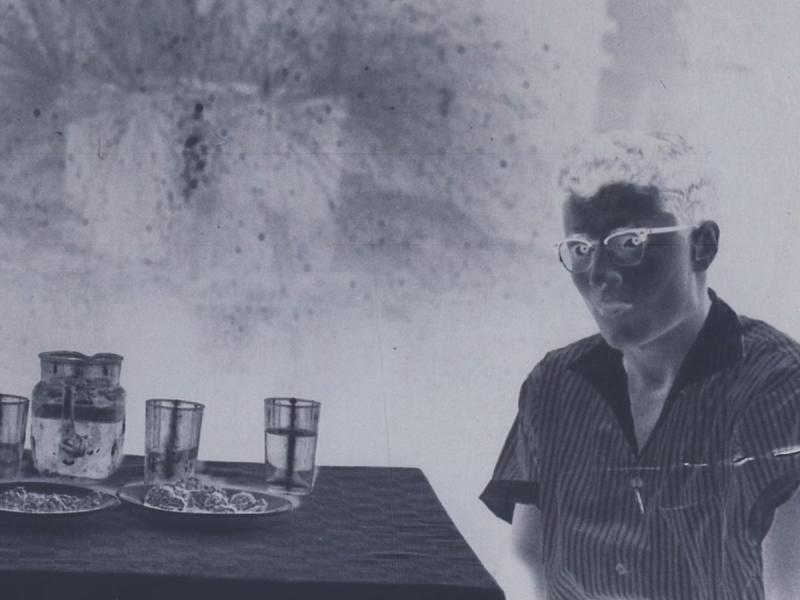
Wank Stallions does quite the opposite. At 22, Allison Murray shot the film somewhere on the coast of Brighton, England, guided by the vitality of her friend, now acclaimed British stage and screen actor Danny Sapani. The result is an improvised dance, choreographed through night-time encounters, clubs, and macho male archetypes. Unyielding and exploratory, Murray’s film unfolds as a series of libidinous encounters: coming face to face with fear and desire in the streets or on the beach when the tide is low are acts of surrender, inscribed only in the fleeting hours of the night.
Words by English poet and author of Winnie the Pooh, A.A. Milne, and American journalist Hunter S. Thompson, as well as hip-hop band Urban Species lyrics, lend a frivolous, yet poetic quality to the societal critique in this short film. From reenacting a conversation from Winnie the Pooh to “Dogs fucked the Pope, no fault of mine” from Fear and Loathing in Las Vegas, a bit of poignant tongue-in-cheek politics fitting for a film with such an evocative name.
Rather than exteriorising their feelings, some young men on the internet bottle up so much ambivalence that it eventually erupts, gushing through the screen. There is a performative appeal to vlogging, but the soliloquy of one self-identified incel (involuntary celibate) prompts Gala Hernández López to write him a letter in La mécanique des fluides. The film opens with him confessing to an absolute loneliness, the pleasant voice swelling with rage as his call for empathy gets crushed by an invasive tendency to self-deprecate—a symptom found in those prone to violent acts. He first speaks over a black screen, then appears: cloaked, concealed with only his eyes visible. Lopez, whom we never see, speaks gently, and her tone is forgiving towards a stranger who may never hear her reaching out. She tells us the guy known as Anathematic Anarchist is no longer active online and that he has left a suicide note. The film documents her search for him through her desktop and morphing computer animations.
The “manosphere” offers a world for the lonely, or the sexually excluded, where radicalisation is the only acceptable form of yearning. La mécanique des fluides is aware of the risks involved in gulping that poison, but also understands how thirsty one must be to succumb to this. That’s why the desktop documentary form works so well here, inviting the viewer into a virtual space of intimacy—the filmmaker’s own screen—as she sifts through incel forums. The place where most incels come together to relish in their damnation is quite a dangerous corner of the Internet, especially for a woman.
Intimacy is a paradox, both miraculously possible and unachievable in full. Bodies cannot merge, nor can minds, but somehow we collectively decided that a certain amount of proximity is what human beings need to be less alone. La mécanique des fluides is a precious attempt to bring two solitudes together—the narrator’s and the subject’s—without insisting on a transformation. Perhaps there is a salvageable aspect to loneliness? As the so-called “male loneliness epidemic” seeks its cure, cinema can bandage the blisters. Not that there is a magical fix in the moving image—or maybe not in this case—but the striving to record, reproduce, and watch what is, in most cases, other people’s loneliness on screen, can surely help.