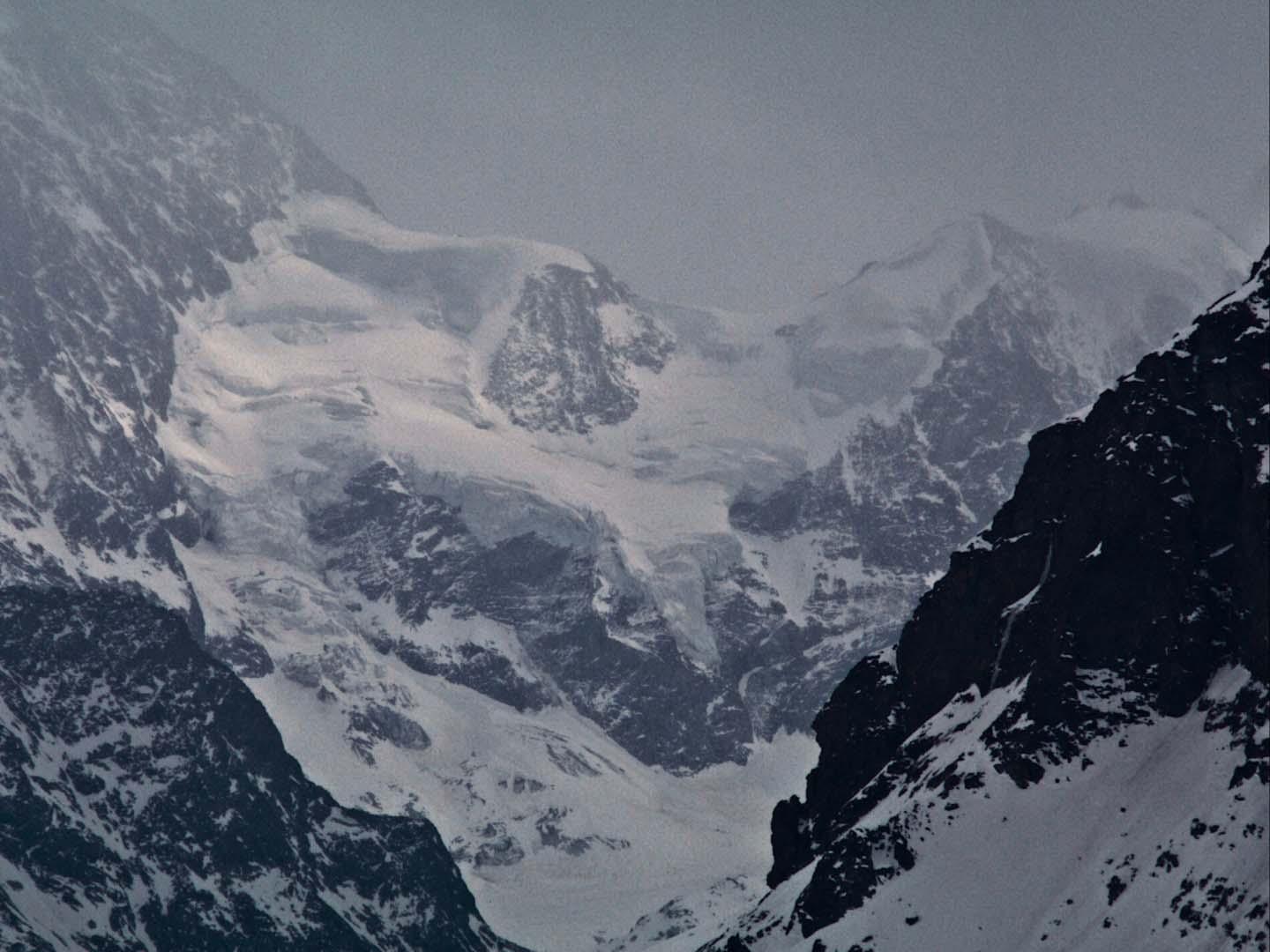
Schaevers’ camera has a paraglider in sight until it promptly takes a mysterious nose-dive and falls out of the frame. After that, the camera searches for natural compositions. In doing so, it reminds us of Michael Snow’s 1971 film La région centrale, in which the humane gaze of “nature” is entirely alienated—we do not see the world clearly but are lost in our search for harmony and order.
These two remarkable scenes act as a thematic prelude, even before the title card pops up. The camera, searching, has yet to drastically descend the mountain to introduce us to the local Zinal youth who live under the watchful eye of melting glaciers. In On Its Way Down, Schaevers casts local youngsters as actors in their own stories. Every day, under the influence of the global climate catastrophe, they are confronted with an irrevocably changing world. Their behaviour screams indifference—apathy and nihilism in response to an inability to grasp the scale of the devastation. Ultimately, humans avert their gaze; Susan Sontag already warned us in her 2003 essay “Regarding the Pain of Others”: “Shock can become familiar. Shock can wear off.” But can any more tremendous shock be imagined than realising the magnitude and scale of Gaia’s human transformation?
One can extrapolate a planetary problem from the microcosm of the Zinal youth: man is incapable of facing such a gigantic catastrophe. The temporal and spatial scale of what theorists now call the “Anthropocene,” and especially its ecological excesses, are almost literally unfathomable. Schaevers’ often lingering camerawork reflects that dilemma. The image of the characters against the backdrop of melting glaciers also suggests that humans become insignificant against the grandeur of mountain landscapes. Is there still a foreground or background? Who is actually the actor in this image? Has “humanised” nature claimed itself free from action?
Schaevers is constantly seeking visual and narrative strategies to capture a problem created by man that has now become so overwhelming that it exceeds human capabilities to cope. We are heading for an almost sublime aesthetic experience of our own demise—the scenes with the patrolman throwing around bombs hint in that direction. At the same time, a local cynically comments on a ski elevator trip as a planetary agony. On Its Way Down leaves no scene unused to launch metaphors about human attitudes toward the impending ecological disaster. Schaevers, however, does not seem intent on moral redemption (à la Melancholia or World War Z), but instead depicts his frustration and inability to act.
In these dark times, this film is a welcome intervention of urgency. What does art still mean in the face of ecological volatility? Can we still create freely, or will we continue to stare at our demise, preferably on the smallest possible screen, with popcorn on our laps? Schaevers, no doubt, wonders it all too, and responds appropriately. So long live explosive nihilism!