yanco Home
Menu
  • Home
  • watch
  • magazine
  • calendar
  • index
  • Subscribe
Search Log in
  • nl
  • en
You are here
  • Home
  • Magazine
  • Sensitive Content
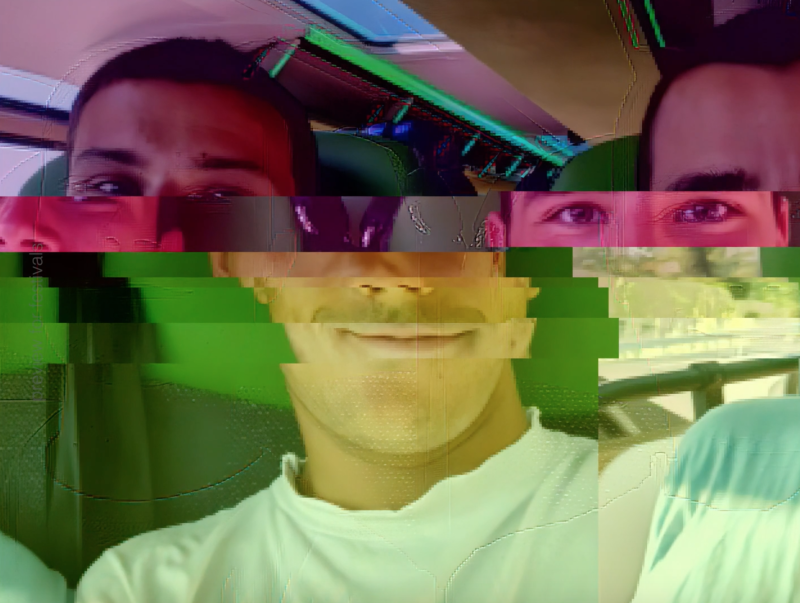
© SENSITIVE CONTENT (NARGES KALHOR, 2023)
Sensitive Content (Narges Kalhor, 2023)

Sensitive Content

essay by
Emily Jisoo Bowles
20/20 Vision
26.09.2025

“The Syrian people are shooting their own deaths.” This remark by a friend catalysed Lebanese artist Rabih Mroué’s lecture-performance The Pixelated Revolution (2012), in which a civilian films his “eye contact” with a military sniper during the early days of the Syrian revolution. There’s a brief moment of suspension when the lens of his phone camera stares down the barrel of the gun. The sniper then pulls the trigger and the frame tumbles into oblivion. The evidence of this brutal act is almost destroyed—the censorship is instant, eliminating the need for its usual bureaucracy.

Since the advent of the smartphone in the early 2010s, the camera has become a cyborgian extension of the body, lying in wait like a phantom limb even when not in use. We no longer rely solely on professional journalists to document war and conflict; rather, the masses making history are the ones making its images, risking their lives to construct a diffuse online network of counter-narratives. Yet as much as the internet is a means to disseminate information and organise protests, it is also a site of surveillance and control, where protestor footage is fed into facial recognition models that can see through masks, and state-enforced blackouts allow it to carry out its crimes in the dark. Curated by Inge Coolsaet for argos, the short film programme “Sensitive Content” probes the uneasy politics of visibility in a world rocked by mass unrest and censorship, where the abundance of irrefutable evidence clashes against technologies of repression.

The programme takes its name from Narges Kalhor’s film Sensitive Content (2023), which opens on the instantly recognisable square of an Instagram post. The photo is blurry to the point of indistinction, overlaid with the symbol of an eye crossed out that brands it with the titular content warning. As Kalhor reduces the opacity of the image, the eye looks left and right, and a woman facing a squadron of riot police slowly comes into view. Building a dispersed portrait of the Woman, Life, Freedom movement that swept across Iran in 2022, the film collages clips recorded by protestors and witnesses who film from balconies, cars, or while running through the streets. The embodied presence of the cameraperson in the shaky footage heightens our awareness of their position relative to the violence, making us fear for their safety. It is impossible to remain a passive spectator when the comforting barrier of distance is stripped away.

Filming is synonymous with seeing in Sensitive Content, a gaze that cannot be fully repressed despite the Islamic Regime’s brutal crackdowns. Yet the entrapment of the images within the Instagram square reminds us of their constant mediation by the social media platforms they depend on. The blurriness of the footage thus speaks to both the necessity of anonymising the protesters and its algorithmic suppression: both AI and human intervention label posts as “sensitive content”. Kalhor’s film illuminates this manufacturing of invisibility and credits the people of Iran who resist its hegemony through their collective camerawork.

Justine Capelle’s The Lost Sail (2022) uses a similar visual strategy of opacity to represent censorship, consisting only of a black screen for its entire duration. The voiceover of director Zao recalls how he was forced to rewrite a film script deemed inappropriate by Chinese censors. Set on a ship, the abandoned film is brought to life through Zao’s enthusiastic description of the scenes, made visible as subtitles in a serif font to mimic the script. INT. BALLROOM - NIGHT becomes a partial revival of its latent form. Curiously, flickers of celluloid artefacts materialise on the screen as if to suggest that the film lives on, if only in this provisional state framed by Capelle’s film.

The impossibility of representation is probed again in Doubts (2024) by Fırat Yücel, this time through the self-reflexive mode of desktop documentary, where the labour of post-production is made visible. Over a fictional text conversation, two filmmakers discuss what to do with the vast amount of footage filmed by protestors during the 2013 Gezi Park Resistance in Istanbul, scrolling through interminable spreadsheets that categorise the videos by content and location. The violence of the state, the resilience of the people: the evidence has been captured, but can it be shown under Turkey’s authoritarian government? To anonymise the protesters, the filmmakers nervously experiment with blurring the image or finding clips with low shutter and wide shots. In foregrounding the anxiety that pervades the editing process, the film becomes an exercise in self-censorship, where no amount of caution and restraint can guarantee safety.

Sécurise tes images : détruis-les (2024) offers a more concrete vision of resistance through a counter-technology in action: facial-recognition software is tweaked to blur faces instead of identifying them. GoPro footage of a demonstration in Sainte-Soline is overlaid by red rectangles hovering over each protester, tracking their movement and categorising them as “person”. The aesthetics of surveillance, usually yoked to police and military technologies, produces a sense of unease. Unlike the shaky, vertical videos shot by protestors gripping their phones, the wide-angle, slow-motion suspension evokes the disembodiment of a video game. Rather than direct documentation of the event, the footage acts as a demonstration of the technology: an Operational Image.

Coined by filmmaker Harun Farocki, Operational Images describe pictures that prioritise action and function over the interpretation of meaning or aesthetics. Originally used in the context of military technologies, the operational now appears to be the default mode of image circulation, where photos posted online are reduced to data to be mined by third parties and scraped by AI. Companies like Meta regulate the velocity at which users scroll through this visual deluge, tracking, measuring, and modulating our perception. If AI is trained on our pictures, then we, in turn, are being trained to engage with images not in a contemplative, critical mode, but in a state of perpetual inattention.

Against this operationalisation, the films in Coolsaet’s programme seek to activate their images as evidence, disrupting their designation as “content”. The civilian-captured footage utilises blurriness and shakiness as markers of authenticity, contesting the high-resolution propaganda of national media and rejecting the legibility demanded by the state. Yet these fragments can never tell the full story. They invite us to look with what filmmaker Maryam Tafakory calls a “critical paranoia”, to read their images with the assumption that something is always missing.
    20/20 Vision is a monthly micro-cinema night in argos’s Black Box, a shifting line-up of video works, from shorts to features, from their archive and beyond. With only 20 chairs for 20 spectators, the audience gathers for a screening programme shaped around a topic or a filmmaker. yanco and argos collaboratively publish a monthly essay on each programme.

    Bio Emily Jisoo Bowles

    Emily Jisoo Bowles is a British-Korean film critic, translator, and film programmer at Queer East festival.

    read more

    Paradise (Laura Vandewynckel, 2014)
    Paradise (Laura Vandewynckel, 2014)
    essay
    Read more

    Impassable Gates

    Laura Vandewynckel’s Paradise (2014)

    Najrin Islam
    13.06.2026

    In five minutes, Paradise scans what determines movement for racially distinct peoples. Borders seek to contain, and any transgressions are preemptively curbed through restrictive legislation or bureaucratic rigmarole. As architect and researcher Shahram Khosravi and Mahmoud Keshavarz point out in their article, “The Magic of Borders”, border fortifications—materialised through visa protocols, military operations, or propaganda media—facilitate mobility for the white traveller as much as they restrict it for racialised refugees.

    Read more
    © The End of Suffering (A Proposal) (Jacqueline Lentzou, 2020)
    The End of Suffering (A Proposal) (Jacqueline Lentzou, 2020)
    interview
    Read more

    Everything Is Already Inside

    Jacqueline Lentzou on The End of Suffering (A Proposal)

    Kathy Vanhout
    02.10.2024

    Greek filmmaker Jacqueline Lentzou does not look for inspiration; inspiration finds her. In her artistic practice, vague ideas slowly develop into something more comprehensible, more tactile. In The End of Suffering (A Proposal), she renders the mere act of “understanding” palpable.

    Read more
    Da-dzma (Jaro Minne, 2019)
    Da-dzma (Jaro Minne, 2019)
    essay
    Read more

    The Last Winter

    Jaro Minne’s Da-dzma

    Savina Petkova
    30.05.2025

    In his work, Belgian director Jaro Minne frequently explores the crossovers between East and West. He spent time in Georgia, resulting in the photography series “Passenger”, interested in the human face and the human scale of things in an overwhelming world. Rather painterly aesthetics are used to subtly convey a socio-political point. In Da-Dzma, Minne does something similar: through sparse compositions, little dialogue, and minimal sound design, the short lets us peek into a world of feelings one frame at a time.

    Read more
    Loveboard (Felipe Casanova, 2023)
    Loveboard (Felipe Casanova, 2023)
    essay
    Read more

    Vicarious Recollections

    Felipe Casanova’s Loveboard

    Flavia Dima
    24.01.2026

    Loveboard speaks to an era in which relationships are increasingly preserved through digital archives and the large amount of digital detritus this generates. Our personal troves of images have grown significantly in recent decades. The availability and cost of film stock constrained people to choose what to archive, and therefore, to also curate the image of their past. In this sense, digital media is counterintuitive, even antithetical to curatorship: it has the ability to seemingly conserve everything, including moments that seem utterly inconsequential, even banal, that are valued only in retrospect (if at all).

    Read more
    © BURN TO SHINE (UGO RONDINONE, 2022)
    verslag
    Read more

    Vrijen met het publiek

    Cinema als avontuur in Anouk De Clercq’s Love That Moves The Sun

    Jannes Callens
    12.06.2024

    De in Berlijn gevestigde Belgische kunstenares Anouk De Clercq wil experimentele films openstellen voor argwanende mensen. Avant-garde cinema noemt ze koppig “avontuurlijke film”. In een kortfilmprogramma voor Courtisane maakt het cerebrale plaats voor een sensuele beleving, een fundamenteel lichamelijke ervaring van cinema.

    Read more
    Waithood (Louisiana Mees-Fongang, 2019)
    Waithood (Louisiana Mees-Fongang, 2019)
    essay
    Read more

    In limbo

    Louisiana Mees-Fongang’s Waithood

    Benjamin Antonissen
    02.02.2022

    Athens often is perceived as the ideal holiday destination. It is the birthplace of democracy, overflowing with culture, and has exceptional cuisine and countless picturesque squares to spend time carelessly. This, however, isn’t the image the five twentysomethings in Waithood have of the Greek capital. For them, Athens feels like a prison where they are forced to kill time together. Christos, the only one in the group with a stable job, cleans up luxurious Airbnbs. When the tourists leave, he and his friends take over the apartments. And then the waiting takes over. Christos and his friends are insecure about their future. Waithood refers to the stagnation recent graduates can find themselves in, especially in economically challenged regions.

    Read more
    © Untitled III (Sarah Pucill, 2001)
    Untitled III (Sarah Pucill, 2001)
    interview
    Read more

    Folding Time

    On Sarah Pucill’s Surrealism

    Laura Stoeckler
    23.08.2025

    Over the last thirty years, Sarah Pucill’s films have shown a sustained engagement with feminist politics, surrealist aesthetics, and the material language of cinema. Her work is connected by a visual and conceptual vocabulary that keeps evolving. Figures, motifs, and techniques reemerge—the principle of continuity is key to understanding how the artist’s work coheres, drawing strength from its self-reflection.

    Read more
    © Bamssi (Mourad Ben Amour, 2024)
    Bamssi (Mourad Ben Amour, 2024)
    essay
    Read more

    An Outstretched Hand

    Mourad Ben Amor’s Bamssi

    Öykü Sofuoğlu
    12.05.2025

    Animals no longer live in nature; they now exist first and foremost on our screens. While each new internet-based encounter with them still feels as surprising and delightful as ever, the obsessive relationship with animal imagery often remains limited to fulfilling our emotional needs—rarely do we question the underlying motives. Mourad Ben Amor’s Bamssi (2024)—a diary film made alongside a pack of animal protagonists—hints that our fascination may sometimes be less about the animals themselves than about the spontaneity and impulsivity that emerge from their most routine gestures.

    Read more

    Subscribe to our monthly newsletter for updates on new releases, publications, and events!

    Subscribe

    yanco is a magazine and streaming library for short-form moving image

    kortfilm.be vzw
    Boondaalse Steenweg 249
    1050 Elsene
    BE 0478 441 315
    info@yanco.be

    with the support of the Flanders Audiovisual Fund (VAF) of the Flemish Government

    VAF
    • about
    • colophon
    • privacy policy
    Facebook Instagram LinkedIn YouTube Letterboxd
    design by de Ronners
    website by eps en kaas