
War, in a Euro-American-centric context, is a momentary interruption of an otherwise undisturbed sociopolitical continuum. By colonial standards, war mostly happens in—or is brought to—foreign lands. Countries that experience armed conflicts as their primary condition of existence, are often ignored by Western media coverage. In the last few years alone, civil unrest has been met with repressive violence from Congo and Rwanda to Myanmar, from Syria to Sudan, from Yemen to Palestine. Russia’s invasion of Ukraine has recently reminded European countries that war is not a faraway reality—an unfortunate situation the many migrants we keep pushing away are escaping from—but also an inevitable miscalculation. The Palestinian genocide offered Europe yet another chance to ignore the teachings of history and resort to either complicity or condoning. Curator Inge Coolsaet’s argos programme “War Is Not Over” surveys polymorphic responses to some of the major historical conflicts still haunting the West, like World War I or the Vietnam War.
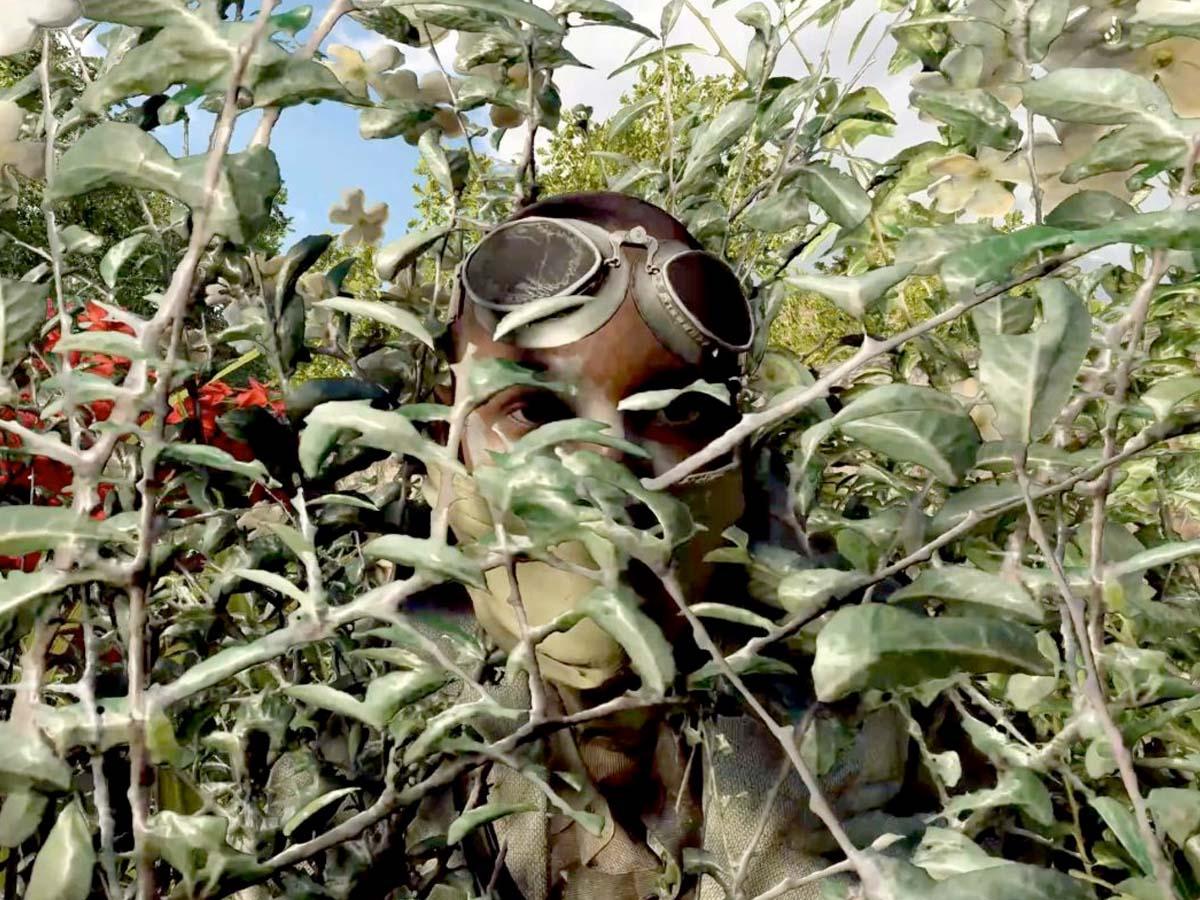
Set in the war-ridden world of Battlefield—a multiplayer online shooter—Total Refusal’s How To Disappear (2020) investigates disobedience in war and games. This machinima, like most of Total Refusal’s works, follows a familiar script: once the thesis has been laid out, the media-guerrilla group looks for the cracks in the code, imbuing the game with alternative, Marxist-inflected readings. Unsurprisingly, a war game like Battlefield doesn’t allow desertion. The limited scope of this online shooter triggers a dystopic ouroboros that only slightly differs from reality. Whereas desertion was once seen as resistance against the social order—or even a productive force in society, according to Karl Marx—nationalisms made deserters into enemies of the people, soldiers who prioritise individuality over the national interest.
By obeying their own interests, nations encourage soldiers to relinquish independent thought, making them into senseless killing machines. Automation dulls the intellect and discourages disobedience. By casting deserters as weak, sickly, and unfit to uphold stereotyped standards of masculinity, they cease to be of value. An anomaly in need of erasure. Battlefield, however, offers a way out: a magic trick enshrouded in smoke. The ultimate farewell to the constrictive logic of the game.
Dutch artist duo Jan Dietvorst and Roy Villevoye worked together on a trilogy about the memory of World War I. Its final chapter, War Is Over (2011), paints a morally muddled postcard of the culture of remembrance in West Flanders, especially around the towns of Ypres and Passendale—two sites of historical importance during the conflict. Opening in an unremarkable forest, where a man searches for the remains of an unknown, dead German soldier, the documentary pieces together various testimonies from people connected to the business of war. One sequence shows young people on a school trip to a privately owned museum exhibiting war memorabilia, alongside guided tours of trenches and a tutorial on how to best throw a hand grenade.
These arguably harmless images uncover the profit-driven exploitation of warfare, where the trivial grumbles of the museum’s third-generation owner—a family business—meet the easygoing demeanour of the high schoolers. Such apparently superficial consumption and understanding of war and its implications is not dissimilar to the players who log into Battlefield to “have fun,” driven by the adrenaline-fuelled rhythm of a shooting game. Whereas Total Refusal commented on how military camps were never situated in the vicinity of forests to discourage desertion, War Is Over unearths the bones of young soldiers who perished in the woods. The fertile soil provides soldiers not with a favourable chance to flee, but rather with a comfortable bedding in death.
The Dynamite Show (2004) by Koen Theys further inhabits the liminal space between the reality of war and the rituals through which societies aestheticise destruction. Composed of videos of explosions developed by Hollywood companies specialising in visual effects, Theys’ work treads a fine line between critique and endorsement. The kinetic display of shimmering lights, smoke, and thundering sound waves becomes a palatable artifice only for those fortunate enough to have lived comfortably shielded from conflict. As fascinating as it is ideologically abrasive, The Dynamite Show reminds us of the unyielding mechanisms of distraction that make devastation appear acceptable, even playful.


