yanco Home
Menu
  • Home
  • watch
  • magazine
  • calendar
  • index
  • Subscribe
Search Log in
  • nl
  • en
You are here
  • Home
  • Magazine
  • Woolen Horizons
Oh Willy... (Emma De Swaef & Marc James Roels, 2011)

Woolen Horizons

Emma De Swaef & Marc James Roels’ Oh Willy... (2001)

article by
Sven Hollebeke
Translated by
Laïka Planchenault
03.12.2023

Soft wool, ambiguous and revealing, wonderfully fragile puppets reflecting a human’s tumultuous growth: Oh Willy…, the fantastic stop-motion film from directing duo Emma De Swaef and Marc James Roels, reads as a surrealist story about loneliness and grief.

Kryzstof Kiéslowksi’s masterpiece La Double vie de Véronique (1991) introduces one of its characters in a most magical scene. Véronique takes her students to see a puppet show. A set of hands reaches for an elegant dancer puppet, dormant in a red box. Next, there is a buzzing in the crowd; the kids in the audience are eager to get a closer look. The puppet girl dies and is reborn as an angel. Sure, the scene is sad, yet also fascinating. The puppet seems more apt to express emotions than the humans who make up the crowd. A similar enigmatic sadness permeates Oh Willy… The short film marked the first professional venture of the puppeteering duo Emma De Swaef and Marc James Roels. Later collaborations, such as the ironic Ce magnifique gâteau (2018), dealing with Belgium’s colonial history, saw the two gaining widespread acclaim.

We witness an older woman in the kitchen through the door frame of a sunny living room. She is naked and storing away some mugs. While still holding a serving tray in her hands, she starts to shiver and shake. She collapses. A short struggle for life follows, and eventually, her body becomes flaccid. She has passed away. In the subsequent shot, we see a framed picture of young and innocent Willy next to a baby goat. Years have passed, and Willy is now presented as a soft and gentle man. Not solely because of his wool and glass fiber make, but more specifically because of the type of life he lives—a life of solitude and silence. Willy is afraid of agency, of going into the world with his head held high. He is used to the nudist colony that formed his surroundings when he was growing up. A warm and safe motherly bosom where he thrived. A kingdom of wool, with a steel gate that is.

When imagining a modern-day film character, Willy isn’t exactly what comes to mind. His puffy face, bellowing belly, curved back, and acute state of escapist dreaminess give him all the allure of a man-child, easy prey to our mean and angry world. After his mother’s passing, he finds solace in the landscapes of magic realism. Like many of us, Willy longs for freedom. De Swaef and Roels’ choice of a nudist colony as the backdrop for his story makes sense in this light.

Belgium is no stranger to surrealism and magic realism. The duo of directors owes a debt to animation pioneer Raoul Servais. His films Chromophobia (1965), Operation X-70 (1971), and the daunting feature Taxandria (1994), all testify to the typically Belgian surrealism and magic realism. Think of painters like René Magritte and Paul Delvaux and writers such as Johan Daisne and Hubert Lampo, and soon, it becomes clear that De Swaef-Roels are continuing this long-standing tradition. Their films are absurd, always, yet never lose focus of profound human emotions. The poetic and dull are inseparable: nudity and vomit mix with dark humor and grand ideas. Oh Willy… is partly based on Diane Arbus’ photography. She took to a nudist site in the sixties and documented day-to-day life. The resulting pictures were equally confronting as mundane. The banal rendered reactionary.

Willy’s roots can also be found in the main character of De Swaef’s graduating film Soft Plants (2008). The short documentary follows an old and lonely officer who finds refuge in his thoughts and fantasies of a dark and magical forest. This longing for safety, a stubborn passivity, or even feigned innocence is woven into the duo’s oeuvre. Ce magnifique gâteau! shows its five main characters marinating in self-pity, yet all capable of committing colonial cruelties. The first part of the Netflix production The House (2022)—directed by De Swaef and Roels—introduces a family unquestioningly accepting a mysterious offer that makes them the owners of an immense gothic mansion. Their ignorance and greed soon lead to their downfall as the house claims its victims. Only the children escape this fate. Infantility proves to be a blessing. The same goes for Willy. He’s tossed around by life, like a wool football, yet manages to connect with and even excel in the company of a wild and furry creature whose anarchy and unpredictability are a surprising safe haven.

Oh, Willy… ’s wool universe feels secure in all its softness. Yet, the film tackles intense themes of vulnerability and sadness. The narrative is inextricably linked with the materials used; they often contradict each other and create a peculiar tension. Reading Oh Willy… solely as a provoking piece about nudists would not do justice to the complexity of this subtle study of a person losing himself in loneliness and grief. The extreme introspection, the grandeur of certain sets, and Wagner’s epic composition Das Rheingold: contrast is the basis of this film. De Swaef and Roels create a universe where its inhabitants and building blocks are allowed their imperfections. It’s in these moments, in between textures, in between deficiency and growth, that Oh Willy… excels. Willy’s world is soft, warm, alienating, but ultimately freeing. Like Kiéslowski’s dancer, Willy proves that puppets hold a lot of wisdom for humans. They are a blank page onto which we can project our values and fascination. If our pondering becomes too cloudy, they allow us this indulgence.

Read more

Oh Willy...

Emma De Swaef, Marc James Roels, Belgium, 2011, 17’

A gentle, middle-aged man returns to the nudist colony he grew up in to visit his elderly mother. Her sudden death leaves Willy in a state of sadness. He soon finds himself lost in the midst of a savage wilderness, trying to find comfort.

Read more

    read more

    © J’ai faim, j’ai froid (Chantal Akerman, 1980)
    artikel
    Read more

    Het leven start hier en nu

    Chantal Akermans J’ai faim, j’ai froid (1984)

    Michaël Van Remoortere
    17.03.2025

    Henri Bergson geloofde dat het fenomeen genaamd humor ontstond wanneer de materiële wereld tekortdeed aan onze spirituele aspiraties. Had hij lang genoeg geleefd om het werk van Chantal Akerman te zien, dan kon hij in haar films een bewijs van zijn stelling vinden. Niet alleen was Akerman een begenadigd metteuse en scène van Chaplineske slapstick-taferelen, ook hoe zij de romantische liefde toont is, door de kloof tussen wensdroom en al te menselijke realiteit, vaak een bron van onbedaarlijk gniffelen.

    Read more
    D’un château l’autre (Emmanuel Marre, 2018)
    D’un château l’autre (Emmanuel Marre, 2018)
    essay
    Read more

    Van links naar rechts

    Emmanuel Marre’s D’un château l’autre

    Öykü Sofuoğlu
    03.04.2023

    The year is 2017. As the French presidential elections approach, the spirit of the times marches at full speed into unrest. Pierre Nisse portrays a young adult whose inner conflicts resonate with those of the outside world. Exasperated trying to fit in with the upper-class frivolities of his university, Pierre looks for answers in the dominant political discourses. D’un château l’autre follows his steps and sneaks into the political rallies of Emmanuel Macron and Marine Le Pen to show us the self-evident artificiality of these gatherings à la Trump.

    Read more
    Ours is a Country of Words (Mathijs Poppe, 2017)
    Ours is a Country of Words (Mathijs Poppe, 2017)
    article
    Read more

    Recurring Dreams

    Mathijs Poppe’s Ours is a Country of Words (2017)

    Yara Yuri Safadi
    20.09.2025

    The voice-over of a man with a Palestinian accent informs viewers that they are watching a “film”, highlighting the artifice of the images while also linking it to the reality of the Nakba. The man’s voice situates us as viewers within an imagined future, one “in which Palestine is free again.” Ironically, we watch this film in 2025, amidst the ongoing genocide in Gaza and the ethnic cleansing and apartheid in the West Bank. Juxtaposed with the harsh realities of the genocidal present, Ours is a Country of Words’s sci-fi-like imagination shows the desire for a future that is increasingly fought for. As the first dialogue unfolds, we are invited into this brighter future: Palestine is liberated, and refugees can return.

    Read more
    Meander (Joke Liberge, 2005)
    Meander (Joke Liberge, 2005)
    essay
    Read more

    The In-Between

    Joke Liberge’s Meander (2005)

    Boet Meijers
    20.07.2026

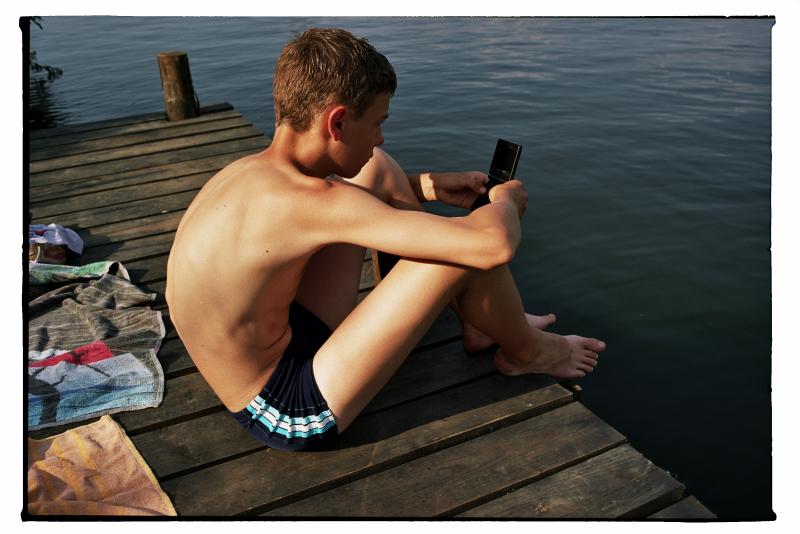
    As on any successful summer’s day, close to nothing happens. The boys compete for the girls’ attention, while the girls, for their part, see them as nothing more than little brothers. Still, they do steal glances from one another. This emptiness contrasts with a wealth of sensory experiences: gentle breezes rustling through the treetops, feet on wooden decking and a summer sun generously casting its light over everything—all of which make the season feel like the protagonist, so tangibly rendered on the big screen. But unlike how such an afternoon would actually sound, Meander is devoid of dialogue.

    Read more
    © Wank Stallions (Alison Murray, 1993)
    Wank Stallions (Alison Murray, 1993)
    essay
    Read more

    Tales of Longing

    “solitude au masculin”

    Savina Petkova
    27.10.2025

    In “solitude au masculin”, curated by Inge Coolsaet for argos, the emotional struggles of men passed down from generation to generation are observed through the queer and feminist lenses of three films, spanning from the 90s through today. The internal battles of the characters reveal discrepancies, conflicting masculinities, and a distressing solitude. Savina Petkova unravels a tale of longing throughout the short film programme.

    Read more
    © Perpetual Night (Pedro Peralta, 2020)
    artikel
    Read more

    Choreografie met lens en licht

    Pedro Peralta’s Perpetual Night

    Inge Coolsaet
    04.02.2021

    De technische uitdaging die de jonge Portugese filmmaker aangaat in zijn kortfilm Perpetual Night getuigt van onverbiddelijke bekwaamheid.

    Read more
    © LITTLE LOWER THAN THE ANGELS (NEOZOON, 2019)
    interview
    Read more

    There Must Be a Way Out of This Disaster

    A conversation with NEOZOON

    Savina Petkova
    25.07.2025

    Do you like cat videos? Try watching a thousand in a row, spread them on a timeline, and map out the similarities and differences between them. This experiment could serve as a primer for the work of two-person art collective NEOZOON, whose preoccupation is human-animal relationality. Using only found footage and social media archives, the duo aims to expose the oppressive power structures that position humans as exceptional, and non-human animals as anything but.

    Read more
    Lisette Ma Neza
    Lisette Ma Neza
    interview
    Read more

    Een collectief gedicht

    Lisette Ma Neza over Branden

    Margot De Grave Loyson
    27.03.2024

    Lisette Ma Neza woont al jaren in de Belgische hoofdstad en mag zich vanaf deze maand ook de eerste officiële stadsdichter van Brussel noemen. Met Branden, het sluitstuk van haar opleiding aan LUCA School of Arts, brengt Ma Neza een ode aan het eeuwige vuur van ontheemde vrouwen en een collectief gedicht over brandende moederlanden. De film sluit dit jaar Courtisane af.

    Read more

    Subscribe to our monthly newsletter for updates on new releases, publications, and events!

    Subscribe

    yanco is a magazine and streaming library for short-form moving image

    kortfilm.be vzw
    Boondaalse Steenweg 249
    1050 Elsene
    BE 0478 441 315
    info@yanco.be

    with the support of the Flanders Audiovisual Fund (VAF) of the Flemish Government

    VAF
    • about
    • colophon
    • privacy policy
    Facebook Instagram LinkedIn YouTube Letterboxd
    design by de Ronners
    website by eps en kaas