yanco Home
Menu
  • Home
  • watch
  • magazine
  • calendar
  • index
  • Subscribe
Search Log in
  • nl
  • en
You are here
  • Home
  • Magazine
  • Why So Serious?!
© BAN♡ITS (Omar Chowdhury, 2024)
BAN♡ITS (Omar Chowdhury, 2024)

Why So Serious?!

On Omar Chowdhury’s BAN♡ITS

article by
Ren Scateni
12.02.2025

As much as we should collectively try to resist polarisations and binarisms, let’s face it: the world is not quite helping us out. This is a time of widespread right-wing resurgence, lack of funds for cultural institutions, and overpowering aggression towards all marginalised communities. So, it may be a bit cringe to support a billionaire vigilante with daddy issues, who punishes petty criminals as a way to offset his guilt over wealth and privilege.

“There’s a reason why everybody hates Batman in those movies,” comments one of the titular protagonists in Omar Chowdhury’s BAN♡ITS. Set in a liminal space between Bangladesh and India, the film follows a group of self-proclaimed “destitutes”, and “agents of chaos” who rob the rich to give to the poor and are obsessed with Heath Ledger, because “he died for his art.” Inhabiting a lawless limbo where radical credos—“we reject the norms”—coexist with state-sanctioned anarchic stances—“order needs chaos”—these outlaws are as porous and opaque as Chowdhury’s film itself.

Based across Brussels and Dhaka, Chowdhury thrives on betweenness in his practice as he explores peripheral spaces and ambiguous categorisations, like in the performance and installation series Faydabad To-Let (2020) and Faydabad For-Sale (2022) that comments on neglected modernist buildings in the Dhaka periphery, or the video work Augustijn (2018) that touches upon religion while demystifying film as an artistic construct. With his art, Chowdhury intentionally blurs narrative boundaries, leaving the viewer oblivious to the interplay between reality and fiction.

BAN♡ITS uses this same para-fictional approach by highlighting opposed histories of peasants’ political resistance through a pop-inflected lens, which is further complicated with questions around authorship, ethnography—albeit mediated by the artist’s diasporic identity—and its own acute complicity in the structures it proposes to unmask, especially around the art world and its fraught dynamics. What to make of such an introspective work then?

“Do you know why you’re making the film?” asks one of the bandits abruptly. “Uh, not really. I’m just interested, I guess,” is the artist’s reply. “What a privilege,” responds the bandit, candidly. Indeed, sharing in cultural capital is a thing for the few, not for the many. However, in BAN♡ITS, which recalls thermal imaging through its fluorescent negative-positive inversion, the artist is as anonymous as his subjects, although not as invisible. On display is the bandits’ intoxication with their long-gone days of glory, whose fading vestiges are captured by the artist’s camera as they reenact a past heist of apparent minimal significance but of extreme mythopoetic grandeur.

This narrative is a little too similar to the one of cultural institutions desperately trying to navigate the fractured, current state of affairs. After shifting alliances and renouncing past vows in the face of Imperialist pressure, their progressive and pluralist ideals of inclusivity are defunct, and their flimsy ethical backbones exposed. If Chowdhury’s bandits are stuck in a self-indulgent delusion—their vigour exhausted, their ideologies just another script to rehearse—then we need a new generation of outlaws. One that can propel revolutions, transcending chaos and order alike.
    BAN♡ITS was part of IFFR’s Tiger Short Competition last week and has previously won a New Cinema Award at Berwick Film & Media Arts Festival.

    Bio Ren Scateni

    Ren Scateni is a film curator and writer whose practice embraces experimental works and artists’ moving image that explore the interstices of political, disruptive, and liminal identities. His writing has appeared in various art and film magazines, including ArtReview, Hyperallergic, and Sight and Sound. Ren is currently Curatorial Lead at Glasgow Short Film Festival and has been/is working across curation, consulting, editing, mentoring, and PR for festivals, cultural organisations, and companies, including Berwick Film & Media Arts Festival, Queer East, Festival du Nouveau Cinéma, BFI Doc Society, and Square Eyes. Ren is a Trustee of Alchemy Film & Arts.

    read more

    Sirens (Raoul Servais, 1968)
    Sirens (Raoul Servais, 1968)
    essay
    Read more

    A Complaint

    Raoul Servais’ Sirens (1968)

    Charlotte Timmermans
    01.10.2022

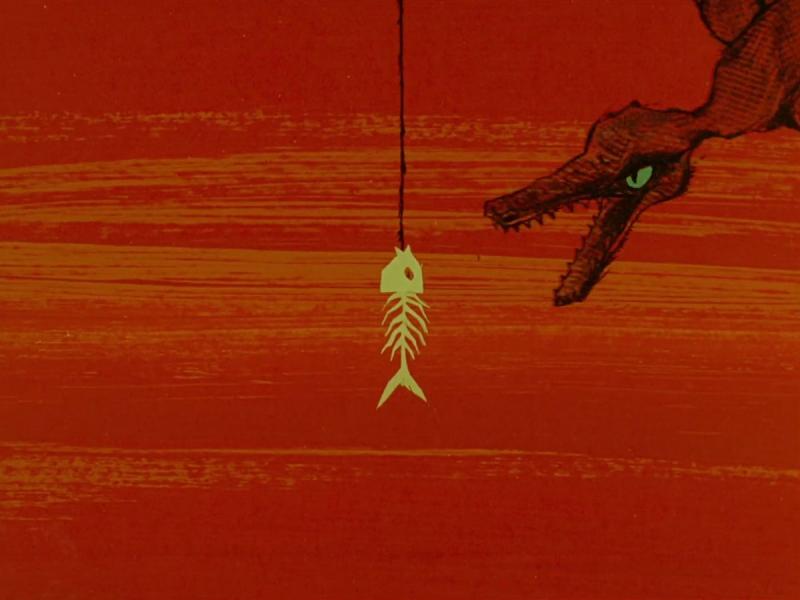
    Early on in the film, Servais employs the boundless possibilities of animated film to portray a surreal scene: two cranes squabbling over a wooden container. The container drops and breaks. Its content: a pile of rocket bombs. War is the central theme in many of Servais’ films (Chromophobia, Operation X-70, Tank); here, however, it seems to only casually add to the dystopian world. The future has been devoured by war and industry. Literally devoured: a lonely fisherman catches nothing but fish bones. He looks deeply saddened.

    Read more
    The Jungle Knows You Better Than You Do (Juanita Onzaga, 2017)
    The Jungle Knows You Better Than You Do (Juanita Onzaga, 2017)
    essay
    Read more

    Enduring Spirits

    Juanita Onzaga’s The Jungle Knows You Better Than You Do

    Alonso Aguilar
    01.05.2023

    With inequality as rampant as it can get and failed political structures eroding more and more as time shows their inherent futility, the milieu of the Latin American urban center has truly evolved into a no man’s land, a non-place of sheltered privilege juxtaposed to chaotic urgency, a “phantom city” as the initial narrator of Juanita Onzaga’s The Jungle Knows You Better Than You Do calls what she used to think as her hometown of Bogotá. The past tense of the latter statement has to do with her moving on from the Colombian capital, a setting that for her can only evoke violence and forgotten bodies, a sense of phantasmagoria close-knit with her family history.

    Read more
    elephantfish (Meltse Van Coillie, 2018)
    elephantfish (Meltse Van Coillie, 2018)
    essay
    Read more

    Dreaming Adrift

    Meltse Van Coillie’s elephantfish

    Mariana Hristova
    01.10.2022

    Darkness can be mysterious and scary but also mind-provoking and triggering for one’s fantasy. elephantfish, a film as unusual as its title, starts by describing an equally peculiar dream narrated by a quiet voice in the background of the black frame: an elephant in the sea greedily drinks the water as if trying to swallow it all. As the dreamer approaches the monster, it gets smaller and smaller, no bigger than a fish. Instead of turning into a Leviathan1 as the quasi-mythological premise of the tale suggests, it eventually dies, and the film itself unfolds in a hardly expected way.

    Read more
    Atopia (Olivier De Vos, 2021)
    Atopia (Olivier De Vos, 2021)
    essay
    Read more

    De stranden van Atopia

    Olivier De Vos’s Atopia (2021)

    Ren Scateni
    20.12.2023

    Through a multilayered construction of archive materials, digitised as well as contemporary pictures, and original footage, De Vos charts their journey to the beaches of Atopia—a placeless place, brimming with both mesmerising potentiality and impossibility, a place you could be homesick for without being able to locate it exactly. As elusive as this promised land it invites viewers to, Atopia refuses easy classifications and finds a transitory place between fiction and documentary, between imagined ethnographic investigation and a research-led use of archival videos and photos to back up De Vos’s personal cognitive meanderings.

    Read more
    Tukuleur (Brahim Tall, 2022)
    Tukuleur (Brahim Tall, 2022)
    artikel
    Read more

    Toucouleur

    Brahim Talls Tukuleur (2022)

    Orlando Verde
    17.04.2023

    De titel van de film speelt met de naam van een 19de-eeuws West-Afrikaans keizerrijk. Toucouleur is ook een van de namen van een volk uit wat vandaag Senegal heet. Maar Tall speelt ook bewust met de verwijzing naar ‘kleur’. Het is belangrijk dat de titel van betekenis verandert afhankelijk van de context waarin die uitgesproken wordt, want ook huidskleur krijgt in verschillende contexten een andere betekenis. Zo ook worden mensen met gemengde etniciteit vaak gezien als van hier noch van daar. Of juist van overal, maar dan anders, zoiets.

    Read more
    © Onde o Verão Vai (episódios da juventude) (David Pinheiro Vicente, 2018)
    artikel
    Read more

    De Portugese ‘saudade’ ontkracht?

    Michiel Philippaerts
    18.05.2020

    Welke (kort)filmmakers treden in de voetsporen van hun landgenoten en grootmeesters Miguel Gomes & Pedro Costa? Een focus op Portugese cinema tijdens de 66e editie van Kurzfilmtage Oberhausen biedt (misschien) antwoord.

    Read more
    Water and Salt (Luisa Mello, 2019)
    Water and Salt (Luisa Mello, 2019)
    essay
    Read more

    Watery tensions

    Luisa Mello’s Water and Salt

    Kathy Vanhout
    03.04.2022

    Apart from water, salt, and clouds, Mello’s work often features young and older people, artists, animals, and cities; these things are the source of her documentaries. Her films always leave room for fictive contemplation and interpretations. Water and Salt, for that matter, hardly reads as a documentary. In these reflective ten minutes, she attempts to translate a thought, a feeling, an observation. In situations like this, where words are insufficient, and the outside world offers few answers, Mello constructs her own images. Or she turns to archival ones.

    Read more
    © La Chambre (Chantal Akerman, 1972)
    La Chambre (Chantal Akerman, 1972)
    article
    Read more

    A Room of Her Own

    Chantal Akerman’s La Chambre

    Öykü Sofuoğlu
    17.11.2024

    Lounging on a small bed, Chantal Akerman’s posture seems casual and relaxed at first glance, but the repetitive tilts of her head—to the left and then back to center—contrasting with the smooth glide of the camera suggest otherwise. Restlessness is in the air, yet before we can discern it, the image is already on the move, retracing its steps for a second time.

    Read more

    Subscribe to our monthly newsletter for updates on new releases, publications, and events!

    Subscribe

    yanco is a magazine and streaming library for short-form moving image

    kortfilm.be vzw
    Boondaalse Steenweg 249
    1050 Elsene
    BE 0478 441 315
    info@yanco.be

    with the support of the Flanders Audiovisual Fund (VAF) of the Flemish Government

    VAF
    • about
    • colophon
    • privacy policy
    Facebook Instagram LinkedIn YouTube Letterboxd
    design by de Ronners
    website by eps en kaas