yanco Home
Menu
  • Home
  • watch
  • magazine
  • calendar
  • index
  • Subscribe
Search Log in
  • nl
  • en
You are here
  • Home
  • Magazine
  • Absent but Present
All We Ever Wanted Was Everything (Enzo Smits, 2014)

Absent but Present

Enzo Smits’s All We Ever Wanted Was Everything

essay by
Hanne Schelstraete
Translated by
Laïka Planchenault
20.11.2022

Those moments between a first date and kiss, between a goodbye and a funeral, between a final exam and a proclamation are seemingly empty. With All We Ever Wanted Was Everything, Enzo Smits zooms in on this idea. What he finds is a beauty that is not easily discovered. Rather than a clear narrative structure, Smits’ debut film presents itself as a stream of impressions. A group of friends pass time together. They talk, walk, and play video games. They stare into nothingness and wander off. What are they waiting for? The first days of school? A taxi? The dawn of their adulthood? In the background, a clock is ticking while one of the boys prepares a cup of tea. Time is slipping by, but nobody’s in a hurry. Growing up is a lesson in patience.

Smits consciously shows these ‘dead’ moments. With this, he seems to fulfill Cesare Zavattini’s ultimate dream, according to André Bazin. The Italian filmmaker Zavattini made a name for himself in the 50s and 60s with his surprisingly empty films. He dreamt of “making a ninety-minute-long film about a man’s life where absolutely nothing happens.” 1 Zavattini believed cinema sells her soul when it fictionalises reality. Beauty is not to be found in big moments but rather somewhere in between. Time and time again, Smits diverts the attention to the temps morts, to everyday moments that at first glance seem meaningless. Two friends are standing next to a tree; they stare into the distance. A group of skaters are walking towards the horizon. A teenager, while gaming, is staring at his TV. Smits strings together these tableaux from day-to-day life, resisting the temptation of embellishing them with surprising plot twists, predetermined framing, or catchy one-liners. In doing so, he emphasises what Zavattini called “the banalities of everyday life.” These moments, he writes, are big not because of “their extraordinary qualities, but because of their ordinary qualities.” 2

With All We Ever Wanted Was Everything, Smits reintroduces us to our daily surroundings, to things that no longer catch our eye. In this act of really looking at what surrounds us, we finally see the beauty of it. Cinema, memetic in its essence, is the perfect medium to confront us with a reality we claim to know. Smits forces our gaze to land on what we prefer to overlook. The ordinary becomes extraordinary; banalities become spectacular. Carefully he chips away at the layers of his film until an associative collage of images remains. However contradictory it might sound, it is exactly this erasure that adds meaning. An absence so noticeable it becomes a presence. In All We Ever Wanted Was Everything, skating takes on that role of absent presence.

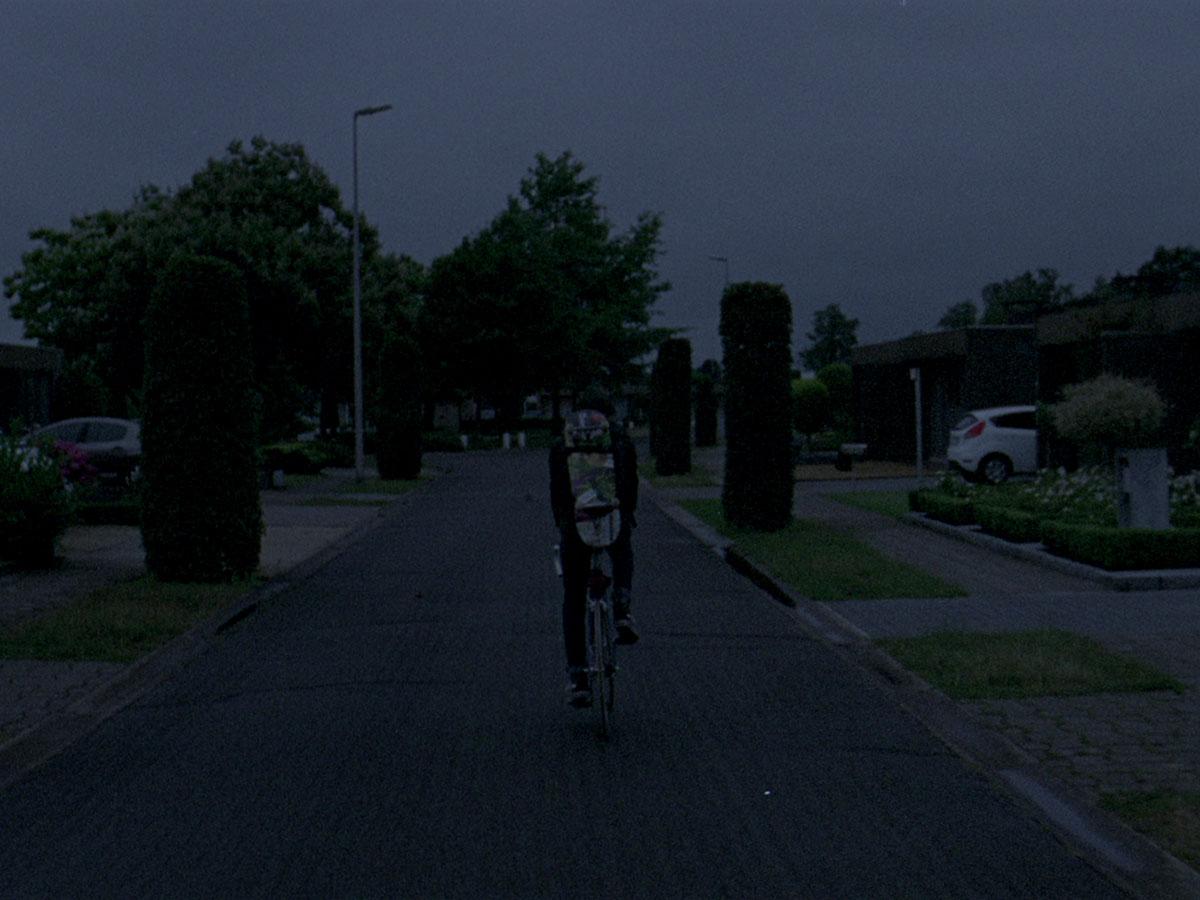
Smits’ film is not a skate film in the likes of Gus van Sants’ Paranoid Park or Paul Brown and Alan Sacks’ Trashin’ with their lyrical camera, swinging and swirling to capture all the tricks. The act of skating is hardly featured here. We see people looking at skaters, skaters riding their bikes with boards on their backs, skaters watching skate videos. Smits never shows the boys boasting confidently, riding their boards, and displaying their coolest tricks. He doesn’t have to. These types of images are fully unnecessary. Because every image carries the distinct echo of that activity the teenagers seemingly, practice every day. Every image shows traces of that other image that ends up never being shown. In this way, Smits plays an ingenious, postmodern game of meaning. As Derrida stated, towards the end of the seventies, every concept always carries that which it is not. It reminds us of what is absent.

Around the same decade as Derrida’s statement, the skateboard symbolized the youth revolting against the dominant culture. A culture with dogmatic distinctions between useful pastime and waste of time, high and low art, Olympic sport, and mere movement. The skateboard signifies a quest for freedom and recognition. All We Ever Wanted Was Everything evokes these connotations without ever showing the act of skating itself. Smits captures liminal spaces where the focal point is absent and seemingly irrelevant things are present. This emptiness depicts not only beauty but also meaning.

Read more

All We Ever Wanted Was Everything

Enzo Smits, Belgium, 2014, 19’

A portrait of young skateboarders growing up in a Flemish suburban town. We meet different characters going through their daily routines: riding around on their skateboards, waiting, hanging out, daydreaming...

Read more

    read more

    Et leurs lettres (Elie Maissin, Mieriën Coppens, 2023)
    Et leurs lettres (Elie Maissin, Mieriën Coppens, 2023)
    artikel
    Read more

    Brieven zonder papieren

    “Malgré tout” van Mieriën Coppens et Elie Maissin

    Bjorn Gabriels
    12.10.2023

    Het werk van Mieriën Coppens en Elie Maissin is naar eigen zeggen nooit afgerond, altijd open. Evengoed biedt hun kortfilmprogramma ‘Malgré tout’ op de biënnale Con10ur een overzicht van de films die ze de afgelopen jaren maakten als medeplichtige archivarissen van het collectief La Voix Des Sans Papiers.

    Read more
    À l’usage des vivants (Pauline Fonsny, 2019)
    À l’usage des vivants (Pauline Fonsny, 2019)
    essay
    Read more

    In the Margins

    Pauline Fonsny’s À l’usage des vivants

    Inge Coolsaet
    11.11.2022

    On September 22, 1998, the young Nigerian asylum seeker Semira Adamu died during a violent deportation attempt. Fleeing a forced marriage, she arrived in Belgium, where she was detained for several months. Searching for the right formal fit for the story Adamu can no longer tell herself, Pauline Fonsny meticulously strings together archival material with contributions from other artists. It can be said to a certain extent that A l’usage des vivants, by gleaning input within a small community of mourning artists and activists, is an example of collective filmmaking.

    Read more
    © Plot Point (Nicolas Provost, 2007)
    Plot Point (Nicolas Provost, 2007)
    essay
    Read more

    (Re)framing Tension

    “Why Don’t the Cops Fight Each Other?”

    Tianyu Jiang
    02.09.2025

    Curated by Inge Coolsaet for argos, the short film programme “Why Don’t the Cops Fight Each Other?” responds to the ever-present police brutality by rejecting futile rhetoric and underlining the urgency and affective power of audio-visual art. This potentially intimidating viewing experience may unsettle viewers’ expectations, but it can also transform the apathetic spectator into an active, reflexive watcher.

    Read more
    La Chute (Sebastian Schaevers, 2022)
    La Chute (Sebastian Schaevers, 2022)
    article
    Read more

    When the Sky Falls

    Sebastian Schaevers’ On Its Way Down

    Jannes Callens
    10.10.2025

    Sebastian Schaevers constantly seeks visual and narrative strategies to capture a man-made problem that has become so overwhelming it exceeds human capacity to cope. We are heading for an almost sublime aesthetic experience of our own demise. On Its Way Down leaves no scene unused to launch metaphors about human attitudes toward the impending ecological disaster.

    Read more
    Les enfants ont des oreilles (Kumail Gasiewski, 2025)
    Les enfants ont des oreilles (Kumail Gasiewski, 2025)
    verslag
    Read more

    Lichting KASK 2024-2025

    Evi Cats, Boet Meijers, Kathy Vanhout
    03.12.2025

    In het multidisciplinaire microklimaat van KASK School of Arts in Gent ontspruit elk jaar opnieuw een uiteenlopende groep filmmakers en audiovisuele kunstenaars. Dit is een selectie van de masterproeven waarmee de lichting 2024-2025 afzwaait.

    Read more
    © The Vampires of Poverty (Carlos Mayolo, Luis Ospina, 1977)
    artikel
    Read more

    Porno miseria: het begin van een einde?

    Over The Vampires of Poverty van Luis Ospina en Carlos Mayolo

    Bo Alfaro Decreton
    14.11.2019

    In The Vampires of Poverty uiten Luis Ospina en Carlos Mayolo kritiek op exportdocumentaires die ellende verheerlijken.

    Read more
    © The End of Suffering (A Proposal) (Jacqueline Lentzou, 2020)
    The End of Suffering (A Proposal) (Jacqueline Lentzou, 2020)
    interview
    Read more

    Everything Is Already Inside

    Jacqueline Lentzou on The End of Suffering (A Proposal)

    Kathy Vanhout
    02.10.2024

    Greek filmmaker Jacqueline Lentzou does not look for inspiration; inspiration finds her. In her artistic practice, vague ideas slowly develop into something more comprehensible, more tactile. In The End of Suffering (A Proposal), she renders the mere act of “understanding” palpable.

    Read more
    This Day Won’t Last (Mouaad el Salem, 2020)
    This Day Won’t Last (Mouaad el Salem, 2020)
    essay
    Read more

    “Queers Were Here”

    Mouaad el Salem’s This Day Won’t Last (2020)

    Sanne Jehoul
    22.04.2024

    This Day Won’t Last carries risk in every shot; through el Salem’s urgency to film, his constraints of what he can film, the aesthetics of lo-fi phone footage, and the images captured on cheap disposable cameras. Even if the undeveloped film can contain desires and identities without danger, even if these clips do not contain immediate reveals, the images we receive are still constrained and chased by fears and threats. However, they are also an assertion of identity and belonging.

    Read more

    Subscribe to our monthly newsletter for updates on new releases, publications, and events!

    Subscribe

    yanco is a magazine and streaming library for short-form moving image

    kortfilm.be vzw
    Boondaalse Steenweg 249
    1050 Elsene
    BE 0478 441 315
    info@yanco.be

    with the support of the Flanders Audiovisual Fund (VAF) of the Flemish Government

    VAF
    • about
    • colophon
    • privacy policy
    Facebook Instagram LinkedIn YouTube Letterboxd
    design by de Ronners
    website by eps en kaas