yanco Home
Menu
  • Home
  • watch
  • magazine
  • calendar
  • index
  • Subscribe
Search Log in
  • nl
  • en
You are here
  • Home
  • Magazine
  • A Complaint
Sirens (Raoul Servais, 1968)

A Complaint

Raoul Servais’ Sirens (1968)

essay by
Charlotte Timmermans
Translated by
Laïka Planchenault
01.10.2022

Glaring sirens herald Sirens, the fifth work of painter and animation pioneer Raoul Servais. A stark contrast with the sweet-voiced mermaid, the actual siren of the story. The mood for the surreal, mechanically controlled harbour city, the backdrop of the story, is set. Perhaps it is Ostend, the birth town of Servais; perhaps it is every other small, beaten-up harbour town anywhere else in the world.

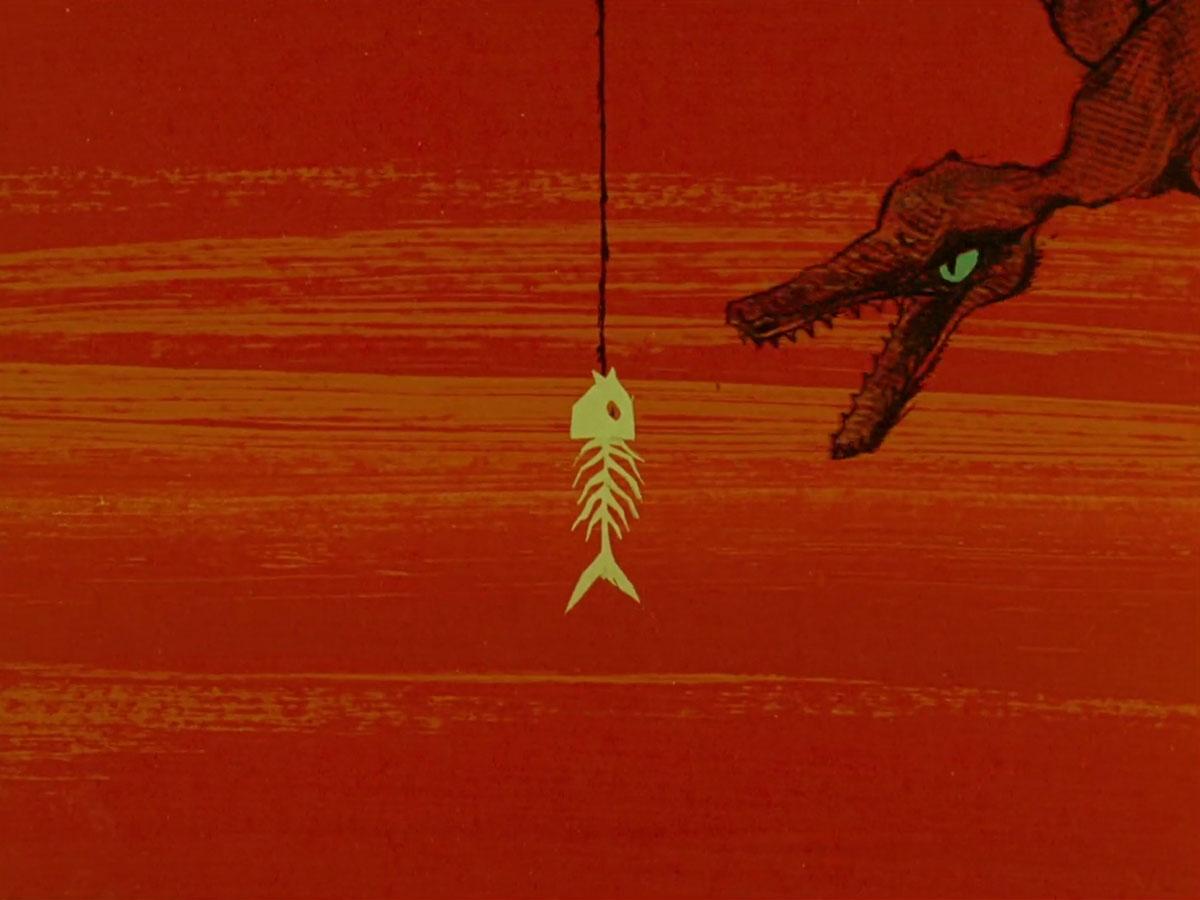
Early on in the film, Servais employs the boundless possibilities of animated film to portray a surreal scene: two cranes squabbling over a wooden container. The container drops and breaks. Its content: a pile of rocket bombs. War is the central theme in many of Servais’ films (Chromophobia, Operation X-70, Tank); here, however, it seems to only casually add to the dystopian world. The future has been devoured by war and industry. Literally devoured: a lonely fisherman catches nothing but fish bones. He looks deeply saddened.

Suddenly, the sound of dreamy flutes catches his ear. The fisherman is witness to a wonderful scene. The blood-red backdrop shifts to a seemingly moonlit blue. This is how Servais introduces an explicitly another alternate world where, just like in his Golden Palm awarded Harpya (1979), a hybrid mythical creature enchants her opponent. A cabin boy, consciously rendered in soft contours, plays the flute to resurrect his loved one. According to legends, the stunning yet evil siren lures the cabin boy to the bottom of the sea. This is not the case here, however. She supplies wind in the ship’s sails and offers a way out of the hellish town. The mechanical vultures guarding the city are alarmed. The sky turns red once more, and a highly suspenseful arch follows until the mermaid is captured by a crane and later falls to her death. A new type of vulture presents itself: an army of police officers, investigators, photographers, and coroners rush to the scene.

This central scene exemplifies Servais’ mastery. The rhythmic game of shapes appears natural and spontaneous, but be mindful: even the smallest movement in an animated film is a conscious choice. Almost every frame is part of an inventive transformation. The black-clothed, skeleton-like men merge and form into one entity. This theme of uniformity was present in Servais’ previous animated film, Chromophobia (1966), where soldiers formed one immobile front and reappear once more in To Speak or Not to Speak (1970).

This merging is more than just form. It also addresses ‘the powers that be’. Though the scene is steeped with humour, it also confronts us with injustice (the random arrest of the fisherman), greed (the zoologists and coroners would rather chop the mermaid in half than allow the other to take her), and boastfulness (the detectives pose with the mermaid’s corpse). By comparing these men to a dinosaur, Servais mocks the conservative patriarchy.

Raoul Servais is known for his diverse style and techniques. On the level of content, however, we see more homogeny. His work often addresses materialism and injustice and can be read as an ode to peace or, in this case, love. Similarly to De Valse Noot (1963), Chromophobia and To Speak or Not to Speak, this film portrays a dystopian world that is coloured by the hopeful ideals of individuals. The cabin boy perseveres in his music and thus remains connected to the mermaid, of whom nothing but chalk tracings remain.

In Sirens, Servais adamantly opts for magic as an antidote to a mechanised society. The backdrop shifts to blue once more. The moon casts a magical light on the pair that ascend to heaven. Is there anything more beautiful than love?

watch now

Read more

Sirens

Raoul Servais, Belgium, 1968, 9’

A lonesome angler becomes witness to an eccentric idyll between a cabin boy and a mermaid. Dream or reality?

Read more

    read more

    À Gis (Thiago Carvalhaes, 2017)
    À Gis (Thiago Carvalhaes, 2017)
    essay
    Read more

    The Freedom One Does Not Allow Oneself

    Thiago Carvalhaes’ À Gis

    Michaël Van Remoortere
    30.04.2023

    Gisberta’s murder holds an important, symbolic place in Portuguese LGBTQIA+ history, similar to the murder of Ihsane Jarfi in Belgian history—a no pasarán after which society decided to enact new laws. Luckily for us (and for her), this film, this short requiem, does not attempt to convince us of the horror by reenacting Gisberta’s death in horrific detail and length, like Animals early last year deemed necessary.

    Read more
    Lettre à Mohamed (Christine Moderbacher, 2013)
    Lettre à Mohamed (Christine Moderbacher, 2013)
    essay
    Read more

    An Archaeology of Moments

    Christine Moderbacher’s Lettre à Mohamed

    Alonso Aguilar
    30.04.2025

    Christine Moderbachers Lettre à Mohamed (2013) is een audiovisuele brief in de puurste vorm. Door gebruik te maken van de grenzeloze mogelijkheden van het format, lijkt de film op geen enkele andere manier te kunnen bestaan. Wij, als kijkers, weten nauwelijks iets over de titulaire Mohamed. Hij heeft Tunesië verlaten, zoveel is duidelijk, en nu krijgt hij de veranderingen te zien die sindsdien in zijn land hebben plaatsgevonden, vanuit het perspectief en de opnames van zijn bevriende filmmaker.

    Read more
    Cyclepaths (Anton Cla, 2023)
    Cyclepaths (Anton Cla, 2023)
    article
    Read more

    Violent Circles

    Anton Cla’s Cyclepaths

    Hanne Schelstraete
    15.02.2025

    A flock of migratory birds circles through the sky at dusk. A dog does laps on the ice. A crane slowly rotates around its own axis, and the blades of a windmill move to the rhythm of the wind. Cyclepaths shows an annular movement that appears to move forward but always returns to the same starting point—a repetitive trajectory without end. Between these associative circular shapes, director Anton Cla shows the blind violence that’s been part of our society for so long, but which only recently took on high-tech proportions.

    Read more
    Saute ma ville (Chantal Akerman, 1968)
    Saute ma ville (Chantal Akerman, 1968)
    artikel
    Read more

    Preludes van een visionair

    Chantal Akermans La Chambre (1972) en Saute ma ville (1968)

    Inge Coolsaet
    27.05.2021

    In haar vroege kortfilms tekende Chantal Akerman, moedwillig maar ook onbewust, de contouren van haar eigen toekomst uit. Alle fundamenten van haar oeuvre, vormelijk en inhoudelijk, werden er gezet.

    Read more
    The Jungle Knows You Better Than You Do (Juanita Onzaga, 2017)
    The Jungle Knows You Better Than You Do (Juanita Onzaga, 2017)
    essay
    Read more

    Enduring Spirits

    Juanita Onzaga’s The Jungle Knows You Better Than You Do

    Alonso Aguilar
    01.05.2023

    With inequality as rampant as it can get and failed political structures eroding more and more as time shows their inherent futility, the milieu of the Latin American urban center has truly evolved into a no man’s land, a non-place of sheltered privilege juxtaposed to chaotic urgency, a “phantom city” as the initial narrator of Juanita Onzaga’s The Jungle Knows You Better Than You Do calls what she used to think as her hometown of Bogotá. The past tense of the latter statement has to do with her moving on from the Colombian capital, a setting that for her can only evoke violence and forgotten bodies, a sense of phantasmagoria close-knit with her family history.

    Read more
    Mamada Perdida (Joke van den hof, 2016)
    Mamada Perdida (Joke van den hof, 2016)
    essay
    Read more

    Pleasure Garden

    Joke Van den hof’s Mamada Perdida

    Laïka Planchenault
    15.12.2024

    Prompted by the curious Vice article “Why Are Cuban Men Putting Pearls in Their Dicks?”, Joke Van den hof’s mind sprouted this steaming tale of love and lust. The Antwerp-based illustrator and animator ponders the consequences of total infatuation. If her playful rendering seems like a far leap from the original story, further consideration has it make perfect sense. Mamada Perdida—which roughly translates to ‘lost blowjob’—reminds us of the frenzied state so characteristic of first love. What better testament to the follies of love (or is it lust?) than a slew of men putting pearls in their penises in hopes of offering their sexual partners the ultimate pleasure?

    Read more
    Red Giant (Anne Verbeure, 2021)
    Red Giant (Anne Verbeure, 2021)
    essay
    Read more

    The Lonely Observer

    Anne Verbeure’s Red Giant (2021)

    Dora Leu
    20.08.2023

    To be a giant comes with the burdensome nature of giant-ness. Most things look infinitely smaller than you. You move awkwardly, lankily, to not inadvertently step on anything you might not see. Thus, this Red Giant proceeds with unsure gestures, sluggishly, as if both depressed and aware of the potential inconveniences his size may cause. Yet, contrary to his stature, a sense of fragility surrounds the giant. Perhaps his nakedness makes him look like a tall, helpless baby. The film’s visual style further underscores this, with the pinkish hues of paint that collect around his small eyes and nose, denoting a form of innocence.

    Read more
    © HERMAN ASSELBERGHS
    verslag
    Read more

    Aandacht voor aandacht

    Time Wasted in argos

    Gilles Vandaele
    18.03.2024

    Nog tot 30 juni is in argos, het Brusselse centrum voor audiovisuele kunst, een videotentoonstelling van Herman Asselberghs te zien. In Time Wasted focust de Belgische filmmaker en kunstdocent op de plaatsen die hij het best kent: de filmzaal en het klaslokaal.

    Read more

    Subscribe to our monthly newsletter for updates on new releases, publications, and events!

    Subscribe

    yanco is a magazine and streaming library for short-form moving image

    kortfilm.be vzw
    Boondaalse Steenweg 249
    1050 Elsene
    BE 0478 441 315
    info@yanco.be

    with the support of the Flanders Audiovisual Fund (VAF) of the Flemish Government

    VAF
    • about
    • colophon
    • privacy policy
    Facebook Instagram LinkedIn YouTube Letterboxd
    design by de Ronners
    website by eps en kaas