yanco Home
Menu
  • Home
  • watch
  • magazine
  • calendar
  • index
  • Subscribe
Search Log in
  • nl
  • en
You are here
  • Home
  • Magazine
  • Documents That Are Here to Stay
Idrish (ইদ্রিস) (Adam Lewis Jacob, 2021)

Documents That Are Here to Stay

A Conversation with Adam Lewis Jacob on Idrish (ইদ্রিস)

interview by
Siavash Minoukadeh
Unearthing the Archive!
14.09.2026

Adam Lewis Jacob’s Idrish (ইদ্রিস) (2021) dances between the present and the personal and political history of British-Bangladeshi community activist Muhammad Idrish. His longstanding opposition to deportation campaigns, beginning with his own, helps to understand both the anti-immigrant movement of the late 20th century and the resistance to it, at a time when echoes of these mechanisms resonate once again.

The film’s core is a body of archival footage documenting the titular man’s fights against deportation. Some elements are from mainstream media but the majority of the material, including newsreels and press clippings, are taken from the countercultural and activist media networks that documented Idrish’s campaigning from within. The urgency of the archival sequences is punctuated by scenes filmed in 2020 by Lewis Jacob on a visit to Bangladesh with Idrish. We follow him as he travels in a car, visits a university physics department, goes to the market and broadly, gets on with his day. The handheld, black-and-white shots have a casual, languid quality, reflecting a man who is now visiting the country of his birth on his terms and not through a forced return. Through this material emerges a fluid portrait that moves across the past and present of a campaigner, the life he fought for, and the movement he became part of.

The same week this conversation took place, masked far-right groups blocked roads in the port towns of Dover and Portsmouth, a further escalation of sinister anti-migrant sentiment that has been growing over the course of this decade. In this light, returning to Idrish’s campaign shows how gathering and presenting community video is a possible strategy to build solidarity against these movements.

How did you come across Idrish’s story and what first drove you to make a film around it?

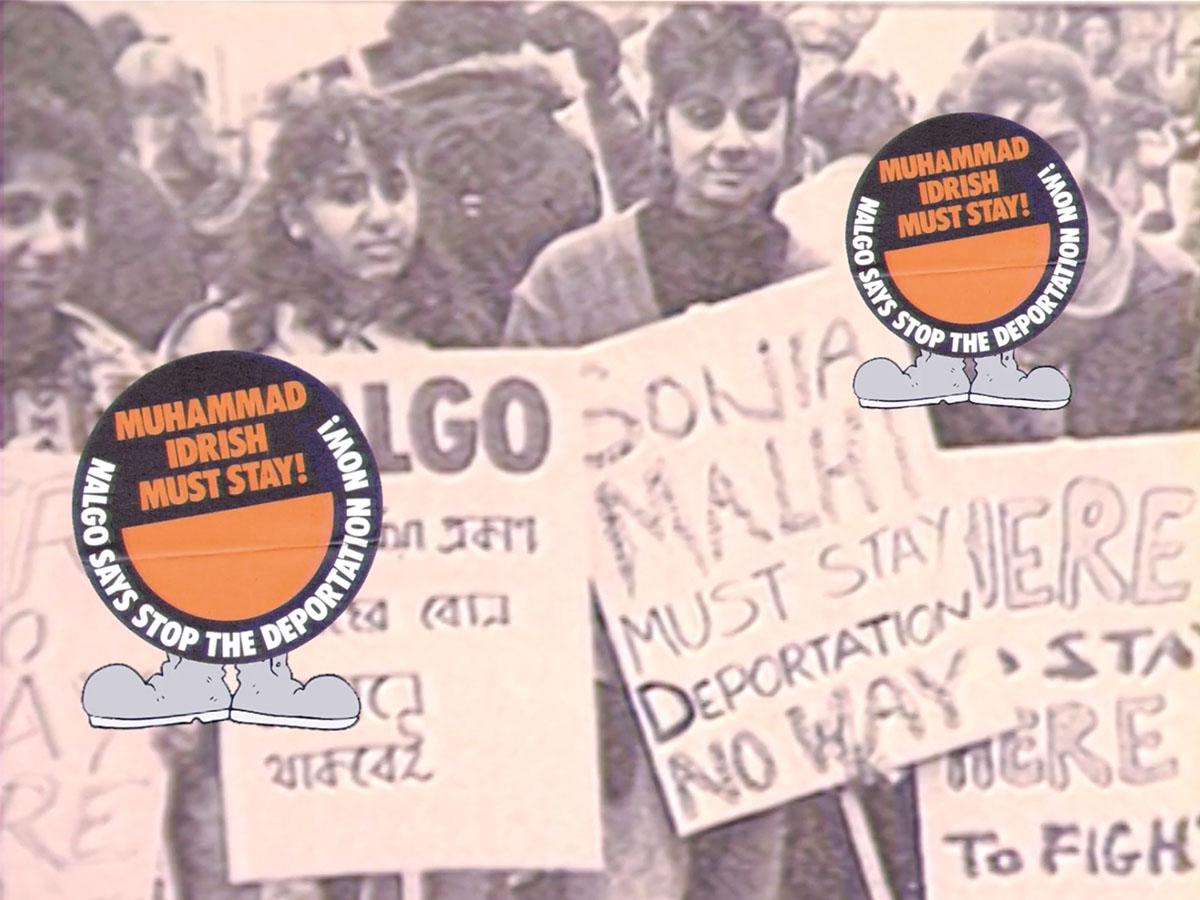
I didn’t initially approach Idrish’s story because I was looking for a particular case through which to talk about deportation. I first came across him while working with Vivid Projects in Birmingham about the history of TURC Video [the video arm of the Birmingham Trade Union Resource Centre]. I found two videos that he appeared in. The first, Muhammad Idrish Must Stay, documented the campaign against his deportation and his fight to remain in the UK. The second was made almost a decade later and showed many people Idrish had subsequently and often successfully helped to remain in the country.

What initially stood out was Idrish himself—his charisma and conviction—but also the way his story extended beyond his campaign. His personal experience became the basis for helping others, so his story opened onto a much wider history of migration, solidarity and collective resistance.

Idrish and I became friends through the process, and at some point he asked if I would make a film about his life for his nieces and nephews back in Bangladesh, so that they could understand what his campaign had achieved. That request became an important starting point for the film.

Idrish (ইদ্রিস) (Adam Lewis Jacob, 2021)

While your film also shows archival material from other, more institutional sources, the footage from TURC Video is crucial. What significance did the origin of this material have for you?

I remember wanting to work with material that already had some kind of charge or weight to it. I kept referring to it as “heavy material”, material that felt bigger than me. There was something appealing about using that as a way of trying to make the author disappear, although of course that’s ultimately impossible because I’m still the person making the compositional decisions.

I was also really interested in and respectful of the work of Marian Hall, a video worker for TURC Video who I think is an overlooked but vital figure in the history of community video. The way she approached collecting interviews was particularly important to me. So the material wasn’t only significant because of what it documented politically, but because of the relationships and methods through which it had been produced.

In that sense, it seems that why an archive comes to be factors into how?

I’m not sure I’m actually that drawn to archives, at least not in the institutional sense. I’m much more interested in personal or amateur collections, particularly at that moment just before they get absorbed by an institution. I still have this feeling of the museum as a kind of mausoleum, somewhere that art and material goes to die. Of course, I appreciate that institutions also preserve things, but that process can sometimes make the material feel much harder to access.

So I’m interested in getting close to collections before that happens, when they still have a relationship to the people who accumulated them. I suppose we need words like “archive” to describe these things, but I often prefer to think of them as collections. Chance and discovery are really important to this as well. I rarely approach a collection knowing exactly what I’m looking for. I’m more interested in what I might unexpectedly encounter and where that encounter might lead.

I suppose we need words like “archive” to describe these things, but I often prefer to think of them as collections. Chance and discovery are really important to this as well. I rarely approach a collection knowing exactly what I’m looking for. I’m more interested in what I might unexpectedly encounter and where that encounter might lead.

Adam Lewis Jacob

That element of chance encounters is something you also leave space for in your work. Idrish and some of your other works such as You Don’t Know What You Don’t Know Do You (2025) not only feature archival footage but also allow their subjects to view and reflect on it in the present. Why is this something that you wanted to allow space for?

I think of montage as a kind of achievable form of time travel. I’m not particularly interested in presenting history as a straightforward progression, partly because I don’t think that’s how history works, but also because it’s not really how my brain works or how I experience the world.

My approach comes from collage and the simple act of cutting things up and reassembling them, putting two things into direct conversation with one another, sometimes just to see what happens.

Showing people archival footage of themselves or of a history they were part of feels like an extension of that. You’re creating the conditions for something new to happen. It may trigger cross-generational conversations and return a certain amount of control to these subjects. I’m much more interested in creating those kinds of situations than in positioning myself as an authority explaining what something means.

I’ve also become increasingly interested in what this does to an audience. Screenings of Idrish have produced very visceral and emotional responses, with people feeling able to share their own, often harrowing stories, and drawing hope from one another. That’s probably been one of the most surprising aspects of making the film. It’s a reminder of how the moving image still has the potential to create a space in which people can come together.

Idrish (ইদ্রিস) (Adam Lewis Jacob, 2021)

In Idrish, such a reflection came about through a visit to Bangladesh in 2020. Why did you want to speak with him there?

Idrish has lived in the UK since the end of the 1970s, before I was born, so he has been here for longer than I have. He regularly returns to Bangladesh to visit his family, and I felt it was important to join him there.

It allowed me to see things I would never otherwise have seen and to experience another place and way of life. I got to meet his nieces, nephews and wider family, which deepened my connection to Idrish and his story, particularly as his original reason for asking me to make the film was so that his family in Bangladesh could understand what he had been part of in Britain. I think that’s something I increasingly value in making art and films. The work should be a way of finding new experiences rather than simply illustrating something you already know.

That footage has also become a document of Bangladesh at a particular moment. When we returned to screen the film in 2025, the country had been through enormous political change following the student-led uprising of 2024, which culminated in Sheikh Hasina’s resignation and the formation of an interim government. Seeing Bangladesh again under those different circumstances made me more conscious of how the film had inadvertently recorded a particular moment in the country’s history. It also made me think differently about the limits of governmental power and how much everyday life in Bangladesh is organised and sustained by people themselves, often outside formal structures of government.

The parallels between the anti-migrant sentiment during Idrish’s campaign and that which has been growing from 2020 until now are striking. How did the process of making Idrish shape your reflection on the current discourse around resisting deportations?

What initially struck me was how familiar it all sounded. Looking through the archival material, so much of the language and hostility around migration felt as though it was echoing across time, and that relatively little had really changed.

Then, by a strange twist of fate, on the final day of editing there was an immigration raid literally on my doorstep, on Kenmure Street in Glasgow. Two of my neighbours were detained and put into an immigration van. An activist climbed underneath the van to prevent it from leaving and gradually more and more people from the community gathered in the street. Eventually, after an eight-hour standoff, the two men were released. What an extraordinary parallel with the history I had just spent so much time with!

I don’t necessarily think about that in terms of optimism or frustration. Hostility towards migrants doesn’t simply resurface by itself; it has to be stoked, and we’re clearly seeing a great deal of that again now. Migrants are being used as scapegoats for much larger governmental and social failures.

    From September to November 2026, three consecutive Glued & Screwed events, wysiwyg’s monthly screening series at Filmhuis Den Haag, form the triptych programme Unearthing the Archive!: a deep-dive into the world of archival films. Adam Lewis Jacob’s Idrish (ইদ্রিস) is part of the first installment in the series, “Excavation”. Using mostly, if not only, pre-existing archival footage, the filmmakers in this programme tell stories through the simple but potent power of editing.

    To accompany the screenings, yanco presents a printed publication featuring reflections and interviews on archival film. The texts are also made available online. Made possible by Filmhuis Den Haag en Stroom Den Haag.

    Bio Siavash Minoukadeh

    Siavash Minoukadeh is a London-based curator, creative producer, and writer working in film and moving image. They have curated work for Open City Documentary Festival and LUX and have worked with film festivals and institutions including BFI London Film Festival, Sheffield DocFest and BFI Flare. Their work centres joy and pleasure, in particular queer notions of pleasure.

    read more

    Les enfants ont des oreilles (Kumail Gasiewski, 2025)
    Les enfants ont des oreilles (Kumail Gasiewski, 2025)
    verslag
    Read more

    Lichting KASK 2024-2025

    Evi Cats, Boet Meijers, Kathy Vanhout
    03.12.2025

    In het multidisciplinaire microklimaat van KASK School of Arts in Gent ontspruit elk jaar opnieuw een uiteenlopende groep filmmakers en audiovisuele kunstenaars. Dit is een selectie van de masterproeven waarmee de lichting 2024-2025 afzwaait.

    Read more
    The List is Black
    opinion
    Read more

    The List is Black

    Greg de Cuir Jr
    02.02.2026

    What are we looking to replicate or reflect when we construct a list of the “greatest films of all time”? The canon is encoded in many of our educations and structures many of our discussions about film—whether we are anti-canon or not. So with exercises such as this newest effort, we are telling ourselves what we already know.

    Read more
    La Jetée
    list
    Read more

    “Greatest” Short Films of All Time 2025

    02.02.2026

    As a collective love letter to the art of short-form moving image, yanco and Kurzfilm Festival Hamburg, together with Talking Shorts, invited filmmakers, curators, critics, and scholars worldwide to participate in a first-ever poll of its kind. Invitees were asked to nominate ten audiovisual works under sixty minutes that they personally consider the “greatest” of all time. Through this non-academic approach to canon-building, this has led to an inspiring list of 105 titles.

    Read more
    Da-dzma (Jaro Minne, 2019)
    Da-dzma (Jaro Minne, 2019)
    essay
    Read more

    The Last Winter

    Jaro Minne’s Da-dzma

    Savina Petkova
    30.05.2025

    In his work, Belgian director Jaro Minne frequently explores the crossovers between East and West. He spent time in Georgia, resulting in the photography series “Passenger”, interested in the human face and the human scale of things in an overwhelming world. Rather painterly aesthetics are used to subtly convey a socio-political point. In Da-Dzma, Minne does something similar: through sparse compositions, little dialogue, and minimal sound design, the short lets us peek into a world of feelings one frame at a time.

    Read more
    © The Vampires of Poverty (Carlos Mayolo, Luis Ospina, 1977)
    artikel
    Read more

    Porno miseria: het begin van een einde?

    Over The Vampires of Poverty van Luis Ospina en Carlos Mayolo

    Bo Alfaro Decreton
    14.11.2019

    In The Vampires of Poverty uiten Luis Ospina en Carlos Mayolo kritiek op exportdocumentaires die ellende verheerlijken.

    Read more
    Water and Salt (Luisa Mello, 2019)
    Water and Salt (Luisa Mello, 2019)
    essay
    Read more

    Watery tensions

    Luisa Mello’s Water and Salt

    Kathy Vanhout
    03.04.2022

    Apart from water, salt, and clouds, Mello’s work often features young and older people, artists, animals, and cities; these things are the source of her documentaries. Her films always leave room for fictive contemplation and interpretations. Water and Salt, for that matter, hardly reads as a documentary. In these reflective ten minutes, she attempts to translate a thought, a feeling, an observation. In situations like this, where words are insufficient, and the outside world offers few answers, Mello constructs her own images. Or she turns to archival ones.

    Read more
    Red Giant (Anne Verbeure, 2021)
    Red Giant (Anne Verbeure, 2021)
    essay
    Read more

    The Lonely Observer

    Anne Verbeure’s Red Giant (2021)

    Dora Leu
    20.08.2023

    To be a giant comes with the burdensome nature of giant-ness. Most things look infinitely smaller than you. You move awkwardly, lankily, to not inadvertently step on anything you might not see. Thus, this Red Giant proceeds with unsure gestures, sluggishly, as if both depressed and aware of the potential inconveniences his size may cause. Yet, contrary to his stature, a sense of fragility surrounds the giant. Perhaps his nakedness makes him look like a tall, helpless baby. The film’s visual style further underscores this, with the pinkish hues of paint that collect around his small eyes and nose, denoting a form of innocence.

    Read more
    © Ramallah, Palestine, décembre 2018 (Juliette Le Monnyer, 2025)
    Ramallah, Palestine, décembre 2018 (Juliette Le Monnyer, 2025)
    article
    Read more

    Agents of Control

    Juliette Le Monnyer’s Ramallah, Palestine, décembre 2018

    Ren Scateni
    16.09.2025

    Juliette Le Monnyer’s Ramallah, Palestine, décembre 2018 (2025) wants us to bear witness. Within a tight ten-minute running time, this minimalist film unfolds as a controlled documentation of one moment of colonial violence during Israel’s occupation of Palestine—almost unremarkable in its sickening mundanity, even tame when compared to the genocidal atrocities livestreamed over the last twenty-three months.

    Read more

    Subscribe to our monthly newsletter for updates on new releases, publications, and events!

    Subscribe

    yanco is a magazine and streaming library for short-form moving image

    kortfilm.be vzw
    Boondaalse Steenweg 249
    1050 Elsene
    BE 0478 441 315
    info@yanco.be

    with the support of the Flanders Audiovisual Fund (VAF) of the Flemish Government

    VAF
    • about
    • colophon
    • privacy policy
    Facebook Instagram LinkedIn YouTube Letterboxd
    design by de Ronners
    website by eps en kaas