yanco Home
Menu
  • Home
  • watch
  • magazine
  • calendar
  • index
  • Subscribe
Search Log in
  • nl
  • en
You are here
  • Home
  • Magazine
  • Rhythms as Reclamations
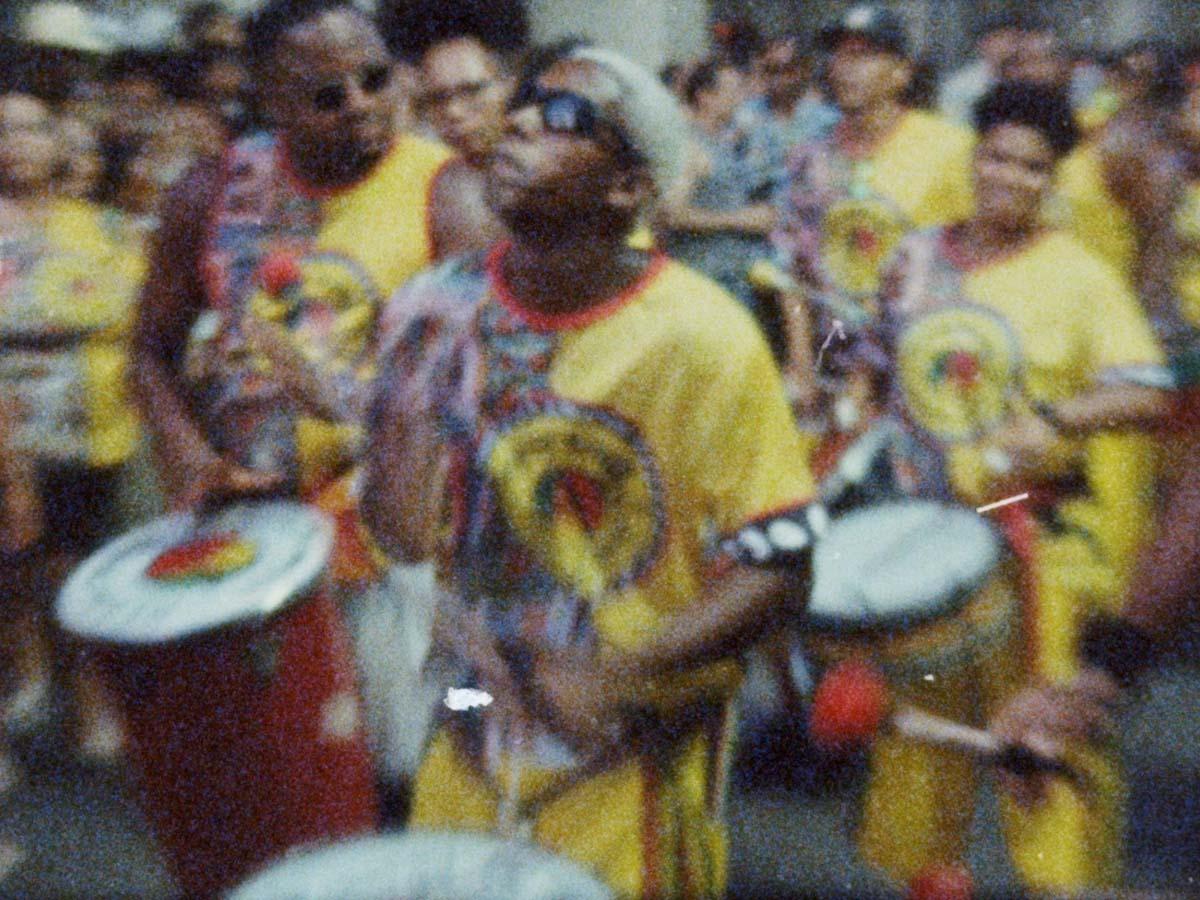
© O Rio de Janeiro continua lindo (Felipe Casanova, 2025)
O Rio de Janeiro continua lindo (Felipe Casanova, 2025)

Rhythms as Reclamations

Felipe Casanova’s O Rio de Janeiro continua lindo

article by
Alonso Aguilar
10.10.2025

From afar, Rio’s Carnival often seems the quintessential expression of everything Brazilian. The intense and relentless rhythms incite a trance-like celebration, where song and dance amplify the joyful aura to its utmost hypnotising. The foreign onlooker gawks at the carnival because of its enthralling release from the usual reign of restraint and rationality. To them, it plays as a sensorial reverie whose exuberant exterior embodies the “exotic”, but beyond the initial flash and pan, there’s a communal force deeply ingrained in the event.

Felipe Casanova’s O Rio de Janeiro continua lindo confronts this by going back to the carnival’s ethos. The Swiss-born, Brussels-based filmmaker grew up in Rio. His recollections of the space stem from a marvellous intersection of personal stories and lived experiences. The camera is at the heart of the celebration, awestruck by the ornate dancing troupes flocking the streets and the colourful floats showcasing the eclectic cultural convergence of indigenous, West African, and East Asian mythologies that make Brazilian iconographies so vibrant and distinct. These longstanding customs and traditions take the nation’s heterogeneous ancestry and mold it to the singularity of the present community. After all, people from all walks of life gravitate towards the carnival for a myriad of reasons—hedonism, but also grief and resistance; sometimes all at the same time.

Without the need to even utter a word, carnival attendees get to dialogue with their environment through song and dance. Be it as reclamation of neglected histories, a brief escape from the structural inequality of Latin American capitalism, or as a way to display their immediate concerns and struggles in a public forum, within the carnival’s realm of hyperreality, many seek some form of solace.

O Rio de Janeiro continua lindo specifically focuses on Ilma, a mother writing to her son who is missing due to the brutality that the Brazilian police exerts on Rio’s infamous favelas. Her voice cracks down as the slowed-down, Super 8 footage of the carnival feels like a phantasmagoria full of lurking spectres. At some point, one of these sweating bodies and ecstatic faces belonged to her son who walked the same streets. Despite his physical absence, his spirit is still felt in the space, as it is weighed down by his memories. Suddenly, the same streets seem different; the textures of the images switch from the dreamy enchantment of celluloid to the rawness of unfiltered digital images. The congregation on screen is also different; anger is now at the forefront, cheerful chants give way to howls of desperation, and samba’s characteristic batucada is drowned out by a dissonant drone.

Two things can be true at the same time: the emotional core between sequences presents a jarring contrast, and it is still clearly the same space, reclaimed by the same kind of popular action that bypasses any generalised, national identity. Both in joy and anger, patterns of communal memory are showcased in the streets. Ilma’s son, and many who like him are lost to state negligence and systemic violence, will never cease being part of the local landscape. It all comes full circle, and, as the title suggests, Rio remains beautiful.

    O Rio de Janeiro continua lindo is part of Film Fest Gent’s International Short Film Competition.

    read more

    © Portrait d’une paresseuse (Chantal Akerman, 1986)
    Portrait d’une paresseuse (Chantal Akerman, 1986)
    article
    Read more

    The Filmmaker Is Present

    Chantal Akerman’s Portrait d’une paresseuse

    Öykü Sofuoğlu
    17.11.2024

    Portrait d’une paresseuse seems one of Chantal Akerman’s more playful and lighter works—a skit in which she acts out a filmmaker’s creative process of attempting (and failing) to make a film about being lazy.

    Read more
    © LITTLE LOWER THAN THE ANGELS (NEOZOON, 2019)
    interview
    Read more

    There Must Be a Way Out of This Disaster

    A conversation with NEOZOON

    Savina Petkova
    25.07.2025

    Do you like cat videos? Try watching a thousand in a row, spread them on a timeline, and map out the similarities and differences between them. This experiment could serve as a primer for the work of two-person art collective NEOZOON, whose preoccupation is human-animal relationality. Using only found footage and social media archives, the duo aims to expose the oppressive power structures that position humans as exceptional, and non-human animals as anything but.

    Read more
    L'escale (Collectif Faire-Part, 2022)
    L’escale (Collectif Faire-Part, 2022)
    artikel
    Read more

    Een hachelijke tussenstop voor Collectif Faire-Part

    Gilles Vandaele
    27.05.2022

    Op 27 mei 2019 landen Paul Shemisi en Nizar Saleh, de Congolese helft van het Belgisch-Congolese filmcollectief Faire-Part, op de luchthaven van Luanda in Angola. Ondanks een geplande, aansluitende connectie zal het duo pas twee dagen later opnieuw opstijgen om hun reis naar Frankfurt verder te zetten. In de filmische brief L’escale doen Shemisi en Saleh hun verhaal over die akelige 'stopover'.

    Read more
    © Memory is an Animal, It Barks with Many Mouths (Eva Giolo, 2025)
    Memory is an Animal, It Barks with Many Mouths (Eva Giolo, 2025)
    interview
    Read more

    The Chorus of the Land

    Whose mother tongue? A conversation with Eva Giolo on Memory is an Animal, It Barks with Many Mouths

    Cici Peng
    15.02.2025

    Eva Giolo’s films are marked by a rhythmic quality attuned to the push and pull of the monumental and the ordinary, the mythical and the everyday. In Memory Is an Animal, It Barks with Many Mouths, Giolo turns her camera to the Italian ski area Val Gardena, nestled in the valleys surrounding the Dolomites, where she evades a touristic image and instead captures isolated moments in nature with her characteristic 16mm Bolex camera.

    Read more
    © In Flanders Fields (Sachin, 2024)
    In Flanders Fields (Sachin, 2024)
    article
    Read more

    A Voice For The Ghosts

    Sachin’s In Flanders Fields

    Eneos Çarka
    13.08.2025

    In Flanders Fields is a ghost story. Directed by Rajasthan-based filmmaker Sachin, the short film is a poetic meditation on war, colonial erasure, and ancestral presence in foreign land. The director introduces us to a rarely acknowledged fact in dominant historical narratives: during the First World War, as many as 1.4 million Indians were conscripted by the British and sent to the frontlines in Flanders. This revelation sets the stage for a cinematic elegy to those forgotten men.

    Read more
    © As If Mother Cried That Night (Hoda Taheri, 2023)
    As If Mother Cried That Night (Hoda Taheri, 2023)
    interview
    Read more

    Love Under Surveillance

    A Conversation with filmmaker Hoda Taheri

    Jori(k) A. Galama
    12.02.2025

    Over the past few years, Hoda Taheri (Tehran, 1992) has toured many a film festival with her short films Mother Prays All Day Long (2022), As If Mother Cried That Night (2023), and Mother is a Natural Sinner (2024), the first of which you can watch via yanco’s streaming library. In this “mother trilogy”, Taheri zooms in on relevant issues such as the right to abortion and the treatment of refugees in Europe. She takes on the lead role herself, cunningly and humorously dramatising her own biography.

    Read more
    © Untitled III (Sarah Pucill, 2001)
    Untitled III (Sarah Pucill, 2001)
    interview
    Read more

    Folding Time

    On Sarah Pucill’s Surrealism

    Laura Stoeckler
    23.08.2025

    Over the last thirty years, Sarah Pucill’s films have shown a sustained engagement with feminist politics, surrealist aesthetics, and the material language of cinema. Her work is connected by a visual and conceptual vocabulary that keeps evolving. Figures, motifs, and techniques reemerge—the principle of continuity is key to understanding how the artist’s work coheres, drawing strength from its self-reflection.

    Read more
    0.2 Milligrams of Gold (Diego Quinderé de Carvalho, 2021)
    0.2 Milligrams of Gold (Diego Quinderé de Carvalho, 2021)
    article
    Read more

    Between Forests

    Diego Quinderé de Carvalho’s 0.2 Milligrams of Gold (2021)

    Jannes Callens
    09.02.2024

    Besides a philosophical reflection on the concept of ‘lieu de mémoire’, the film is also an appeal to protect non-human phenomena in their uniqueness. The filmmaker concludes that he walks on paved forest paths because they are easier to control and more welcoming to man. Without naming it directly, this audiovisual essay touches on the Anthropocene: the era in which the earth suffers the consequences of human activity.

    Read more

    Subscribe to our monthly newsletter for updates on new releases, publications, and events!

    Subscribe

    yanco is a magazine and streaming library for short-form moving image

    kortfilm.be vzw
    Boondaalse Steenweg 249
    1050 Elsene
    BE 0478 441 315
    info@yanco.be

    with the support of the Flanders Audiovisual Fund (VAF) of the Flemish Government

    VAF
    • about
    • colophon
    • privacy policy
    Facebook Instagram LinkedIn YouTube Letterboxd
    design by de Ronners
    website by eps en kaas