yanco Home
Menu
  • Home
  • watch
  • magazine
  • calendar
  • index
  • Subscribe
Search Log in
  • nl
  • en
You are here
  • Home
  • Magazine
  • Unsaved Progress
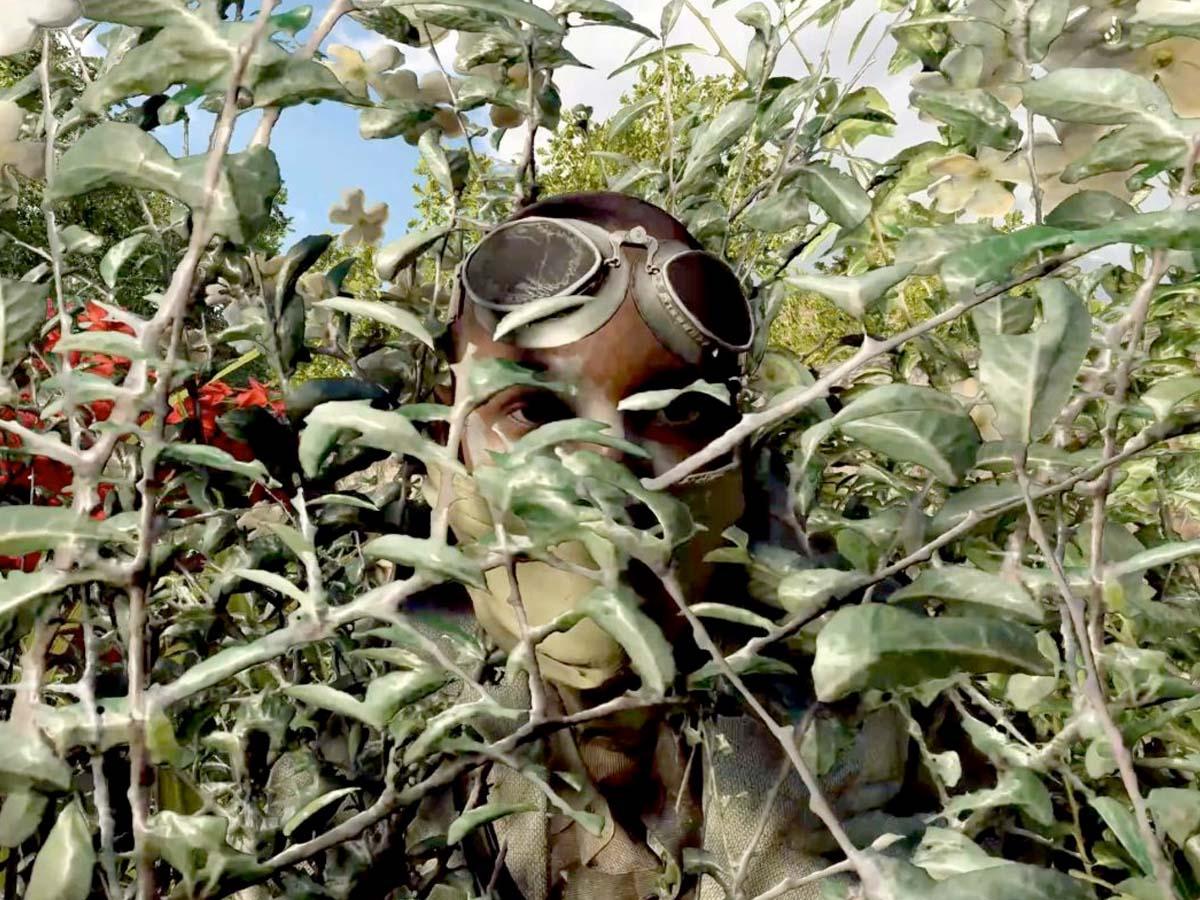
How to Disappaear (Total Refusal, 2020)

Unsaved Progress

“War Is Not Over”

essay by
Ren Scateni
20/20 Vision
15.12.2025

War, in a Euro-American-centric context, is a momentary interruption of an otherwise undisturbed sociopolitical continuum. By colonial standards, war mostly happens in—or is brought to—foreign lands. Countries that experience armed conflicts as their primary condition of existence, are often ignored by Western media coverage. In the last few years alone, civil unrest has been met with repressive violence from Congo and Rwanda to Myanmar, from Syria to Sudan, from Yemen to Palestine. Russia’s invasion of Ukraine has recently reminded European countries that war is not a faraway reality—an unfortunate situation the many migrants we keep pushing away are escaping from—but also an inevitable miscalculation. The Palestinian genocide offered Europe yet another chance to ignore the teachings of history and resort to either complicity or condoning. Curator Inge Coolsaet’s argos programme “War Is Not Over” surveys polymorphic responses to some of the major historical conflicts still haunting the West, like World War I or the Vietnam War.

Set in the war-ridden world of Battlefield—a multiplayer online shooter—Total Refusal’s How To Disappear (2020) investigates disobedience in war and games. This machinima, like most of Total Refusal’s works, follows a familiar script: once the thesis has been laid out, the media-guerrilla group looks for the cracks in the code, imbuing the game with alternative, Marxist-inflected readings. Unsurprisingly, a war game like Battlefield doesn’t allow desertion. The limited scope of this online shooter triggers a dystopic ouroboros that only slightly differs from reality. Whereas desertion was once seen as resistance against the social order—or even a productive force in society, according to Karl Marx—nationalisms made deserters into enemies of the people, soldiers who prioritise individuality over the national interest.

By obeying their own interests, nations encourage soldiers to relinquish independent thought, making them into senseless killing machines. Automation dulls the intellect and discourages disobedience. By casting deserters as weak, sickly, and unfit to uphold stereotyped standards of masculinity, they cease to be of value. An anomaly in need of erasure. Battlefield, however, offers a way out: a magic trick enshrouded in smoke. The ultimate farewell to the constrictive logic of the game.

Dutch artist duo Jan Dietvorst and Roy Villevoye worked together on a trilogy about the memory of World War I. Its final chapter, War Is Over (2011), paints a morally muddled postcard of the culture of remembrance in West Flanders, especially around the towns of Ypres and Passendale—two sites of historical importance during the conflict. Opening in an unremarkable forest, where a man searches for the remains of an unknown, dead German soldier, the documentary pieces together various testimonies from people connected to the business of war. One sequence shows young people on a school trip to a privately owned museum exhibiting war memorabilia, alongside guided tours of trenches and a tutorial on how to best throw a hand grenade.

These arguably harmless images uncover the profit-driven exploitation of warfare, where the trivial grumbles of the museum’s third-generation owner—a family business—meet the easygoing demeanour of the high schoolers. Such apparently superficial consumption and understanding of war and its implications is not dissimilar to the players who log into Battlefield to “have fun,” driven by the adrenaline-fuelled rhythm of a shooting game. Whereas Total Refusal commented on how military camps were never situated in the vicinity of forests to discourage desertion, War Is Over unearths the bones of young soldiers who perished in the woods. The fertile soil provides soldiers not with a favourable chance to flee, but rather with a comfortable bedding in death.

The Dynamite Show (2004) by Koen Theys further inhabits the liminal space between the reality of war and the rituals through which societies aestheticise destruction. Composed of videos of explosions developed by Hollywood companies specialising in visual effects, Theys’ work treads a fine line between critique and endorsement. The kinetic display of shimmering lights, smoke, and thundering sound waves becomes a palatable artifice only for those fortunate enough to have lived comfortably shielded from conflict. As fascinating as it is ideologically abrasive, The Dynamite Show reminds us of the unyielding mechanisms of distraction that make devastation appear acceptable, even playful.

The Dynamite Show (Koen Theys, 2004)

Flipping the script, Esther Johnson’s experimental assemblage Liberation Radio (2021) puts deserters in a good light, recognising their critical importance by hijacking the mainstream media narrative around the Vietnam War. The film tells the story of a group of Americans who fled to Sweden in 1968, hoping to join the Vietnamese army but instead being recruited for anti-war propaganda. Weaving together archival footage with contributions from two original Liberation Radio participants, the film subverts declassified U.S. military footage once used to manufacture consent for this pointless war. Its linguistic texture is carefully constructed too: narrated through voiceover in English, Vietnamese, and Swedish, this sensitive multilingual approach is echoed in the double-language subtitles. In this way, deserters are freed from a history marked by shame and silence—as How To Disappear’s dejected commentary teaches us—their voices and pacifist intentions once again rippling through cultures.

Concluding the programme, Isabelle Tollenaere’s subtly arresting The Remembered Film (2018) leads us back to the forest. Opening with placid sequences of young soldiers relaxing among lush greenery or attentively exploring their surroundings, the film stands on elusive ground. One after another, the boys step in front of the camera to share recollections of their experiences of war. It’s only when we hear Tollenaere cutting in that doubts creep in. What seemed like fiction is, in fact, a documentary. What we took to be genuine is, instead, a re-enactment. Suddenly, we realise the boys are too young to have lived through those experiences, too fragile to wear those uniforms proudly, too insecure to embody some of the atrocities they recount. Unlike the high schoolers listening to stories of war in War Is Over, these boys are vessels through which such stories percolate until they are released. At last, the space between war and spectacle, reality and fiction, is hybridised once more. A final opportunity for distraction, if not reflection, before we turn to the news cycle again. War is, very much, never over.

    20/20 Vision is a monthly micro-cinema night in argos’s Black Box, a shifting line-up of video works, from shorts to features, from their archive and beyond. With only 20 chairs for 20 spectators, the audience gathers for a screening programme shaped around a topic or a filmmaker. yanco and argos collaboratively publish a monthly essay on each programme.

    Bio Ren Scateni

    Ren Scateni is a film curator and writer whose practice embraces experimental works and artists’ moving image that explore the interstices of political, disruptive, and liminal identities. His writing has appeared in various art and film magazines, including ArtReview, Hyperallergic, and Sight and Sound. Ren is currently Curatorial Lead at Glasgow Short Film Festival and has been/is working across curation, consulting, editing, mentoring, and PR for festivals, cultural organisations, and companies, including Berwick Film & Media Arts Festival, Queer East, Festival du Nouveau Cinéma, BFI Doc Society, and Square Eyes. Ren is a Trustee of Alchemy Film & Arts.

    read more

    © HERMAN ASSELBERGHS
    verslag
    Read more

    Aandacht voor aandacht

    Time Wasted in argos

    Gilles Vandaele
    18.03.2024

    Nog tot 30 juni is in argos, het Brusselse centrum voor audiovisuele kunst, een videotentoonstelling van Herman Asselberghs te zien. In Time Wasted focust de Belgische filmmaker en kunstdocent op de plaatsen die hij het best kent: de filmzaal en het klaslokaal.

    Read more
    Water and Salt (Luisa Mello, 2019)
    Water and Salt (Luisa Mello, 2019)
    essay
    Read more

    Watery tensions

    Luisa Mello’s Water and Salt

    Kathy Vanhout
    03.04.2022

    Apart from water, salt, and clouds, Mello’s work often features young and older people, artists, animals, and cities; these things are the source of her documentaries. Her films always leave room for fictive contemplation and interpretations. Water and Salt, for that matter, hardly reads as a documentary. In these reflective ten minutes, she attempts to translate a thought, a feeling, an observation. In situations like this, where words are insufficient, and the outside world offers few answers, Mello constructs her own images. Or she turns to archival ones.

    Read more
    © MAGIC, A PORTRAIT OF JORIS (CHLOË DELANGHE, 2018)
    Magic, a portrait of Joris (Chloë Delanghe, 2018)
    interview
    Read more

    De ruimte die ons omringt

    Portretten van nabijheid: Chloë Delanghe’s Magic, a portrait of Joris

    Nina de Vroome
    13.01.2025

    Het fototoestel meet afstanden. Zijn brandpunt komt samen met een voorwerp in de ruimte en door de leegte rondom wordt er iets zichtbaar. Het is een vanzelfsprekende vaststelling, maar toch is deze essentie van fotografie van belang in het werk van Chloë Delanghe. Haar werk bevindt zich in een spanningsveld van intimiteit en afstand.

    Read more
    Note on Multitude (Ibro Hasanović, 2015)
    Note on Multitude (Ibro Hasanović, 2015)
    essay
    Read more

    Long Goodbyes

    Ibro Hasanović’s Note on Multitude

    Savina Petkova
    01.10.2022

    Note on Multitude observes a multiplicity of queues—at first, from afar, and then, up close—aggressively bridging the distance with rapid cuts where ‘here’ and ‘there’ switch up their positions. In less than eight minutes, Ibro Hasanović (director, cinematographer, editor) has encapsulated an ever-unfolding web of stories, their nuclei forever embedded in these black-and-white nocturnal shots. A harsh but beckoning pull becomes the connecting tissue between sequences as bodies make room for faces in conversation with other faces.

    Read more
    Ours is a Country of Words (Mathijs Poppe, 2017)
    Ours is a Country of Words (Mathijs Poppe, 2017)
    article
    Read more

    Recurring Dreams

    Mathijs Poppe’s Ours is a Country of Words (2017)

    Yara Yuri Safadi
    20.09.2025

    The voice-over of a man with a Palestinian accent informs viewers that they are watching a “film”, highlighting the artifice of the images while also linking it to the reality of the Nakba. The man’s voice situates us as viewers within an imagined future, one “in which Palestine is free again.” Ironically, we watch this film in 2025, amidst the ongoing genocide in Gaza and the ethnic cleansing and apartheid in the West Bank. Juxtaposed with the harsh realities of the genocidal present, Ours is a Country of Words’s sci-fi-like imagination shows the desire for a future that is increasingly fought for. As the first dialogue unfolds, we are invited into this brighter future: Palestine is liberated, and refugees can return.

    Read more
    Old Child (Elettra Bisogno & Hazem Alqaddi, 2019)
    Old Child (Elettra Bisogno & Hazem Alqaddi, 2019)
    essay
    Read more

    Flickering Memories

    Elettra Bisogno & Hazem Alqaddi’s Old Child

    Savina Petkova
    10.05.2025

    For a refugee or an immigrant, memories of a prior life are not simply broken; they are snapped in two, three, four, or more pieces and doomed to exist separately. These split memories can emit a particular shine, as attested by Elettra Bisogno and Hazem Alqaddi’s short Old Child. The film dwells in the paradox of its title, where old age and childhood are readily coupled, as if there were no time or space in between these two ends of a human life spectrum. Of course, the title also holds melancholy, which is only one feeling in the vast emotional landscape of Old Child.

    Read more
    © Neighbours (Norman McLaren, 1952)
    artikel
    Read more

    De vernieuwende animatietechnieken van McLaren

    Norman McLarens Neighbours

    Benjamin Antonissen
    27.05.2020

    De Schots-Canadese animator Norman McLaren experimenteerde al van jongs af met verschillende filmtechnieken.

    Read more
    Red Giant (Anne Verbeure, 2021)
    Red Giant (Anne Verbeure, 2021)
    essay
    Read more

    The Lonely Observer

    Anne Verbeure’s Red Giant (2021)

    Dora Leu
    20.08.2023

    To be a giant comes with the burdensome nature of giant-ness. Most things look infinitely smaller than you. You move awkwardly, lankily, to not inadvertently step on anything you might not see. Thus, this Red Giant proceeds with unsure gestures, sluggishly, as if both depressed and aware of the potential inconveniences his size may cause. Yet, contrary to his stature, a sense of fragility surrounds the giant. Perhaps his nakedness makes him look like a tall, helpless baby. The film’s visual style further underscores this, with the pinkish hues of paint that collect around his small eyes and nose, denoting a form of innocence.

    Read more

    Subscribe to our monthly newsletter for updates on new releases, publications, and events!

    Subscribe

    yanco is a magazine and streaming library for short-form moving image

    kortfilm.be vzw
    Boondaalse Steenweg 249
    1050 Elsene
    BE 0478 441 315
    info@yanco.be

    with the support of the Flanders Audiovisual Fund (VAF) of the Flemish Government

    VAF
    • about
    • colophon
    • privacy policy
    Facebook Instagram LinkedIn YouTube Letterboxd
    design by de Ronners
    website by eps en kaas