yanco Home
Menu
  • Home
  • watch
  • magazine
  • calendar
  • index
  • Subscribe
Search Log in
  • nl
  • en
You are here
  • Home
  • Magazine
  • In the Bosom of Images
Henry is a Girl Who Likes to Sleep (Marthe Peters, 2026)

In the Bosom of Images

Marthe Peters’ Henry is a Girl Who Likes to Sleep (2026)

article by
Öykü Sofuoğlu
31.03.2026

First-person narrative is sometimes deemed the easiest approach a filmmaker can employ—a common misconception that overlooks the creative effort required to express subjectivity without falling into the trap of self-indulgence. Even harder is the process when the self takes too much space in one’s life. It can become so overwhelming that one feels the need to externalise it by pouring it into images and sounds. Dutch filmmaker Marthe Peters seems to have found softer, more delicate forms to confront the unpredictability of the self.

Peters’ films brilliantly adopt an introspective stance that reaches outward, addressing the Other through the exploration of love and care. Baldilocks, her graduation short, primarily consists of childhood video footage—transient moments of joy and compassion shared with her parents. Through this material, Peters reflects on living in a fragile present shaped by the cancer she survived twenty years ago.

As an extension of these intimate meditations, the follow-up Henry is a Girl Who Likes to Sleep finds the filmmaker once again looking back at herself, this time by orienting her gaze toward her beloved cat, the titular Henry—a chubby white feline with tricoloured splotches on her fur. Throughout the film, Peters delivers a playful voice-over addressed to Henry, drawing comparisons between their bodies, their unique habits and traits, while also questioning the love and affection she may be burdening her cat with. Since she deals with the long-term traces of her childhood illness, the filmmaker admittedly doubts her capacities as Henry’s caregiver, as she sometimes finds herself in a state where even taking care of her own well-being feels tiresome and painful, let alone caring for others.

“I wish I had a fur coat to retreat into,” laments the filmmaker at one point. The spiral curl of Henry’s body echoes in another animal’s anatomy: the snail. Though the filmmaker doesn’t mention it directly, this comparison suggests a longing for a shell to retreat into. Almost like a metonymic extension of her self-described “sluggishness”, she adorns her frames with snails in numerous forms—ranging from real snails placed on the back of her partner’s shoulders and neck, to a snail-shaped blanket that covers a sleeping body. As indolent as these snails might appear, their movements and textures across different environments—on paper, skin, or bed linens—embody resilience and persistence, traits for which the filmmaker also deserves recognition, no matter how discreet she may be about them.

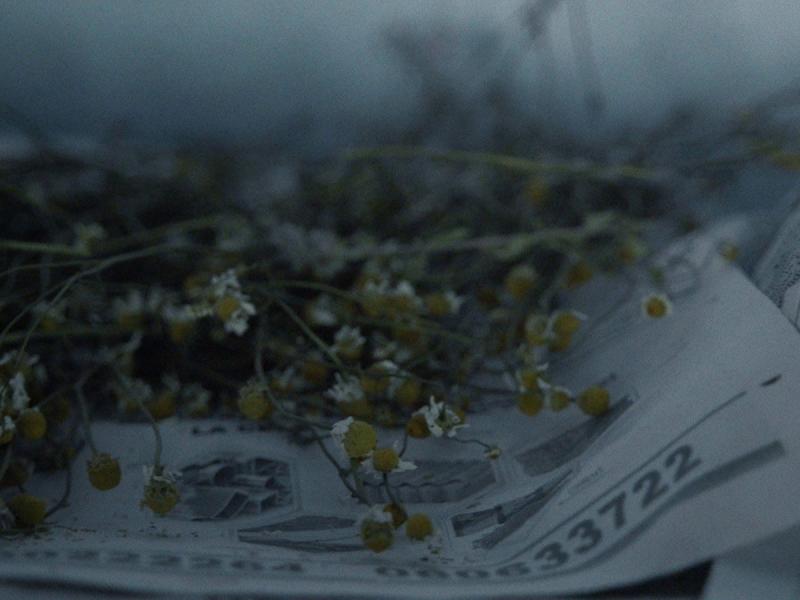
Alternating between digital and analogue formats, Peters’ images seem to tumble out of a cabinet of curiosities, pushed into the frame by an evocative force from the filmmaker’s thoughts. Much like the bedsheets and fabrics pulled and thrown in different directions in one of the scenes, she creates harmony through the layering of ostensibly disjointed elements. Composed of domestic miscellanea—animal-themed drawings, trinkets, and keepsakes—Peters’ haptic vignettes exude a coziness that feels unexpectedly open and welcoming for such a personal film. As the handwritten credits roll, one wishes to stay with these images a little longer—drawn in by their warmth and by this shared desire to reconnect with ourselves.

    Henry is a Girl Who Likes to Sleep is part of Courtisane’s opening programme “Undercurrents 1 - Rest Assured”, curated in collaboration with Marthe Peters and Leon Decock. Click here for screening dates.

    Bio Öykü Sofuoğlu

    Öykü Sofuoğlu is a Turkish film critic and journalist based in Paris. Her film-related writings have been published in various outlets, including International Documentary Magazine, Screen Slate, and Letterboxd Journal. She is also one of the co-editors of Outskirts Film Magazine. 

    read more

    Lisette Ma Neza
    Lisette Ma Neza
    interview
    Read more

    Een collectief gedicht

    Lisette Ma Neza over Branden

    Margot De Grave Loyson
    27.03.2024

    Lisette Ma Neza woont al jaren in de Belgische hoofdstad en mag zich vanaf deze maand ook de eerste officiële stadsdichter van Brussel noemen. Met Branden, het sluitstuk van haar opleiding aan LUCA School of Arts, brengt Ma Neza een ode aan het eeuwige vuur van ontheemde vrouwen en een collectief gedicht over brandende moederlanden. De film sluit dit jaar Courtisane af.

    Read more
    Note on Multitude (Ibro Hasanović, 2015)
    Note on Multitude (Ibro Hasanović, 2015)
    essay
    Read more

    Long Goodbyes

    Ibro Hasanović’s Note on Multitude

    Savina Petkova
    01.10.2022

    Note on Multitude observes a multiplicity of queues—at first, from afar, and then, up close—aggressively bridging the distance with rapid cuts where ‘here’ and ‘there’ switch up their positions. In less than eight minutes, Ibro Hasanović (director, cinematographer, editor) has encapsulated an ever-unfolding web of stories, their nuclei forever embedded in these black-and-white nocturnal shots. A harsh but beckoning pull becomes the connecting tissue between sequences as bodies make room for faces in conversation with other faces.

    Read more
    © Plot Point (Nicolas Provost, 2007)
    Plot Point (Nicolas Provost, 2007)
    essay
    Read more

    (Re)framing Tension

    “Why Don’t the Cops Fight Each Other?”

    Tianyu Jiang
    02.09.2025

    Curated by Inge Coolsaet for argos, the short film programme “Why Don’t the Cops Fight Each Other?” responds to the ever-present police brutality by rejecting futile rhetoric and underlining the urgency and affective power of audio-visual art. This potentially intimidating viewing experience may unsettle viewers’ expectations, but it can also transform the apathetic spectator into an active, reflexive watcher.

    Read more
    The Jungle Knows You Better Than You Do (Juanita Onzaga, 2017)
    The Jungle Knows You Better Than You Do (Juanita Onzaga, 2017)
    essay
    Read more

    Enduring Spirits

    Juanita Onzaga’s The Jungle Knows You Better Than You Do

    Alonso Aguilar
    01.05.2023

    With inequality as rampant as it can get and failed political structures eroding more and more as time shows their inherent futility, the milieu of the Latin American urban center has truly evolved into a no man’s land, a non-place of sheltered privilege juxtaposed to chaotic urgency, a “phantom city” as the initial narrator of Juanita Onzaga’s The Jungle Knows You Better Than You Do calls what she used to think as her hometown of Bogotá. The past tense of the latter statement has to do with her moving on from the Colombian capital, a setting that for her can only evoke violence and forgotten bodies, a sense of phantasmagoria close-knit with her family history.

    Read more
    Waithood (Louisiana Mees-Fongang, 2019)
    Waithood (Louisiana Mees-Fongang, 2019)
    essay
    Read more

    In limbo

    Louisiana Mees-Fongang’s Waithood

    Benjamin Antonissen
    02.02.2022

    Athens often is perceived as the ideal holiday destination. It is the birthplace of democracy, overflowing with culture, and has exceptional cuisine and countless picturesque squares to spend time carelessly. This, however, isn’t the image the five twentysomethings in Waithood have of the Greek capital. For them, Athens feels like a prison where they are forced to kill time together. Christos, the only one in the group with a stable job, cleans up luxurious Airbnbs. When the tourists leave, he and his friends take over the apartments. And then the waiting takes over. Christos and his friends are insecure about their future. Waithood refers to the stagnation recent graduates can find themselves in, especially in economically challenged regions.

    Read more
    Les enfants ont des oreilles (Kumail Gasiewski, 2025)
    Les enfants ont des oreilles (Kumail Gasiewski, 2025)
    verslag
    Read more

    Lichting KASK 2024-2025

    Evi Cats, Boet Meijers, Kathy Vanhout
    03.12.2025

    In het multidisciplinaire microklimaat van KASK School of Arts in Gent ontspruit elk jaar opnieuw een uiteenlopende groep filmmakers en audiovisuele kunstenaars. Dit is een selectie van de masterproeven waarmee de lichting 2024-2025 afzwaait.

    Read more
    Nanu Tudor (Olga Lucovnicova, 2020)
    Nanu Tudor (Olga Lucovnicova, 2020)
    essay
    Read more

    Rhythms of Silence

    Olga Lucovnicova’s My Uncle Tudor (2020)

    Emily Jisoo Bowles
    01.07.2026

    Returning to her great-grandparents’ home in Moldova, where her uncle sexually abused her when she was nine years old, Lucovnicova films the site of her childhood trauma with a detached ambivalence. A shot of the house’s sunlit exterior is bookended by glimpses of uncle Tudor, contesting the idyllic quality of its rural setting. “So fresh, so green,” enthuses her mother, “it’s my childhood and my youth.” Lucovnicova’s lens might capture this nostalgia, but it does not endorse the sentiment.

    Read more
    © 8 Miljard Ikken (Nemo Vos, 2024)
    artikel
    Read more

    Van flaneur tot voyeur

    Nemo Vos’ 8 Miljard Ikken

    Elias Voskamp
    15.02.2025

    De Nederlandse digitale kunstenaar Nemo Vos aka Tibor de Jong creëert virtual reality-ervaringen die nog het best te omschrijven zijn als droomvluchten voor volwassenen. Zijn kunst neemt de kijker mee op een betoverende reis, waarbij die altijd in het ongewisse blijft over wat er in de volgende ruimte te wachten staat. 8 Miljard Ikken, zijn nieuwste en prijzenwinnende kortfilm, reflecteert op hoe we onze menselijkheid trachten te behouden in een steeds meer virtuele wereld.

    Read more

    Subscribe to our monthly newsletter for updates on new releases, publications, and events!

    Subscribe

    yanco is a magazine and streaming library for short-form moving image

    kortfilm.be vzw
    Boondaalse Steenweg 249
    1050 Elsene
    BE 0478 441 315
    info@yanco.be

    with the support of the Flanders Audiovisual Fund (VAF) of the Flemish Government

    VAF
    • about
    • colophon
    • privacy policy
    Facebook Instagram LinkedIn YouTube Letterboxd
    design by de Ronners
    website by eps en kaas